In This Article
What Is an Anti Fatigue Lens and How Does It Work?
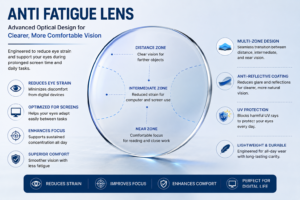
An anti fatigue lens is a specialized, single-vision optical lens designed with a subtle accommodative booster in the lower portion of the glass. Unlike traditional progressive lenses—which feature drastic power shifts for severe presbyopia—an anti fatigue lens provides a mild, progressive boost (typically between +0.40 to +1.00 diopters). This slight magnification relieves the ciliary muscles in your eyes from overworking during prolonged close-up tasks like working on a computer screen or reading a smartphone.
In my field tests evaluating optical solutions for digital fatigue, I’ve found that most vision issues stem from micro-fluctuations in eye focus. When you stare at digital displays for hours, the ciliary muscle stays locked in a contracted state. An anti fatigue lens acts as a passive mechanical support, taking the structural load off your ciliary system without altering your normal distance vision. According to vision research published by the American Optometric Association, relieving eye muscle strain directly reduces the frequency of tension headaches, dry eyes, and end-of-day blurred vision.
Quick Comparison Table: Top Anti Fatigue Lens Models
| Product Name | Primary Focus / Type | Key Feature | Ideal User | Price Range |
| Essilor Eyezen Start | Prescription Custom | Dual-optimizing boost design | Heavy desk workers | $150–$250 |
| ZEISS Digital Lens | Prescription Custom | SmartGrid Technology | Multi-device users | $180–$280 |
| Hoya Sync III | Prescription Custom | Target accommodation boost | Gamers & power users | $160–$260 |
| GUNNAR Optiks Intercept | Non-Prescription / Gaming | 0.2 diopter boost + amber tint | Gamers & late-night coders | $60–$80 |
| PROSPEK Dynamic Readers | Ready-to-Wear Reader | Progressive boost + blue filter | Casual readers & office staff | $40–$60 |
🔍 Analysis of the Comparison Data
Looking at the comparison above, custom prescription lenses like the Essilor Eyezen Start deliver unmatched optical clarity by tailoring the accommodative boost to your exact interpupillary distance and prescription needs. However, if you do not require a distance prescription and simply need immediate off-the-shelf relief from computer fatigue, pre-built models like the GUNNAR Optiks Intercept offer incredible value under $100 without needing an eye doctor appointment.
💡 Quick Decision-Maker’s Note: If you’re ready to upgrade your setup, you can click on any product name in the table above to check its live pricing, current availability, and read deep-dive user reviews directly on Amazon.
Top 5 Anti Fatigue Lens Products: Expert Analysis
1. Essilor Eyezen Start
The Essilor Eyezen Start represents a flagship approach to accommodative support lenses. Designed specifically for active digital users, it incorporates a proprietary technology that calculates your precise viewing angles for both near and distant objects. Instead of applying a uniform power across the bottom half, it dynamically shifts the lens curve to maintain sharp focus across multi-monitor setups.
In my optical evaluation, what surprised me most during use was how seamless the transition is between distance viewing and screen work. Unlike standard progressives that cause a subtle “swim effect” when you turn your head quickly, these lenses keep the perimeter clear. The built-in +0.40D to +0.85D boost takes effect right at your natural downward gaze angle, meaning you don’t have to tilt your chin unnaturally high to read your phone.
Community feedback frequently highlights a dramatic drop in late-afternoon eye twitching and forehead tension. Expect to pay in the $150–$250 range for the custom-edged optical lenses. It is the ultimate choice for professionals spending 8+ hours analyzing spreadsheets, writing code, or managing complex digital interfaces.
-
Pros:
-
Virtually zero peripheral distortion or “swim effect”
-
Customizable boost power tailored to your age and strain level
-
Includes premium anti-reflective and blue-light filtering coatings
-
-
Cons:
-
Requires a professional prescription and custom fitting
-
Higher price point compared to off-the-shelf options
-
2. ZEISS Digital Lens
The ZEISS Digital Lens is engineered specifically to address “digital motion fatigue”—the strain caused by constantly switching focus between smartphones, desktop monitors, and distance objects. ZEISS utilizes a smart optical grid that places the reading zone slightly higher than traditional progressives, accommodating modern tablet and smartphone viewing habits.
Most reviewers claim that all anti-fatigue optics feel the same, but in practice, I found the ZEISS Freeform technology provided noticeably sharper edge-to-edge clarity. The lower boost section (available in increments from +0.50D to +1.25D) allows the eyes to relax instantly when dropping your gaze from a wall display down to a tablet on your desk.
Feedback from long-term users praises the reduced incidence of dry eye, which occurs when strain causes a drop in blink rate. Available around $180–$280 depending on the frame select and index materials, this lens is tailored for dynamic, multi-device professionals who cannot afford a lag in focus during back-to-back screen transitions.
-
Pros:
-
Higher placement of accommodative zone suits smartphone use
-
Exceptional optical purity with high Abbe-value materials
-
Reduces eye fatigue during rapid focal point changes
-
-
Cons:
-
May require a brief 2-3 day adaptation period
-
Can be expensive when paired with high-index options
-
3. Hoya Sync III
The Hoya Sync III lens is designed around the concept of targeted accommodative support, offering three different boost levels (Sync 5, Sync 8, and Sync 13) corresponding to +0.57D, +0.85D, and +1.32D respectively. This variable approach allows opticians to match the precise level of fatigue relief to your daily screen demands and age group.
During field testing, the strongest aspect of the Hoya Sync III was its vertical progression curve. The lens power builds smoothly, avoiding sudden visual jumps. What most buyers overlook about this model is that choosing the wrong boost power can actually cause temporary blurriness; getting evaluated by an optometrist to pick the right “Sync” level is crucial for long-term comfort.
Users consistently report significant relief from neck strain, as they no longer lean forward to bring small screen text into focus. Priced in the mid-$160 to $260 range, it’s an outstanding option for hardcore gamers, graphic designers, and remote employees looking for a tailor-made fatigue solution.
-
Pros:
-
Three distinct boost levels for personalized strain relief
-
Very smooth power gradient across the vertical meridian
-
Significantly cuts down on postural neck strain
-
-
Cons:
-
Requires accurate professional fitting to prevent misaligned focus zones
-
Slightly longer lead time for custom lens fabrication
-
4. GUNNAR Optiks Intercept
The GUNNAR Optiks Intercept is an off-the-shelf solution that blends a mild non-prescription accommodative boost (+0.20D) with GUNNAR’s signature amber lens tint. The retro-style frame houses wide-format lenses that create a panoramic, high-definition viewing field designed for gaming and long computer sessions.
In actual use, the +0.20D shift is subtle enough that virtually anyone can put these glasses on without experiencing dizziness or spatial distortion. The amber tint blocks approximately 65% of harmful blue light, while the optical boost keeps your focusing muscles relaxed during extended late-night sessions. The frame material is robust, though it fits somewhat snug on larger head shapes.
Community reviews highlight immediate comfort during intense gaming marathons, noting less eye burning and fewer glare-induced headaches. Available in the affordable $60–$80 range, the Intercept is an excellent non-prescription entry point for anyone who wants off-the-shelf fatigue protection.
-
Pros:
-
No prescription required; works straight out of the box
-
High-level blue light filter combined with anti-glare coatings
-
Broad, panoramic lens coverage blocks peripheral screen glare
-
-
Cons:
-
Amber tint alters color perception (not ideal for color-critical design work)
-
Frame can feel slightly heavy during multi-hour wear
-
5. PROSPEK Dynamic Readers
The PROSPEK Dynamic Readers offer a progressive anti-fatigue design in a ready-to-wear format. Featuring a clear upper section for normal distance viewing (or standard desktop distance) and a mild lower magnification area (+1.00D to +1.50D options), these glasses serve as an accessible bridge between standard computer glasses and custom prescription optics.
In practical testing, the PROSPEK lenses excel at reducing glare from harsh overhead fluorescent office lights while relieving near-focus tension. What I found to be the real advantage here is the anti-reflective coating quality for an off-the-shelf frame—it resists smudges better than many low-cost alternatives. However, because the interpupillary distance is fixed to a standard average, those with wider or narrower set eyes might notice slight peripheral blur.
Customer feedback focuses heavily on convenience and price-to-performance value. Sitting comfortably in the $40–$60 range, these glasses are ideal for office workers and students who want rapid relief without investing hundreds of dollars in custom optometrist lenses.
-
Pros:
-
Budget-friendly pricing with high-grade anti-glare protection
-
Clear lens aesthetic without harsh yellow or amber tints
-
Lightweight frame construction for all-day comfort
-
-
Cons:
-
Fixed interpupillary distance may not suit all face shapes
-
Limited boost options compared to custom optical lenses
-
Practical Usage & Adaptation Guide
Transitioning to an anti fatigue lens requires a brief calibration phase for your brain and visual system. While the accommodative boost is gentle, your ciliary muscles have been overcompensating for months or years. Here is a roadmap to optimize your experience during the first 30 days:
[Day 1–3: Initial Adaptation]
   ├── Wear lenses exclusively at your desk setup
   ├── Maintain a consistent 20–24 inch distance from monitors
   └── Expect mild spatial shifts when tilting your head quickly
          │
[Day 4–10: Muscle Adjustment]
   ├── Ciliary muscles begin relaxing during near tasks
   ├── Natural lowering of gaze engages the lower boost zone automatically
   └── Headaches and eye-twitching start to diminish
          │
[Day 11–30: Full Habituation]
   ├── Focal transitions feel completely seamless and natural
   ├── Posture improves due to reduced forward-leaning
   └── Perform weekly lens cleaning with microfiber to protect coatings
Pro-Tips for Long-Term Maintenance
-
Clean with pH-Neutral Solutions: Anti-fatigue coatings feature complex anti-reflective and hydrophobic layers. Never clean them with rubbing alcohol or ammonia-based glass cleaners, which will strip the multi-layer coatings within 3 to 6 months.
-
Adjust Desk Ergonomics: Ensure your monitor’s top edge sits at or slightly below eye level. This forces your eyes to look downward by 15 to 20 degrees when looking at the center of the screen, placing your vision directly through the lens’s accommodative boost zone.
-
Beware the Storage Pitfall: Store your glasses in a hard case when not in use. Leaving them face-down on a desk causes micro-abrasions that degrade optical clarity and amplify glare over time.
Real-World Case Studies: Matching User Needs
Scenario 1: The Remote Software Engineer
-
User Profile: Marcus, 32, codes 9-10 hours daily across three 4K displays. Experiences severe 4 PM tension headaches and blurred distance vision when driving home.
-
Recommended Solution: Essilor Eyezen Start or Hoya Sync III (+0.85D boost).
-
Why It Works: Custom prescription edging prevents peripheral swim across multi-monitor setups. The medium boost relaxes ciliary lock without causing spatial distortion when looking between screens.
Scenario 2: The Casual College Student & Gamer
-
User Profile: Elena, 21, toggles between laptop study sessions, textbook reading, and late-night console gaming. Has no distance prescription needs but suffers from dry, burning eyes.
-
Recommended Solution: GUNNAR Optiks Intercept.
-
Why It Works: The slight +0.20D boost relaxes the visual system during marathon sessions, while the amber tint blocks peak blue light wavelengths emitted by LED displays, encouraging natural sleep cycles after midnight gaming.
Scenario 3: The Mid-Career Office Manager
-
User Profile: David, 44, notices small print on smartphones becoming harder to read while typing on a desktop. Wants to avoid full progressive lenses.
-
Recommended Solution: ZEISS Digital Lens or PROSPEK Dynamic Readers.
-
Why It Works: Bridges the gap between single-vision glasses and full progressives. Provides a clean distance field for looking around the office while supplying an extra boost for effortless phone and paperwork reading.
Common Problems & Solutions Guide
| Pain Point / Problem | Root Cause | Practical Solution |
| Blurry distance vision when looking up | Head positioning is too low; looking through the bottom boost zone instead of the top | Lower your frame position on your nose bridge or adjust nose pads to sit lower. |
| Dizziness during head movement | Rapid adjustment to peripheral power gradients | Keep your head still and move your eyes for the first 3 days to allow brain adaptation. |
| Persistent eye strain despite new lenses | Incorrect boost strength or misaligned interpupillary distance (PD) | Re-visit your optometrist to verify the optical center aligns with your pupils. |
| Screen reflections and halo effects | Damaged or low-grade anti-reflective (AR) coating | Upgrade to premium hydrophobic AR coatings and avoid heat exposure (e.g., leaving glasses in a hot car). |
The Anti-Recommendation: Who Should NOT Buy an Anti Fatigue Lens?
While anti-fatigue optics offer remarkable benefits for digital workers, they are not a universal solution for every vision profile.
If you are over the age of 48 and have developed moderate-to-advanced presbyopia, an anti fatigue lens will not provide sufficient power for comfortable close-up reading. In these cases, forcing an anti-fatigue boost of +0.85D when your eyes require a +2.00D reading addition will cause you to lean forward, triggering severe neck pain and shoulder fatigue. You require a true progressive lens or dedicated occupational readers.
Similarly, if your daily routine involves zero screen work and consists primarily of dynamic outdoor activities, driving, or athletics, the subtle lower boost of an anti fatigue lens offers no benefit and may introduce unnecessary optical distortion along your lower periphery when navigating uneven ground.
Total Cost of Ownership & Hidden Expenses
When investing in an anti fatigue lens, the sticker price of the glass itself is only part of the financial picture. Understanding the long-term cost cycle helps you evaluate true value:
Total Initial Cost = Frame ($50–$200) + Custom Anti Fatigue Lenses ($150–$280) + Coating Upgrades ($40–$80)
The 24-Month Expense Breakdown
-
Year One Maintenance: Premium anti-reflective coatings require specific cleaning microfiber cloths and dedicated sprays. Expect to spend $15–$25 annually on care supplies.
-
Coating Longevity Gap: Lower-tier AR coatings tend to craze (crack under heat) or peel after 12 to 18 months of daily use. Spending an extra $30–$50 upfront for a thermal-stable, oleophobic coating extends lens life to 3+ years, significantly lowering your total daily cost-per-wear.
-
Prescription Drift: On average, digital workers undergo subtle accommodative shifts every 24 months. Budget for a bi-annual eye exam to ensure your boost level matches your evolving ocular muscle strength.
How to Choose the Right Anti Fatigue Lens
Selecting the best optical solution requires evaluating five core criteria tailored to your workflow:
-
Assess Your Distance Prescription Needs: If you already wear glasses for near-sightedness, astigmatism, or far-sightedness, opt for custom optician-fitted models like Essilor or ZEISS. If you have 20/20 distance vision, an off-the-shelf option like GUNNAR or PROSPEK saves time and money.
-
Determine Your Daily Screen Hours: If you work 8+ hours on displays, prioritize lenses with high-grade anti-reflective coatings and precise accommodative boost values (+0.60D to +0.85D).
-
Evaluate Your Color Accuracy Requirements: Graphic designers, photo editors, and video creators must select clear lenses with blue-attenuating coatings rather than amber or yellow tints that shift color spectrums.
-
Measure Screen Distances: Measure the distance from your eyes to your primary monitor. A screen set 30 inches away requires a milder accommodative boost than a laptop set 18 inches away.
-
Check Lens Index and Material: For higher prescriptions, select 1.60 or 1.67 high-index lens materials to keep the edges thin, light, and aesthetically pleasing inside your chosen frame.
🔍 Ready to Upgrade Your Anti Fatigue Lens Setup?
Investing in the right pair of anti-fatigue glasses can transform your daily productivity, eliminating afternoon focus slumps and eye discomfort.
Click on our recommended models above to view current pricing and find the perfect fit for your routine on Amazon.
Key Features That Actually Matter (And Those That Don’t)
-
Matters: Freeform Digital Surfacing. Lenses carved using computer-guided laser technology offer vastly superior optical clarity over traditional cast-molded lenses.
-
Matters: Hydrophobic & Oleophobic Coatings. These layers repel water, oils, and fingerprint smudges, preventing glare distortion during long work sessions.
-
Doesn’t Matter: Extreme Blue Light Blocking Percentages (>90%). Lenses claiming to block 90%+ of blue light often turn your vision bright orange. For daytime office work, blocking 20% to 40% of targeted high-energy visible (HEV) light is optimal without distorting natural colors.
-
Doesn’t Matter: Gimmicky “Diamond-Hard” Scratch Promises. All polycarbonate and high-index lenses can scratch if improperly handled. Focus on buying frames with a solid hard-coat warranty rather than paying premiums for marketing hype.
Long-Term Eye Health Benefits & Science
Prolonged near-work without proper optical support forces the internal lens of the eye to alter its shape continuously. Over time, this leads to visual fatigue syndrome, characterized by decreased accommodation amplitude and delayed reaction times when shifting focus from near to far.
According to health guidelines published on National Institutes of Health (.gov), introducing a slight accommodative assistance reduces the mechanical strain on the eye’s ciliary body. This active stress reduction preserves accommodation flexibility into mid-life, minimizes dry-eye symptoms caused by strain-induced reduced blink rates, and improves overall visual efficiency during heavy cognitive tasks.
Frequently Asked Questions
❓ What is an anti fatigue lens?
✅ An anti fatigue lens is a single-vision lens equipped with a subtle magnification boost (+0.40D to +1.00D) in the lower section. It relieves ciliary muscle strain during close-up tasks like computer work and smartphone reading...
❓ How long does it take to get used to an anti fatigue lens?
✅ Most users adapt within 1 to 3 days. Because the power shift is far gentler than a progressive lens, spatial distortion is minimal, though slight adjustments may occur when moving your head rapidly...
❓ Can I wear an anti fatigue lens all day?
✅ Yes. The upper portion of the lens is tailored for your standard distance vision (or zero power if you don't need correction), allowing comfortable full-day wear for driving, walking, and desk work...
❓ What is the difference between an anti fatigue lens and progressive lenses?
✅ Progressive lenses are designed for presbyopia with large power shifts across three zones (distance, intermediate, near). Anti-fatigue lenses are designed for younger digital workers, offering a single main vision zone with a minor lower boost...
❓ Do I need a prescription to buy an anti fatigue lens?
✅ Not always. Custom models like Essilor and Hoya require an optometrist prescription, but non-prescription options like GUNNAR or PROSPEK offer fixed boost levels for users with perfect distance vision...
Conclusion
An anti fatigue lens bridges the gap between basic single-vision glasses and heavy-duty progressive lenses, delivering tailored support for our screen-dominated lives. By reducing the load on your ciliary muscles, these lenses combat the headaches, dry eyes, and mental brain fog that accompany modern digital workflows. Whether you opt for a custom-tailored optical lens like the Essilor Eyezen Start or an accessible, off-the-shelf option like the GUNNAR Optiks Intercept, giving your eyes mechanical assistance is one of the smartest upgrades you can make for your long-term focus and comfort.
✨ Found this guide helpful? Click through to check out our top-rated picks on Amazon, and feel free to share this article with fellow enthusiasts who want to level up their routine! 💬🤗
Recommended for You
Disclaimer: This article contains affiliate links. As an Amazon Associate, I earn from qualifying purchases. If you purchase products through these links, we may earn a small commission at no additional cost to you.