In This Article
Glasses Tinting in 2026: Why a Little Color Changes Everything
Squinting through a sunny commute in clear lenses? Wincing under office fluorescents by 3 p.m.? Glasses tinting is the fix most people never think to ask about, and it’s far more flexible than “just buy sunglasses.” With glasses tinting, a clear plastic lens takes on color — anything from a barely-there 10% rose to a deep sunglass gray — without touching your prescription.
Here’s the twist: not every route to tinted eyewear involves dye. In 2026, your realistic options fall into three camps. You can dye lenses yourself with a craft or lab-grade dye (cheap, hands-on, a little risky). You can add tint over your existing glasses with clip-ons or fitovers (instant, reversible, zero chemistry). Or you can go therapeutic with precision FL-41 lenses built for light sensitivity and migraine.
This guide compares seven real products across all three camps, based on manufacturer specs and aggregated customer feedback — not hype. Along the way, you’ll learn which lens materials actually accept dye (spoiler: your polycarbonate lenses probably won’t), what the different lens tint colors really do, and one fact that surprises most shoppers. According to the American Academy of Ophthalmology’s guide to choosing sunglasses, darker lenses don’t automatically block more UV. Color is about comfort and contrast; UV protection is a separate spec you have to verify on its own.
So whether you’re a weekend tinkerer, a daily driver, or someone whose migraines flare under office lights, there’s a smart way to add color to your world. Let’s break it down.
What Is Glasses Tinting?
Glasses tinting is the process of adding color to eyeglass lenses — usually by immersing clear plastic lenses in a heated dye bath — to reduce brightness, improve contrast, or filter specific wavelengths of light. Tint darkness depends on dye concentration and immersion time, and it doesn’t change your prescription.
Quick Comparison: Glasses Tinting Options at a Glance
Before we dig into each product, here’s the 30-second overview. Notice that the seven picks don’t compete head-to-head across the board — they solve different problems.
| Product | Type | Works With | Typical Price Range | Best For |
|---|---|---|---|---|
| Jacquard iDye Poly | DIY disperse dye packet | Uncoated CR-39 and many plastics | Under $15 per packet | Budget color experiments |
| Rit DyeMore Synthetic | DIY liquid dye | Many synthetics and plastics | Under $10 per bottle | Easy-to-dose small batches |
| BPI Lens Dye Concentrate | Lab-grade optical dye | CR-39 and tintable hard coats | Higher per bottle; check current price | Repeatable, professional shades |
| Solar Shield Clip-Ons | Polarized clip-on | Most Rx frames (fit-matched) | Around $20 | One-pair commuters |
| Cocoons Fitover Polarized Sunglasses | Polarized fitover | Nearly any Rx frame | Roughly $30–$60 | Drivers and anglers |
| Axon Optics Migraine Glasses | Precision therapeutic tint | Non-Rx (Rx via brand) | Premium; check current price | Fluorescent-light sensitivity |
| TheraSpecs WearOver FL-41 Glasses | FL-41 fitover | Over your Rx glasses | Premium; check current price | Migraine relief without new Rx |
Looking at the table, the dividing line is commitment. The three dyes permanently change a lens — BPI Lens Dye Concentrate delivers the most predictable color, while Jacquard iDye Poly and Rit DyeMore Synthetic trade precision for a rock-bottom entry cost. The clip-on and fitover picks (Solar Shield Clip-Ons and Cocoons Fitover Polarized Sunglasses) are fully reversible, and the two therapeutic options, Axon Optics Migraine Glasses and TheraSpecs WearOver FL-41 Glasses, are less about style and more about filtering specific light that bothers sensitive eyes.
If you own a single pair of prescription glasses with polycarbonate or high-index lenses, start with the reversible options — dye simply may not take. If you have a spare CR-39 pair and a free Saturday, the DIY route becomes genuinely fun.
💬 One click helps other shoppers make an informed choice too! 😊
Top 7 Glasses Tinting Products: Expert Analysis
Each pick below is evaluated on what its specs mean in daily use, who it actually suits, and what real customers consistently report.
1. Jacquard iDye Poly — cheapest way to experiment with color
If you want to find out whether DIY lens tinting is your thing without spending much, this is the low-risk entry ticket. Jacquard iDye Poly is a disperse dye made for synthetic materials, and it comes in a dissolvable packet with a separate color intensifier. In practice, the dissolvable packet means less airborne powder drifting around your kitchen, while the intensifier helps push color into stubborn plastics. Disperse dyes are the same chemical family optical labs use on CR-39 lenses, which is why prop makers and hobbyists reach for it when they need to tint clear plastic.
Honest take: Jacquard iDye Poly is best for spare frames, fashion or costume lenses, and older CR-39 pairs you’re willing to sacrifice — not your only prescription glasses. It won’t reliably tint polycarbonate or most factory hard-coated lenses, and shade control is coarser than with lab dyes, so expect a learning curve when matching colors between two lenses.
Customer sentiment is genuinely mixed, and the reason matters: reviews from people dyeing plastic lenses and helmet visors often describe vivid, even color, while negative reviews mostly come from buyers using it on materials it isn’t designed for, where it simply doesn’t take. Material compatibility is everything.
Pros:
- ✅ Very low cost per experiment
- ✅ Dissolvable packet keeps powder mess down
- ✅ Strong color uptake on compatible plastics
Cons:
- ❌ Not reliable on polycarbonate or hard coats
- ❌ Harder to fine-tune exact shade darkness
Usually under $15 per packet depending on the seller — excellent value for experiments, poor value if your lenses are polycarbonate.
2. Rit DyeMore Synthetic — easiest liquid dye to dose
A liquid concentrate makes small-batch tinting much easier to measure, and that’s the core appeal here. Rit DyeMore Synthetic is formulated specifically for synthetic materials, and heat is what makes it work: hot water opens the plastic’s surface so dye molecules can settle in. Because it’s a liquid, you can dose by the teaspoon instead of guessing with a powder — a real advantage when you’re tinting a single pair of lenses rather than a bathtub of fabric.
Based on the specs and hobbyist results, Rit DyeMore Synthetic suits people who want neutral darker shades (graphite, black, brown) on fashion lenses, sunglass replacements, or prop eyewear. It’s sold widely in US stores and online, so it’s easy to grab a second bottle mid-project. The trade-off is consistency: it’s a general-purpose synthetic dye, not an optical one, so results vary more by plastic type than with a dedicated lens dye.
Aggregated feedback from craft and prop-making communities follows a clear pattern: many people report good results on plastic with enough heat and patience, while others note that some clear plastics need multiple passes or barely take color at all. Rit also sells a ColorStay fixative that some users pair with it to help color hold up to sunlight.
Pros:
- ✅ Liquid format is easy to measure precisely
- ✅ Widely available across US retailers
- ✅ Good range of neutral and fashion colors
Cons:
- ❌ Results vary noticeably by plastic type
- ❌ May need repeated dips for darker shades
Typically under $10 a bottle — the best value for repeat DIY tinting, with consistency as the main compromise.
3. BPI Lens Dye Concentrate — pro-grade consistency for serious DIYers
When color accuracy matters more than cost, this is the dye opticians actually use. BPI Lens Dye Concentrate comes from Brain Power Inc. (BPI), widely described as the world’s largest manufacturer of optical tints. Each 3 fl oz bottle makes one quart of solution, which the maker says is enough to tint hundreds of lenses. Translation: the per-lens cost drops to pennies once you’re set up. The palette is huge — gray, sun gray, browns, G-15 green, yellow, rose, teal, and more — and Solar Brown and Solar Black versions are marketed for added UV and infrared protection.
On paper, this is the pick for optometry students, small optical shops, or a dedicated hobbyist tinting several pairs a year. Because it’s engineered for ophthalmic lenses, shades are more repeatable and you can blend basic colors to hit custom tints. The catch: it expects a controlled hot bath (lab dyes are typically run around 200°F), a thermometer, and careful handling — the distributor listing carries a California Proposition 65 warning, so gloves and ventilation aren’t optional.
On reviews, honesty first: BPI is sold mostly through optical distributors, so a broad base of consumer reviews is hard to verify. Optician forum discussions treat it as a standard lab dye rather than anything exotic.
Pros:
- ✅ Designed specifically for eyeglass lenses
- ✅ Huge color palette, including solar shades
- ✅ Lowest cost per lens once set up
Cons:
- ❌ Needs precise heat and safety precautions
- ❌ Limited, seller-dependent consumer availability
Costs more per bottle than craft dyes (check the current price), but it’s the best long-term value if you tint regularly.
4. Solar Shield Clip-Ons — instant tint with zero chemistry
Not ready to dunk your lenses in hot dye? Clip-ons give you tinted lenses in two seconds and come off just as fast. Solar Shield Clip-Ons use polarized lenses with 100% UVA/UVB protection, a scratch-resistant finish, and “Gentle Grip” padding designed to protect your frames from the clip. The brand says its lineup spans more than 250 shape-and-size combinations that fit over 95% of eyeglasses — which, in practice, means you shop by your frame’s shape and width rather than grabbing a one-size-fits-all model.
Who’s it for? The person with one good pair of prescription glasses who drives daily and doesn’t want to pay for a second prescription pair. Because polarization cuts reflected glare off roads and windshields, Solar Shield Clip-Ons also improve comfort beyond simple dimming. They’re light enough to live in a shirt pocket, and the matched shapes keep them from looking like an afterthought.
Reviews consistently praise how closely well-chosen models match the look of the glasses underneath and how much money they save versus prescription sunglasses. Common complaints: some older designs broke at the spring-loaded bridge, a clip can loosen over time, and polarization can make certain dashboard or phone screens harder to read — a quirk of all polarized lenses.
Pros:
- ✅ Instant, fully reversible tint
- ✅ Polarized lenses cut road glare
- ✅ Many shapes to match your frames
Cons:
- ❌ Fit depends on choosing the exact model
- ❌ Polarization can dim some digital displays
Around $20 at the time of writing — arguably the best value per dollar for everyday sun comfort.
5. Cocoons Fitover Polarized Sunglasses — best coverage over any frame
If clip-ons won’t fit your frames, a fitover wraps around them entirely. Cocoons Fitover Polarized Sunglasses use Polaré polarized lenses with UV400 protection, durable ballistic-nylon frames, and Flex2Fit temples you can bend to custom-contour around your ears. Sizes run from Medium (fits frames up to about 5 1/4″ × 1 1/2″) to Extra Large (up to about 5 1/2″ × 2″), and lens options include gray, amber, copper, yellow, and blue mirror. Frames carry a limited lifetime warranty against breakage, and the brand states they meet the ANSI Z80.3 sunglass standard.
Why does the wraparound shape matter? Side coverage blocks light sneaking in around your prescription frames — and the AAO notes that more coverage means less sun exposure for your eyes. That makes Cocoons Fitovers a strong fit for drivers, boaters, anglers, and people recovering from cataract surgery who need serious glare control.
Review themes are consistent: comfort, sharp optics, and big savings versus prescription sunglasses come up again and again, especially from drivers. The downsides people mention are looks (they’re unmistakably fitovers) and fit — some reviewers found the nose area too narrow for their frames, which is why measuring your glasses before ordering is essential.
Pros:
- ✅ Excellent side coverage against stray light
- ✅ Adjustable temples for a custom fit
- ✅ Durable frames with lifetime breakage warranty
Cons:
- ❌ Bulkier look than clip-ons
- ❌ Nose area too narrow for some frames
Roughly $30–$60 depending on style — strong value for heavy outdoor use.
6. Axon Optics Migraine Glasses — doctor-founded light-sensitivity lenses
This is the pick for people whose problem isn’t sunshine — it’s light itself. Axon Optics Migraine Glasses come from a brand co-founded in 2011 by Bradley Katz, a neuro-ophthalmologist at the University of Utah, with precision-tinted lenses designed for photophobia (light sensitivity). The non-prescription versions sell on Amazon, while prescription pairs are ordered through the company. One practical note: the brand’s lens formulations have evolved over the years, so check whether a given listing describes a classic FL-41 tint or a newer filter.
What makes this different from sunglasses? Katz has explained that wearing dark glasses indoors can make light sensitivity worse once you take them off, because your eyes dark-adapt. Precision tints instead target the blue-green band most associated with discomfort, without plunging you into darkness. That makes Axon Optics Migraine Glasses a smart choice for office workers under fluorescent lights who want to test the concept before paying for prescription lenses.
Aggregated reviews describe noticeable relief under fluorescent lighting and screens, plus helpful customer service. The recurring caveat: converting a non-prescription Amazon pair into a prescription pair isn’t free, so some buyers end up owning both.
Pros:
- ✅ Developed by a neuro-ophthalmologist
- ✅ Targets triggering light without heavy darkening
- ✅ Non-Rx version lets you test first
Cons:
- ❌ Rose tint is noticeable to others
- ❌ Prescription version costs extra
Premium-priced compared with generic tinted glasses (check the current price) — worth it if light triggers your symptoms.
7. TheraSpecs WearOver FL-41 Glasses — therapeutic tint that fits over your Rx
Keep your current prescription glasses and add migraine-focused filtering on top — that’s the whole idea. TheraSpecs WearOver FL-41 Glasses use the FL-41 precision tint, which filters part of the blue-green spectrum (roughly the 480–520 nm range) linked to light sensitivity. The brand offers several lens options, including an indoor tint, darker outdoor versions, and a lighter “FL-Blend” that’s less noticeable for office wear.
Based on the design, this is ideal if your prescription changes often, if you don’t want to commit to a new prescription pair yet, or if you need separate indoor and outdoor solutions. Since the WearOver sits over your existing glasses, you keep your exact correction and simply add filtering when lights get harsh — during a long meeting, a store visit, or a flare-up.
Aggregated customer feedback is strongly positive, with many reviewers describing fewer problems under fluorescent lights and praising responsive support; some compare it favorably on price and fit against competitors. The trade-off people mention is the inherent bulk of any fit-over frame and the very visible rose color of the classic indoor tint.
Pros:
- ✅ Works with your existing prescription glasses
- ✅ Multiple tint strengths for different settings
- ✅ Strong, consistent customer satisfaction
Cons:
- ❌ Fit-over frames add visible bulk
- ❌ Classic rose tint stands out
Premium pricing (check the current price), but excellent value if it replaces a separate prescription therapeutic pair.
Head-to-Head: How the 7 Glasses Tinting Picks Compare
The quick table showed you who each product is for. This one digs into the features that separate them in daily use.
| Product | Permanent? | UV Protection | Skill Needed | Review Sentiment | Best For |
|---|---|---|---|---|---|
| Jacquard iDye Poly | Yes | Not inherent | Moderate | Mixed; material-dependent | Jacquard iDye Poly for cheap experiments |
| Rit DyeMore Synthetic | Yes | Not inherent | Moderate | Mixed; varies by plastic | Rit DyeMore Synthetic for repeat DIY |
| BPI Lens Dye Concentrate | Yes | Solar versions add UV/IR | High | Pro standard; few consumer reviews | BPI Lens Dye Concentrate for precise shades |
| Solar Shield Clip-Ons | No | 100% UVA/UVB | None | Positive; fit-dependent | Solar Shield Clip-Ons for commuters |
| Cocoons Fitover Polarized Sunglasses | No | UV400 | None | Positive; sizing matters | Cocoons Fitovers for maximum coverage |
| Axon Optics Migraine Glasses | No | Varies by model | None | Positive for light sensitivity | Axon Optics Migraine Glasses for office lighting |
| TheraSpecs WearOver FL-41 Glasses | No | Varies by lens | None | Strongly positive | TheraSpecs WearOver FL-41 Glasses for Rx wearers |
The biggest insight here is that DIY dyes don’t automatically add UV protection — a dyed lens can look like a sunglass lens without behaving like one, unless the dye (like the solar versions of BPI Lens Dye Concentrate) is designed for it or your lens already blocks UV. Meanwhile, Solar Shield Clip-Ons and Cocoons Fitovers carry clear UV ratings out of the box. For light sensitivity, TheraSpecs WearOver FL-41 Glasses edge ahead for prescription wearers simply because there’s no second prescription to buy.
✨ Ready to see your world in a more comfortable shade?
🔍 Take your eyewear to the next level with this carefully curated lineup. Click a highlighted product to check current pricing and availability — these picks will help you get glare-free, comfortable vision you’ll appreciate every single day!
How to Tint Glasses at Home: A Safe Step-by-Step Guide
If you’ve decided on DIY lens tinting, here’s how to tint glasses the way labs do, scaled down for a kitchen. Optical makers like ZEISS describe the professional process of tinting lenses in a temperature-controlled dye bath, and the home version follows the same logic.
Before you start
- ✅ Confirm your lenses are CR-39 (standard plastic). Ask your optician or check your receipt — polycarbonate and high-index usually won’t take dye.
- ✅ Use a dedicated stainless pot, a candy or lab thermometer, tongs, nitrile gloves, and good ventilation.
- ✅ Remove lenses from the frame if possible; heat can warp plastic frames.
The process
- Clean thoroughly. Wash lenses with dish soap and warm water. Skin oils create blotchy patches.
- Heat the bath. Mix dye per the label and bring it close to — but below — a boil. Lab dyes are typically run around 200°F.
- Dip in short intervals. Start with 30–60 seconds, rinse, and check. Darkness builds with time, so it’s easier to go darker than lighter.
- Keep moving. Gently swirl the lens so dye doesn’t settle unevenly.
- Rinse and compare. Rinse in clean warm water, dry, and hold both lenses against white paper to match shades.
- Repeat until matched, then let the lenses cool fully before reinstalling.
Pro tip for gradients: dip the lens progressively deeper in stages, so the top spends the most time in the dye. And keep a “reference lens” from your first successful batch — labs use the same trick to keep future jobs consistent.
Real-World Scenarios: Which Glasses Tinting Option Fits Your Life?
Specs are useful, but decisions happen in real life. Here’s how three common buyer profiles map to the seven picks.
🚗 Maria, 42 — daily commuter, one pair of glasses
Maria drives about 30 miles round-trip and wears polycarbonate progressives she paid a lot for. Dyeing them is off the table — polycarbonate resists standard dyes, and a botched DIY job would mean replacing expensive lenses. Her best fit is Solar Shield Clip-Ons matched to her frame shape: around $20, polarized against road glare, and in her glovebox when she needs them. If her frames are an unusual shape, Cocoons Fitover Polarized Sunglasses are the fallback with fuller coverage.
🛠️ Jake, 27 — hobbyist with spare frames
Jake has two old CR-39 pairs from previous prescriptions and wants a smoky-gray look for weekends. He’s comfortable in the kitchen and doesn’t mind a learning curve. He should start with Rit DyeMore Synthetic or Jacquard iDye Poly on one spare pair to learn the timing, then step up to BPI Lens Dye Concentrate if he wants repeatable shades for multiple pairs. Budget: under $30 total to experiment.
💼 Priya, 35 — office worker with migraines
Priya spends eight hours under fluorescent lighting and notices light-triggered headaches several times a month. She shouldn’t simply darken her lenses — dark glasses indoors can backfire. TheraSpecs WearOver FL-41 Glasses let her keep her prescription glasses and add filtering at her desk, while Axon Optics Migraine Glasses are a good way to test precision tinting before ordering a prescription pair. She should also loop in her doctor, since light sensitivity can have several causes.
Problem → Solution: Fixing Common Glasses Tinting Problems
Even careful tinters run into trouble. Here are the most common issues and what to do about them.
Problem 1: The lens won’t take color at all.
✅ Solution: You’re almost certainly dealing with polycarbonate, high-index, or a factory hard coat. Optician forums note that polycarbonate mostly tints through a tintable coating rather than the lens itself. Switch to Solar Shield Clip-Ons or Cocoons Fitovers, or ask an optician about a professional tintable coating.
Problem 2: Blotchy or streaky color.
✅ Solution: Re-clean with dish soap (oils block dye), keep the lens moving in the bath, and make sure the dye is fully dissolved. With Jacquard iDye Poly, stir until the packet film is completely gone before dipping.
Problem 3: The two lenses don’t match.
✅ Solution: Tint both lenses together on the same holder, and check them side by side against white paper after every dip. Darken the lighter one in short 10–20 second bursts.
Problem 4: The tint came out too dark.
✅ Solution: Professional labs use tint-removal (neutralizer) solutions, but they can damage hard coats on some lens materials. For a DIY job, it’s often wiser to accept the shade for outdoor use or start over with a fresh lens.
Problem 5: The frame warped.
✅ Solution: Always remove lenses before dyeing when possible, and never let the bath reach a rolling boil. If a plastic frame softens, an optician can sometimes reshape it with controlled heat.
How to Choose Glasses Tinting: 7 Steps
Follow these seven steps to choose the right glasses tinting approach the first time.
- Identify your lens material. CR-39 tints easily; polycarbonate and high-index generally don’t. This single fact eliminates half your options.
- Define the job. Sun comfort, fashion, or light sensitivity? Each points to a different product category.
- Decide on permanence. Dye is permanent; clip-ons, fitovers, and wear-over therapeutic glasses are reversible.
- Verify UV protection separately. Color doesn’t equal UV blocking. Look for “100% UVA/UVB” or “UV400” labeling.
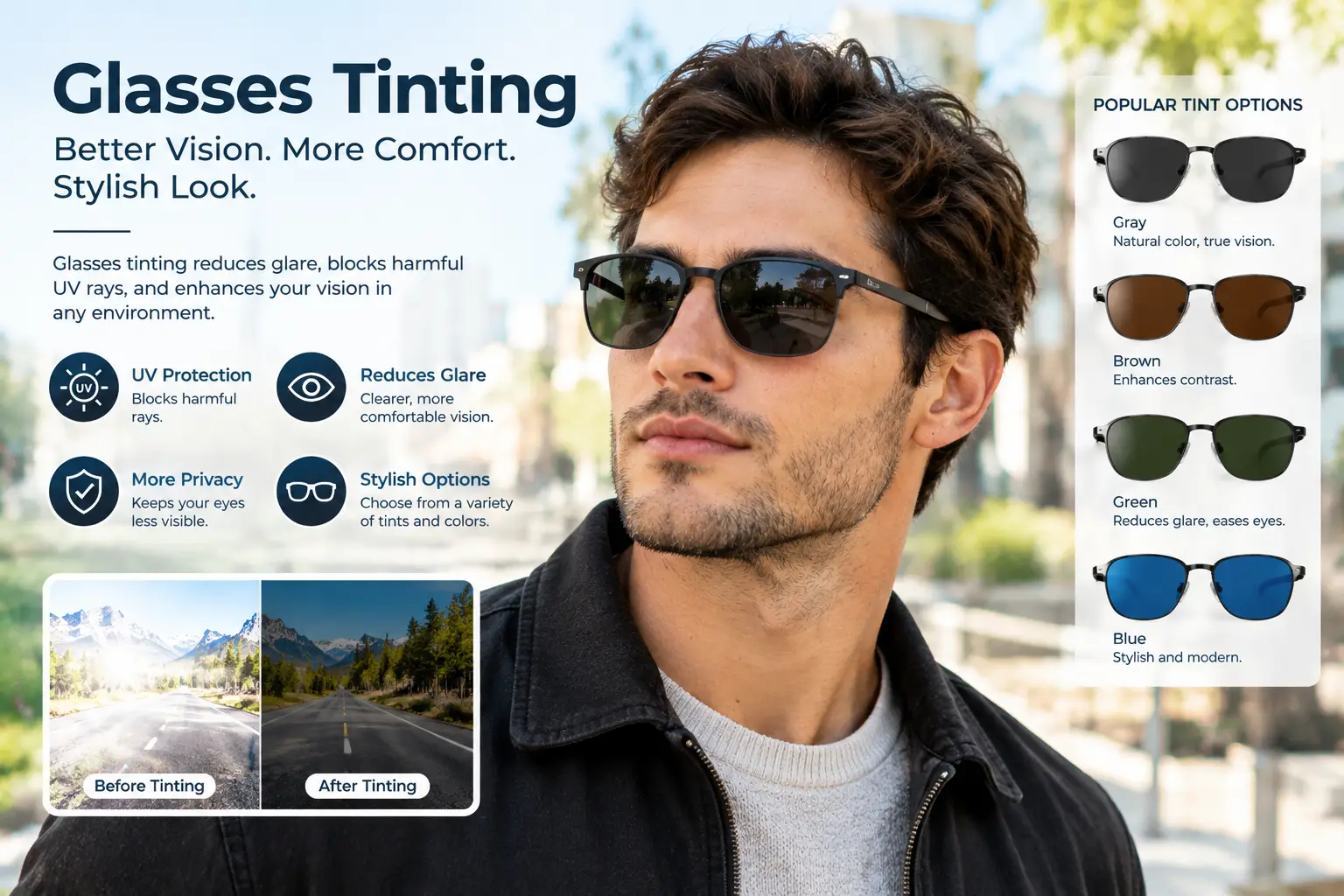
- Pick the shade by use. Gray for true color, brown/amber for contrast, rose or FL-41 for light sensitivity (more on lens tint colors below).
- Choose darkness by environment. Light tints for indoor wear; medium to dark for outdoor sun — never dark tints for night driving.
- Match the budget to frequency. Occasional use favors clip-ons; regular DIY tinting favors BPI Lens Dye Concentrate; daily migraine management justifies a therapeutic investment.
The order matters: if you skip step 1, you can waste an afternoon and a bottle of dye on lenses that were never going to change color.
Lens Tint Colors Explained: What Each Shade Really Does
Marketing loves exotic color names, but lens tint colors mostly boil down to a few functional families. Here’s what actually matters — and what doesn’t.
Gray — the true-color neutral
Gray reduces overall brightness without shifting colors much, which makes it the safest all-purpose sunglass tint. If you want to tint prescription glasses for general outdoor use, gray is hard to beat.
Brown and amber — the contrast boosters
Brown and amber tints filter more blue light, which can make edges and depth look sharper on overcast days or on the golf course. The AAO notes that tinted lenses can increase contrast for sports, even though they don’t block more UV.
Green (G-15) — the balanced classic
G-15 green, offered in dye lines like BPI Lens Dye Concentrate, sits between gray and brown: decent contrast with relatively natural color.
Rose and FL-41 — the light-sensitivity specialists
Fashion rose looks pretty; FL-41 is engineered. The difference is precision: FL-41 targets a specific blue-green band, while generic pink tints may not. That’s why TheraSpecs WearOver FL-41 Glasses and Axon Optics Migraine Glasses cost more than a cosmetic rose lens.
Yellow — the overhyped one
Yellow can feel brighter in haze, but it’s widely marketed for night driving — where any tint reduces the light reaching your eyes.
Features that don’t matter as much as you think: exotic color names, “HD” labels, and extreme darkness. Features that do: UV rating, tint evenness, and matching the color to your task.
Glasses Tinting vs Clip-Ons, Fitovers, and Photochromic Lenses
Is dyeing your lenses actually better than the alternatives? It depends on what you value. Here’s how permanent glasses tinting stacks up against the traditional options.
| Factor | Dyed Lenses | Clip-Ons | Fitovers | Photochromic Lenses |
|---|---|---|---|---|
| Upfront cost | Very low (DIY) | Low | Low–moderate | High (new lenses) |
| Reversible? | No | Yes | Yes | Automatic |
| Works indoors? | Light tints only | Remove indoors | Remove indoors | Mostly clear indoors |
| Works with polycarbonate? | Rarely | Yes | Yes | Yes |
| Best for | BPI Lens Dye Concentrate users with CR-39 | Solar Shield Clip-Ons fans | Cocoons Fitovers for coverage | Buyers ordering new lenses |
The table shows the real advantage of dyed lenses: a permanent, custom color at a tiny cost — but only if your lenses are tintable. Clip-ons and fitovers win on flexibility and material compatibility, while photochromic lenses are the premium hands-free choice that only makes sense when you’re already buying new lenses.
There’s also a comfort angle. Photochromic lenses react to UV, so they often don’t darken much behind a car windshield, which blocks much of the UV that triggers them. That’s one reason many drivers still keep Solar Shield Clip-Ons or Cocoons Fitovers in the car even when they own photochromic glasses. And unlike any of these, a permanent light tint (10–20%) can stay on all day indoors for gentle glare reduction — something no clip-on can do without looking odd.
Tinted Glasses for Migraines and Light Sensitivity
For many people, tinted glasses for migraines are less about style and more about getting through a workday. Light sensitivity (photophobia) is one of the most common migraine complaints, and fluorescent lights and screens are frequent triggers.
The research behind FL-41 is more substantial than for most tints. A peer-reviewed study published in PubMed Central summarizes earlier findings that FL-41 tinted spectacle lenses reduced migraine frequency in children from about 6.2 to 1.6 attacks per month — and notes that, until recently, FL-41 was the only migraine-specific optical treatment. Newer filters are being studied, but FL-41 remains the most established option.
What does that mean for you as a shopper?
- ✅ Precision beats “pink.” A generic rose lens may not filter the same wavelengths. Neurology clinicians have cautioned that quality and light transmission vary between sellers claiming FL-41.
- ✅ Don’t default to dark sunglasses indoors. Dark-adapting your eyes can make sensitivity worse once the glasses come off.
- ✅ Test before committing. Non-prescription Axon Optics Migraine Glasses or TheraSpecs WearOver FL-41 Glasses let you trial the concept before ordering prescription lenses.
- ✅ Talk to your doctor. Light sensitivity can stem from migraine, concussion, dry eye, and other conditions — tinted lenses complement treatment, they don’t replace a diagnosis.
If you want to tint prescription glasses with FL-41 permanently, some academic eye clinics and optical labs can add the filter to your lenses — ask whether they use a verified FL-41 dye rather than a cosmetic rose.
Common Mistakes to Avoid With Glasses Tinting
Most glasses tinting regrets come from a handful of avoidable errors. Here’s what to watch for.
❌ Mistake 1: Assuming darker means safer. The AAO is clear that lens darkness isn’t an indicator of UV protection. A dark DIY tint with no UV blocker can actually be worse than clear lenses outdoors, because your pupils open wider behind the darkness.
❌ Mistake 2: Dyeing your only pair. DIY lens tinting carries a real risk of blotches, mismatched shades, or a warped frame. Practice on a spare.
❌ Mistake 3: Ignoring the lens material. Polycarbonate and high-index lenses — extremely common in modern prescriptions — usually won’t take dye. Check first.
❌ Mistake 4: Buying clip-ons by guesswork. With Solar Shield Clip-Ons, fit depends on matching your frame’s shape and size. With Cocoons Fitovers, measure your frame width and height before ordering.
❌ Mistake 5: Wearing tinted lenses for night driving. Any tint reduces light reaching your eyes. Even yellow “night driving” lenses don’t add light.
❌ Mistake 6: Treating all FL-41 as equal. Cheap rose lenses may look the part without filtering the right wavelengths. When shopping for tinted glasses for migraines, buy from brands that document their filtering.
❌ Mistake 7: Skipping safety gear. Lab dyes like BPI Lens Dye Concentrate carry chemical warnings. Gloves, ventilation, and a dedicated pot are non-negotiable.
Long-Term Cost and Maintenance
Upfront price is only half the story. Here’s how the seven picks compare over a few years of ownership.
| Option | Upfront Cost | Ongoing Cost | Lifespan Factors | Best Value For |
|---|---|---|---|---|
| Jacquard iDye Poly / Rit DyeMore Synthetic | Under $15 | Re-buy per project | Tint can fade with heavy sun | Occasional DIYers |
| BPI Lens Dye Concentrate | Higher per bottle | Pennies per lens | One quart covers many lenses | Frequent tinters |
| Solar Shield Clip-Ons | Around $20 | Replace if clip loosens | Bridge wear over time | Budget commuters |
| Cocoons Fitover Polarized Sunglasses | $30–$60 | Minimal | Lifetime frame warranty | Heavy outdoor users |
| Axon Optics Migraine Glasses / TheraSpecs WearOver FL-41 Glasses | Premium | Rx upgrades extra | Scratches over daily wear | Daily light sensitivity |
The value math favors BPI Lens Dye Concentrate if you tint often, because one quart of solution covers many lenses. For most single-pair owners, though, Solar Shield Clip-Ons or Cocoons Fitovers deliver the lowest cost of ownership with zero risk to expensive prescription lenses. And for light sensitivity, a wear-over therapeutic pair often costs less over time than replacing prescription lenses every time your correction changes.
Maintenance tips that extend life
- ✅ Clean tinted lenses with lens cleaner and microfiber, not paper towels — scratches show more on tinted surfaces.
- ✅ Store clip-ons in their case; loose clip-ons in a cup holder scratch quickly.
- ✅ DIY-dyed lenses can lighten with prolonged sun exposure; a quick re-dip restores depth on CR-39.
- ✅ Re-check therapeutic lenses yearly — scratched FL-41 lenses scatter light, which partly defeats the purpose.
Safety, Regulations, and Standards
Tinting isn’t just cosmetic — eyewear sold in the US is regulated as a medical device, and a few standards are worth knowing before you buy or DIY.
Impact resistance
Under FDA regulation 21 CFR 801.410, eyeglass and sunglass lenses sold in the US must be impact-resistant, verified with a drop-ball test in which a 5/8-inch steel ball is dropped from 50 inches onto the lens. Commercial products like Solar Shield Clip-Ons and Cocoons Fitovers are sold under these requirements. A home-dyed lens doesn’t get re-certified — and if overheating weakens or warps it, you won’t know. That’s one more reason to keep bath temperatures controlled.
Sunglass performance standards
ANSI Z80.3 is the US standard for nonprescription sunglasses, covering properties such as light transmittance and UV performance. Cocoons Fitover Polarized Sunglasses state that they meet it.
UV labeling
Per the AAO, look for “100% UVA/UVB” or “UV400.” If you’re unsure about a pair, many optical shops can test lenses with a UV meter.
Chemical safety
Optical dyes are industrial chemicals. BPI Lens Dye Concentrate listings carry a California Proposition 65 warning. Use gloves, ventilate, keep pets and kids away, and never reuse the dye pot for food.
Driving
A tint that’s comfortable at noon can be unsafe at dusk. Keep a clear pair available for night driving, and check your state DMV’s vision requirements if you have specific concerns.
FAQs
❓ Can an optician tint my existing prescription glasses?
❓ How much does it cost to tint prescription glasses at a shop?
❓ Can tint be removed from glasses lenses?
❓ Do tinted glasses block blue light from screens?
❓ Is glasses tinting worth it compared with buying sunglasses?
Conclusion
Glasses tinting in 2026 isn’t one decision — it’s three. If you have spare CR-39 lenses and an adventurous streak, DIY lens tinting with Jacquard iDye Poly or Rit DyeMore Synthetic is cheap and genuinely fun, and BPI Lens Dye Concentrate takes you to professional consistency once you’re hooked. If you own a single pair of prescription glasses, especially polycarbonate, reversible tint is the smarter play: Solar Shield Clip-Ons for a sleek, budget-friendly match, or Cocoons Fitover Polarized Sunglasses for maximum coverage behind the wheel or on the water.
And if light itself is your enemy, skip the cosmetic tints. TheraSpecs WearOver FL-41 Glasses let you keep your current prescription while adding research-backed filtering, and Axon Optics Migraine Glasses offer a doctor-founded way to test precision tinting before committing to prescription lenses.
Whatever you choose, remember the three rules from this guide: check your lens material before buying dye, verify UV protection separately from color, and match lens tint colors to the task rather than the trend. Get those right, and a little color will make your days noticeably easier on the eyes.
🌟 Your most comfortable view is one click away!
👓 Pick the option that fits your glasses and your lifestyle, click a highlighted product to check current pricing and availability, and enjoy brighter days with less squinting — starting this week!
Recommended for You
- Computer Monitor Screen Cover: 7 Best Picks Worth Buying in 2026
- Safety Glasses with Lights: 7 Best Picks for 2026 (Avoid Duds)
- Rimless Sunglasses Men: 7 Best Lightweight Picks for 2026
Disclaimer: This post contains affiliate links. As an Amazon Associate, I earn from qualifying purchases made through these links, at no additional cost to you.
✨ Found this article helpful? Share it with someone who needs it! 💬🤗