In This Article
What Are Amber Tinted Glasses?
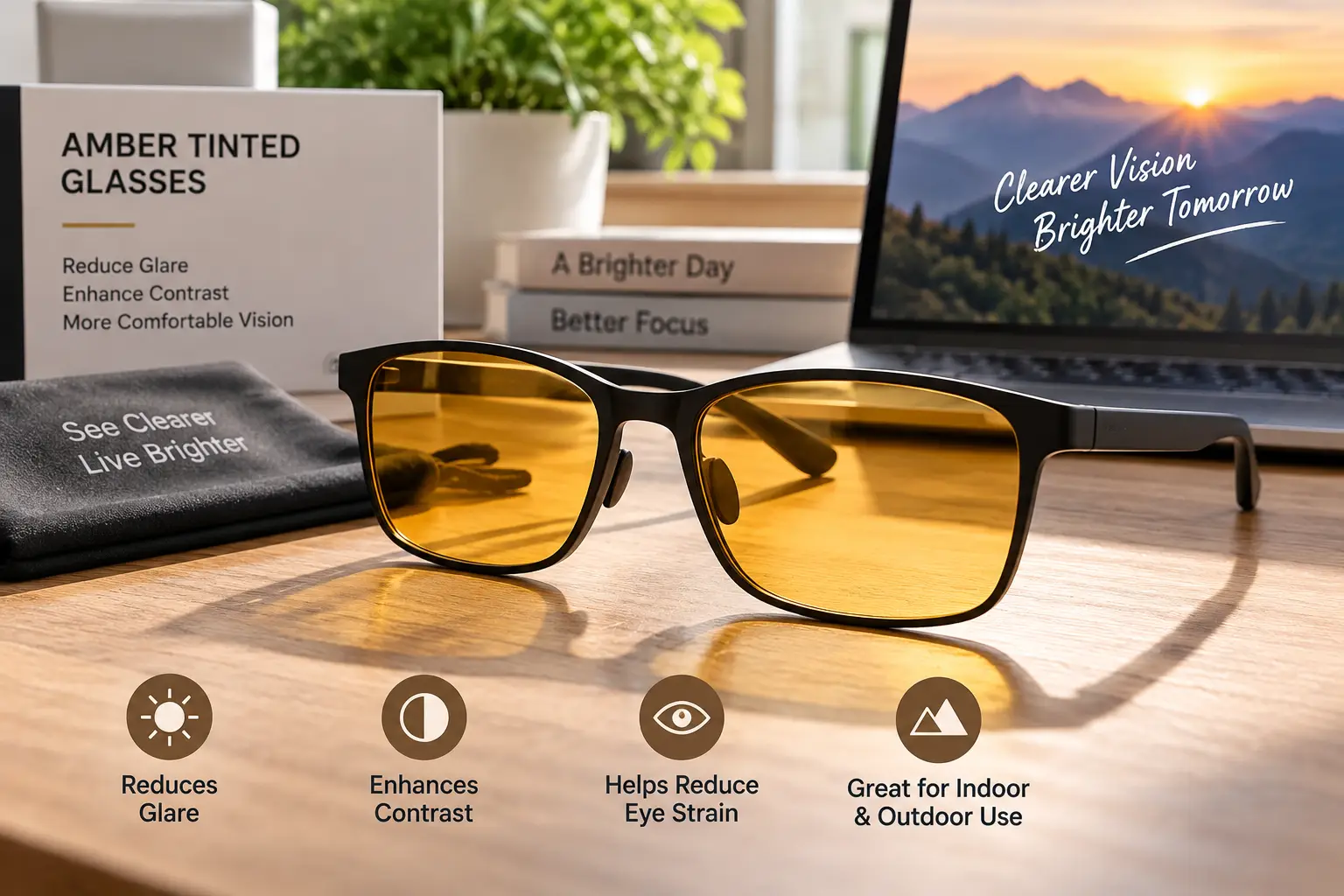
Amber tinted glasses are eyewear with orange-to-amber colored lenses designed to filter out blue and blue-green wavelengths of light, the part of the visible spectrum most linked to suppressing melatonin production in the evening. They’re typically worn in the hour or two before bed, during night-shift work, or at a computer screen after dark, and they’re also called blue light blocking glasses, night shift glasses, or bipolar glasses in some sleep-medicine circles.
If you’ve landed here because your feed is suddenly full of ads for orange-lensed eyewear promising deeper sleep, you’re not imagining things. Search interest in amber tinted glasses has climbed steadily as more people chase better sleep hygiene without giving up their phones entirely. And the appeal makes sense: unlike blackout curtains or a total screen ban, a pair of amber tinted glasses lets you keep scrolling, reading, or finishing a work email while (in theory) sparing your circadian rhythm from the worst of it.
But “in theory” is doing some work in that sentence, and it’s worth unpacking before you buy. Researchers have long noted that light of any color can suppress melatonin secretion, but blue wavelengths do so more powerfully than the rest of the visible spectrum. That’s the physiological basis for amber lenses: by filtering out the blue end of the spectrum, they theoretically let the rest of the visible light through while blocking the wavelengths your brain reads as “daytime.” For a deeper dive into the underlying science, the Harvard Health overview on blue light’s effects on sleep is one of the more balanced summaries available to consumers.
This guide is built around that nuance. Rather than just telling you amber tinted glasses are magic, we’re going to walk through seven real, currently available options on Amazon — from bargain-bin industrial safety glasses to purpose-built sleep eyewear — explain what actually differs between them, and help you figure out whether (and which) amber lenses make sense for your evening routine. We’ll also cover the buying mistakes that trip people up, the regulations that govern honest marketing in this space, and a few scenarios where amber tinted glasses genuinely earn their keep.
Amber Tinted Glasses at a Glance: Quick Comparison
If you’re short on time, here’s how the seven amber tinted glasses in this guide stack up before we get into the details.
| Product | Lens Style | Best For | Price Range |
|---|---|---|---|
| SomniLight Amber Sleep Glasses (Fit Over) | Deep amber, fits over prescription glasses | Serious sleep-hygiene routines | $30–$45 |
| Spectra479 99.9% Blue Light Blocking Amber Glasses | Bright amber, standalone frame | Everyday evening wear without looking “tinted” | $15–$25 |
| Uvex by Honeywell Skyper (S1933X) | SCT-orange, wraparound uni-lens | Budget-conscious screen users | under $15 |
| NoCry Blue Light Blocking Safety Glasses Over Eyeglasses | Orange, ANSI Z87.1 wraparound | Anyone who wants safety-rated protection too | $15–$25 |
| TIJN Orange Bluelight Blocking Glasses | Amber wayfarer | Style-conscious first-time buyers | under $20 |
| Eyekepper Amber Fit Over Glasses | Amber, oversized fit-over | Budget fit-over shoppers | $15–$20 |
| ZIHVEUC Amber Reading Glasses | Amber with built-in magnification | Readers who also need reading power | $12–$20 |
A quick read of this table tells you most of what you need to know about positioning: the SomniLight Amber Sleep Glasses sit at the premium end because they’re purpose-built for sleep medicine use, the Uvex Skyper is the budget workhorse borrowed from industrial safety eyewear, and everything else fills in the middle depending on whether you wear prescription glasses, want a magnification boost, or just want something that doesn’t scream “I’m wearing orange glasses” at the dinner table.
💬 Ready to see the full picture? Scroll down for the complete rundown of all seven amber tinted glasses, including honest pros, cons, and who each pair is actually built for.
The 7 Best Amber Tinted Glasses in 2026 (Expert Picks)
We picked these seven amber tinted glasses to cover a genuine range: fit-over designs for people who already wear prescription glasses, industrial-grade orange lenses borrowed from workplace safety gear, budget wayfarers for casual users, and a magnifying option for readers. Here’s the fuller comparison before we break each one down.
| Product | Blue Light Claim | Frame Style | Price Range |
|---|---|---|---|
| SomniLight Amber Sleep Glasses (Fit Over) | 99%+ of disruptive blue wavelengths | Oversized fit-over, polycarbonate | $30–$45 |
| Spectra479 99.9% Blue Light Blocking Amber Glasses | 99.9% from 280–510nm (includes UV) | Standalone wayfarer | $15–$25 |
| Uvex by Honeywell Skyper (S1933X) | 98%+ via SCT-Orange coating | Wraparound uni-lens, industrial | under $15 |
| NoCry Blue Light Blocking Safety Glasses Over Eyeglasses | Blue-light filtering + 100% UV | ANSI Z87.1 wraparound, fit-over | $15–$25 |
| TIJN Orange Bluelight Blocking Glasses | Blue-green filtering, dual AR coating | TR90 wayfarer | under $20 |
| Eyekepper Amber Fit Over Glasses | 100% blue light reduction (brand claim) | Oversized fit-over, TR90 | $15–$20 |
| ZIHVEUC Amber Reading Glasses | 99% blue light blocking (brand claim) | Reader-style, +1.0 to +2.5 magnification | $12–$20 |
Looking at the table above, the pattern that jumps out is fit: three of the seven ( SomniLight, NoCry, and Eyekepper) are built to go over existing prescription glasses, which matters enormously if you already wear specs and don’t want prescription lenses tinted. The Uvex Skyper and TIJN pair are the most affordable standalone options, while the ZIHVEUC readers solve a problem none of the others do: needing magnification and blue light filtering in the same lens.
💬 One click helps other shoppers make an informed choice too! 😊
1. SomniLight Amber Sleep Glasses (Fit Over) — deepest amber tint on this list
Of the seven amber tinted glasses here, this is the one built specifically around sleep medicine rather than computer comfort, and the depth of the tint shows it. SomniLight is a light-therapy brand that also sells FL-41 tinted glasses for migraine and photophobia, so amber sleep lenses are their core business rather than a side product.
The fit-over design measures roughly 6.2 inches wide and is made from lightweight polycarbonate, meaning it’s built to sit comfortably over most prescription and reading glasses rather than replace them. In practice, that means you don’t need to buy a second pair of prescription blue-blockers — you just slip these on top of what you already wear. The lenses are rated UV400, so they double as daytime UV protection if you ever wear them outdoors, and the brand states the tint filters over 99% of the blue wavelengths most associated with suppressing melatonin.
Based on comparing the specs against the rest of this list, this is the pick for people who’ve already tried a cheaper amber lens and found the tint too light to notice a difference. The deeper amber color is a deliberate trade-off: you’ll see the world in warmer tones the moment you put them on, which some buyers love and others find jarring for casual TV-watching. Reviews consistently report that the fit-over design is the standout feature for glasses-wearers, since most amber tinted glasses on the market assume you don’t already wear specs.
Pros:
- ✅ Fits comfortably over most prescription glasses
- ✅ Purpose-built by a sleep-focused eyewear brand
- ✅ UV400 rated for daytime backup use
Cons:
- ❌ Noticeably darker tint than casual-use alternatives
- ❌ Sits at the higher end of the price range for this category
At around $30–$45, this isn’t the cheapest amber tinted glasses option on the list, but if you’re serious about a consistent pre-bed routine and already wear glasses, the fit-over design alone justifies the premium over a standalone frame you’d have to choose between wearing and seeing clearly.
2. Spectra479 99.9% Blue Light Blocking Amber Glasses — bright lens for social evenings
Spectra479 takes a different approach to the same problem: instead of a dark, obviously-tinted lens, the brand designed a “bright lens” amber tint intended to let more non-blue light through so you don’t look like you’re wearing sunglasses indoors. The company markets this specifically so wearers can still make eye contact and hold a normal conversation without the glasses being a visual barrier.
Technically, the lenses are tested to block over 99.9% of light in the 280–510 nanometer range, which covers both UV and the most disruptive blue wavelengths, according to the brand’s published spec sheet. What that means in practice: you get comparable blue-light filtering to darker amber tints, but with a lighter, more transparent-looking lens. The trade-off is that a lighter tint typically means somewhat less blue light is filtered per photon reaching your eye compared to the darkest amber lenses on this list — a real technical compromise, not just a cosmetic one.
Spectra479 is a small business seller on Amazon rather than a large eyewear brand, which shows up in more limited style variety but also in the kind of narrowly-focused product design you see here. This is the amber tinted glasses pick for people who want to wear them at a family dinner or while a partner is in the room, not just alone at a desk.
Pros:
- ✅ Designed to preserve natural eye contact and color perception
- ✅ Tested blocking claim spans UV plus the disruptive blue range
- ✅ Standalone frame, no need to stack over other glasses
Cons:
- ❌ Lighter tint may filter less blue light than the darkest amber options
- ❌ Limited size and style variety as a smaller brand
In the $15–$25 range, Spectra479 lands solidly in the middle of the pack — a reasonable price for a lens designed with a genuinely different use case in mind than the darker, function-over-form options elsewhere on this list.
3. Uvex by Honeywell Skyper (S1933X) — best value for skeptics testing the category
If you want to try amber tinted glasses without spending much, the Uvex Skyper is the obvious starting point, and it comes with an unusual pedigree: it’s industrial safety eyewear repurposed for screen use, made by Honeywell, a company that’s been manufacturing protective gear for over a century.
The SCT-Orange lens uses Spectrum Control Technology to absorb what Honeywell states is more than 98% of the blue light from laptops and phones, paired with a wraparound uni-lens design that includes integrated side shields. What most buyers overlook with this model is that it’s certified to meet ANSI+ 2015 and tested against the CSA Z94.3 standard — certifications built for workplace protective eyewear, not fashion glasses, which is part of why the frame looks more like shop goggles than sleep eyewear. A three-position ratcheting lens tilt and adjustable Duoflex temples let you fine-tune the fit, and Honeywell backs the frame with a lifetime guarantee.
Reviews consistently report genuine satisfaction with the value here: one independent reviewer who wore the Skyper nightly for over a month described the blue-blocking performance as matching or exceeding pricier alternatives, while acknowledging the trade-offs are mostly cosmetic — you’ll look like you’re about to operate machinery, not head to bed. At under $15, this is a low-risk way to find out whether amber tinted glasses do anything for you before committing to a pricier pair.
Pros:
- ✅ Backed by Honeywell’s decades of protective-eyewear manufacturing
- ✅ Certified to ANSI+ 2015 and CSA Z94.3 standards
- ✅ Lifetime guarantee on the frame
Cons:
- ❌ Industrial styling looks more like safety glasses than sleep eyewear
- ❌ Not designed to fit over prescription glasses
4. NoCry Blue Light Blocking Safety Glasses Over Eyeglasses — two jobs, one frame
NoCry built its name on affordable safety eyewear, and this model does double duty: it’s ANSI Z87.1 certified protective eyewear that also happens to filter blue light through an orange lens, designed specifically to fit over prescription glasses. That combination is unusual on this list and genuinely useful for a specific buyer — someone who works with tools, does lab or dental work, or just wants real impact protection alongside blue-light filtering.
The wraparound polycarbonate lens includes a UV coating the brand states blocks 90–100% of UV radiation, anti-fog and anti-scratch treatment, and adjustable SoftPad temple arms designed to distribute weight so the frame doesn’t pinch behind the ears during extended wear. What the spec sheet doesn’t say, but reviews reveal, is that the safety certification is a real differentiator for a specific niche: reviewers highlight using these for both office screen work and hands-on shop tasks, noting the fit-over design accommodated their prescription glasses without the awkward double-frame bulk some fit-overs create.
Here’s what to weigh: if you don’t need impact protection, you’re paying for a feature you won’t use. But if you split time between a workshop, garage, or lab and a late-night screen, one frame covering both use cases is a genuine convenience upgrade over buying two separate pairs of glasses.
Pros:
- ✅ ANSI Z87.1 safety certified, not just a marketing claim
- ✅ Fits comfortably over most prescription eyewear
- ✅ Anti-fog and anti-scratch coating for daily durability
Cons:
- ❌ Bulkier, more industrial look than dedicated sleep glasses
- ❌ Safety certification is wasted value if you’ll only wear them in bed
5. TIJN Orange Bluelight Blocking Glasses — most fashion-forward budget pick
TIJN leans hard into looking like normal glasses rather than obvious blue-light gear, and at under $20, it’s the most style-conscious entry point on this list. The wayfarer-style frame is built from TR90 material, a flexible nylon composite that’s genuinely lighter and more bend-resistant than standard acetate, which matters if these are going to live on your nightstand and get knocked around.
The amber-orange lens uses a dual anti-reflective coating alongside the tint, aimed at reducing glare from screens and overhead lighting in addition to filtering blue-green wavelengths. Based on comparing this against the plainer industrial options on this list, TIJN‘s appeal is squarely aesthetic — this is the pair you could wear on a video call without anyone asking what’s on your face, which the darker fit-over options on this list can’t claim.
One independent reviewer who tested the glasses over several days for editing work described the warm amber tint as relaxing on the eyes and noted fewer headaches during long sessions, while flagging that color-sensitive tasks like photo editing weren’t a good match given the inherent color shift any amber lens introduces. That’s an honest trade-off worth internalizing: any amber tint will distort true color perception to some degree, and TIJN is no exception.
Pros:
- ✅ Lightweight, flexible TR90 frame built for everyday wear
- ✅ Dual anti-reflective coating cuts screen glare
- ✅ Priced as one of the most affordable standalone options here
Cons:
- ❌ Not designed to fit over prescription glasses
- ❌ Amber tint distorts color accuracy, a poor fit for color-critical work
6. Eyekepper Amber Fit Over Glasses — budget fit-over alternative
Eyekepper has sold reading glasses and eyewear accessories since 2015, and this fit-over model is its answer to the more expensive fit-over options on this list. The oversized frame is built from TR90 material and is designed to slip over most standard prescription glasses, turning your existing eyewear into blue-light-filtering eyewear without needing a second prescription pair.
The brand states the amber lens delivers 100% blue light reduction, though as with most consumer amber glasses, that figure comes from the manufacturer rather than an independent lab test, so it’s worth treating as a marketing claim rather than a verified spec. What most buyers overlook with fit-over designs generally is fit tolerance: Eyekepper‘s listing specifies a frame width of roughly 5.9 inches and asks buyers to measure their existing glasses before ordering, since a fit-over that’s too small simply won’t close comfortably over a wider prescription frame.
Compared with the SomniLight and NoCry fit-over options above, Eyekepper is the budget play — you’re trading some brand reputation and certification rigor for a noticeably lower price point, which is a reasonable trade for a casual user who just wants to try the fit-over format without a $40 commitment.
Pros:
- ✅ Lowest-priced fit-over design on this list
- ✅ Includes a case and cleaning cloth in most listings
- ✅ Lightweight TR90 construction
Cons:
- ❌ Blue-light blocking claim is unverified by independent testing
- ❌ Sizing runs large; requires measuring your existing glasses first
7. ZIHVEUC Amber Reading Glasses — the only pick with built-in magnification
Every other pair on this list assumes you don’t need corrective magnification. ZIHVEUC solves for the reader who does: this is a pair of amber-tinted reading glasses available in magnification strengths from +1.0 up to +2.5, combining blue light filtering with the reading power some buyers would otherwise need a completely separate pair of glasses for.
The brand markets the lens as blocking 99% of blue light, and functionally these work like standard drugstore reading glasses with an amber tint layered on top rather than a fit-over accessory. That makes them the simplest option here if you already read on a screen or on paper in bed and need magnification anyway — instead of stacking amber sleep glasses on top of your readers, one frame does both jobs.
Honesty check: aggregated review data specific to this exact listing is thinner than for the more established brands above, so we can’t respectably characterize customer sentiment the way we can for SomniLight or TIJN. What we can say with confidence is the mechanical logic of the product — combining a documented magnification strength with an amber tint — is sound. If verified reviews matter to your decision, check the current listing’s review count and recent feedback before buying, since that can shift quickly for smaller sellers.
Pros:
- ✅ Only pick on this list with built-in reading magnification
- ✅ Eliminates the need to stack two pairs of glasses
- ✅ Available across a range of common diopter strengths
Cons:
- ❌ Thinner aggregated review history than the other picks here
- ❌ Not a fit-over design, so it replaces rather than layers over your glasses
Amber Tinted Glasses vs. Other Blue Light Solutions
Amber tinted glasses aren’t the only way to reduce evening blue light exposure, so it’s worth seeing how they stack up against the alternatives you’ve probably already tried.
| Method | Blue Light Reduction | Convenience | Ongoing Cost |
|---|---|---|---|
| Amber tinted glasses | High (tint-dependent) | Requires remembering to wear them | One-time purchase |
| Device night mode / f.lux-style apps | Moderate | Automatic, no extra item to wear | Free |
| Blackout curtains + dim red lighting | High (ambient light only) | Doesn’t address screens directly | Low, one-time |
| Clear “blue light” computer glasses | Low to moderate | Wearable all day, no color distortion | One-time purchase |
The table makes the trade-off pretty clear: amber tinted glasses filter more blue light per the manufacturer specs than software-based night modes, but only while you’re actually wearing them, and only for your eyes, not your whole bedroom. Night mode settings and blue-light-filtering apps are free and automatic but generally shift color temperature less aggressively than a physical amber lens, since screen manufacturers have to balance readability against genuine blue-light reduction. If you’re chasing the deepest possible blue-light cut before bed, pairing amber glasses with a night-mode setting and dim lighting covers more bases than any single method alone.
✨ Don’t miss these exclusive deals! 🔍 Compare all seven amber tinted glasses side by side and find the pair that matches your sleep goals — check current pricing and availability before stock shifts.
How to Choose Amber Tinted Glasses
Picking between dozens of near-identical orange-lensed frames is genuinely confusing, so here’s the criteria that actually separate a good pair from a gimmick.
- Check the wavelength range, not just a blocking percentage. A claim of “99% blue light blocking” means little without knowing which wavelengths it covers; look for specs citing a nanometer range (ideally covering roughly 450–510nm, the most sleep-disruptive band).
- Decide if you need a fit-over design. If you wear prescription glasses, a standalone frame either replaces your regular glasses (bad for evening reading) or requires an awkward stack — go fit-over instead.
- Match the tint depth to your use case. Darker ambers filter more aggressively but distort color and social interaction more; lighter “bright lens” tints trade some filtering for wearability around others.
- Look for a UV rating if you’ll wear them outdoors too. UV400-rated lenses double as daytime sun protection, adding value beyond the bedroom.
- Consider certification where it matters. If you also need impact or workplace eye protection, an ANSI Z87.1-certified pair like the NoCry model does double duty.
- Read the return policy before the reviews. Because tint depth and comfort are subjective, a forgiving return window matters more here than in most eyewear categories.
Common Mistakes to Avoid When Buying Amber Tinted Glasses
Even with a clear buying framework, a few recurring mistakes show up across amber tinted glasses shoppers.
The first is trusting an unverified blocking percentage as gospel. Many listings state figures like “99.9% blue light blocking” as a manufacturer claim rather than an independently tested spec, and reputable sellers should be transparent about the difference. When you’re comparing customer reviews or influencer recommendations for any product category, it’s worth knowing that the FTC’s endorsement guidelines require paid endorsements and affiliate relationships to be clearly disclosed — a useful filter for spotting which reviews are genuinely independent.
The second mistake is buying the darkest available tint by default, assuming darker automatically means better. As covered above, a deep amber tint sacrifices color accuracy and social wearability; for a lot of buyers, a moderate tint worn consistently outperforms an extreme tint worn inconsistently because it’s uncomfortable.
The third mistake is skipping the fit-over question entirely. Buyers who wear prescription glasses sometimes order a standalone frame, realize they can’t see clearly through it, and either stop using it or squint through blurry vision — neither outcome delivers the sleep benefit they were after.
Finally, don’t assume amber tinted glasses are a substitute for basic sleep hygiene. They’re a supplement to reduced screen time before bed, not a replacement for it.
Amber Tinted Glasses vs Clear Blue Light Glasses: What’s the Real Difference?
Clear “blue light glasses” marketed for daytime computer use and amber tinted glasses marketed for bedtime use are often confused, but they’re built for different jobs. Clear lenses use a thin coating that reflects a modest amount of blue light — often in the 10–30% range — while staying visually neutral so you can wear them all day at a desk without anyone noticing a tint. Amber lenses go much further, physically filtering out most of the blue spectrum through the tint itself, which is why they look orange and why you wouldn’t want to wear them during a video call with color-critical work on screen.
The practical takeaway: clear blue light glasses are a daytime comfort product aimed at reducing glare and eye fatigue, while amber tinted glasses are an evening circadian-rhythm tool aimed at protecting melatonin production. If your main complaint is dry, tired eyes at 2pm, clear lenses (or, per the ophthalmology guidance below, simply taking more screen breaks) are the better match. If your main complaint is trouble falling asleep after late-night scrolling, amber is the more targeted tool.
What to Expect: Everyday Performance With Amber Lenses
Putting on amber tinted glasses for the first time is a noticeable experience — everything shifts toward warm orange and yellow tones immediately, and whites no longer look white. Most wearers report this becomes less jarring within a few nights as your eyes adjust to the color shift, but it’s worth knowing upfront rather than being surprised.
Screen text typically stays perfectly readable through amber lenses; what changes is color accuracy, not clarity, so reading, browsing, or watching a show works fine, while editing photos or matching paint colors does not. Comfort varies more by frame design than lens tint: fit-over models like SomniLight, NoCry, and Eyekepper can feel bulkier on the face, while standalone wayfarers like TIJN sit closer to how normal glasses feel. If you’re prone to headaches from tight-fitting eyewear, prioritize adjustable temples and lightweight frame material (TR90 shows up across several picks here specifically for this reason) over lens tint depth.
Amber Tinted Glasses for Shift Workers, Night Owls, and Light-Sensitive Readers
Amber tinted glasses aren’t a one-size-fits-all product, and the ideal pick shifts depending on who’s wearing them.
Shift workers dealing with irregular sleep windows benefit most from a darker tint like the SomniLight or Spectra479 models, worn consistently during the “wind-down” hour before a daytime sleep block, since the goal is maximizing the signal to your body that it’s time to rest regardless of the actual clock time. Night owls who read or scroll in bed but don’t have a formal sleep disorder often do fine with a lighter tint like TIJN or the Uvex Skyper, since the goal is incremental improvement rather than a clinical intervention. Light-sensitive readers, including people managing migraines or general photophobia, may want to look specifically at brands that also sell FL-41 tinted lenses (a rose-tinted option distinct from amber, designed for daytime light sensitivity rather than nighttime blue-light filtering) rather than assuming amber is the right tint for every light-sensitivity complaint.
Long-Term Cost and Maintenance of Amber Lenses
Amber tinted glasses are a one-time purchase rather than a subscription, which makes the total cost of ownership straightforward compared to, say, a light-therapy lamp or a sleep-tracking subscription. Budget picks like the Uvex Skyper or TIJN frame cost less upfront but may need replacing sooner if the coating scratches or the hinge loosens with daily use; sturdier fit-over designs like NoCry, built to ANSI Z87.1 durability standards, tend to hold up longer under regular handling.
Maintenance is minimal across the board: rinse lenses under warm water with a mild soap, avoid paper towels or rough cloth that can scratch the tint coating, and dry with a microfiber cloth. Store the glasses in a hard case when not in use — several picks on this list, including Eyekepper, ship with one — since a loose pair rattling around a nightstand drawer is the most common cause of scratched lenses and bent frames within the first few months.
Features That Actually Matter (and Ones That Don’t)
Cutting through the marketing on amber tinted glasses listings, a few features consistently matter for real-world performance: the wavelength range a lens is tested against (not just a blocking percentage), fit-over compatibility if you wear prescription glasses, and frame material weight for anyone planning to wear them for an hour or more nightly.
A few features matter far less than the marketing copy suggests. “99.9%” blocking claims sound more impressive than “98%,” but the difference is largely marketing precision rather than a meaningfully different sleep outcome, since both are well above the threshold where further gains are hard to notice subjectively. It’s also worth staying grounded on the underlying science here: the American Academy of Ophthalmology has stated it does not currently recommend blue-light-blocking eyewear for general computer use, citing limited evidence that blue light itself causes digital eye strain — its position is more supportive of a role for blue-light filtering specifically around sleep timing than around daytime eye comfort. That’s a useful distinction: buy amber tinted glasses to support your evening wind-down routine, not as a guaranteed fix for tired eyes at your desk.
Safety, Regulations, and Standards for Amber-Tinted Eyewear
Most amber tinted glasses aren’t subject to strict federal safety regulation the way prescription eyewear or actual protective equipment is, which is part of why blocking-percentage claims vary so widely between listings with little independent verification. The exception is any pair marketed with a safety certification, like the NoCry model’s ANSI Z87.1 rating — a real, enforceable standard maintained through OSHA’s eye and face protection regulations for workplace impact protection, distinct from and unrelated to any blue-light-blocking claim on the same frame.
UV protection is the other standard worth checking: a UV400 rating (present on several picks here, including SomniLight and NoCry) indicates the lens blocks light up to 400 nanometers, covering the full UVA and UVB range, and is a genuinely verifiable spec rather than a marketing estimate, since UV blocking is easier to test consistently than subjective blue-light filtering claims. If a listing advertises both a blue-light percentage and a UV rating, treat the UV number as the more reliable of the two.
Getting Started: Your First 30 Nights With Amber Tinted Glasses
The biggest mistake new buyers make with amber tinted glasses is wearing them inconsistently for a few nights, not noticing a dramatic change, and giving up. A more realistic first-month approach looks like this: put them on roughly 90 minutes before your target bedtime, every night, regardless of whether you’re actively looking at a screen — ambient room lighting, especially LED bulbs, contributes to blue light exposure too, not just phones and laptops.
In the first week, expect the color shift to feel strange; most wearers report it fades into the background by day four or five. By week two, pair the glasses with reduced screen brightness rather than relying on the tint alone to do all the work — the two together filter more effectively than either does solo. By the end of the first month, you should have a sense of whether the darker or lighter tint options on this list suit you better; if a deep amber like SomniLight feels too intense for nightly use, a lighter option like Spectra479 or TIJN may be a better long-term fit than forcing yourself through a routine you’ll eventually abandon. Common early mistakes include only wearing them while actively on a screen (missing the ambient-light benefit), and washing lenses with harsh cleaners that degrade the anti-reflective coating faster than normal wear would.
Real-World Scenarios: Who Actually Needs Amber Tinted Glasses?
Consider three different buyers to see how the picks above map onto real routines. A remote worker who reads on their phone in bed most nights and wears prescription glasses during the day is the clearest match for a fit-over design like NoCry or Eyekepper — they need something that layers over existing eyewear without a second prescription. A night-shift nurse trying to wind down for daytime sleep after an overnight shift benefits most from a deeper tint like SomniLight, worn consistently during the drive home and the hour before sleep, since the goal is maximizing the circadian signal regardless of the actual clock time outside. A college student who mostly wants a low-cost way to test whether amber glasses help with late-night study sessions is well served starting with the Uvex Skyper or TIJN, where the entry cost is low enough to experiment without much financial risk if the routine doesn’t stick.
None of these profiles are mutually exclusive, and plenty of buyers will find themselves somewhere between two of them — which is exactly why this list includes options across price points and fit styles rather than a single “best” pick.
Buyer Decision Framework: Which Amber Tinted Glasses Fit Your Life?
If you’re still deciding, run through this simple priority checklist. If you wear prescription glasses daily, start with the fit-over options — SomniLight, NoCry, or Eyekepper — since a standalone frame will either blur your vision or force you to choose between seeing clearly and filtering blue light. If budget is your primary constraint and you just want to test the category, choose Uvex Skyper or TIJN, both under $20, before committing to a pricier pair. If you also need workplace-grade eye protection alongside blue-light filtering, NoCry‘s ANSI Z87.1 certification is the only pick here that covers both needs in one frame. If you need reading magnification, ZIHVEUC is the only option built for that specific combination. And if you want the deepest, most clinically-oriented tint and don’t mind the higher price, SomniLight remains the most purpose-built choice on this list.
Frequently Asked Questions
❓ Do amber tinted glasses actually help you fall asleep faster?
❓ How dark should amber tinted glasses be for nighttime use?
❓ Can I wear amber tinted glasses over my prescription glasses?
❓ Are amber tinted glasses the same as blue light computer glasses?
❓ How much do amber tinted glasses typically cost?
Conclusion
Amber tinted glasses aren’t a miracle cure for bad sleep, and the honest evidence base sits somewhere between “does nothing” and “solves everything” — closer to a genuinely useful supplement to good screen habits than a replacement for them. What the seven picks in this guide make clear is that the category isn’t one-size-fits-all: whether you need a fit-over design, a workplace-safety certification, built-in reading magnification, or just a cheap way to test the concept, there’s a legitimately different product here for each of those needs rather than seven near-identical orange frames.
If you take one thing from this guide, let it be this: match the product to your actual routine rather than chasing the highest blocking percentage on the label. A moderately-tinted pair you’ll actually wear every night before bed will do more for your sleep than an extreme-tint pair that sits in a drawer after week one. Start with the quick comparison table near the top of this guide, cross-reference it against the buyer framework above, and check current pricing and availability before you commit — stock and pricing on smaller-brand listings especially can shift quickly.
✨ Ready to upgrade your bedtime routine? 🔍 Browse the full lineup of amber tinted glasses above and check current pricing before you decide — your circadian rhythm will thank you.
Recommended for You
- Amber Lens Glasses: 7 Best Picks for 2026 (Pros & Cons)
- Air Optix Gemstone Green: 7 Best Green Contacts to Try in 2026
- Air Optix Contact Lenses Color: 7 Best Picks for 2026
Disclaimer: This post contains affiliate links. As an Amazon Associate, I earn from qualifying purchases made through these links, at no additional cost to you.
✨ Found this article helpful? Share it with someone who needs it! 💬🤗