In This Article
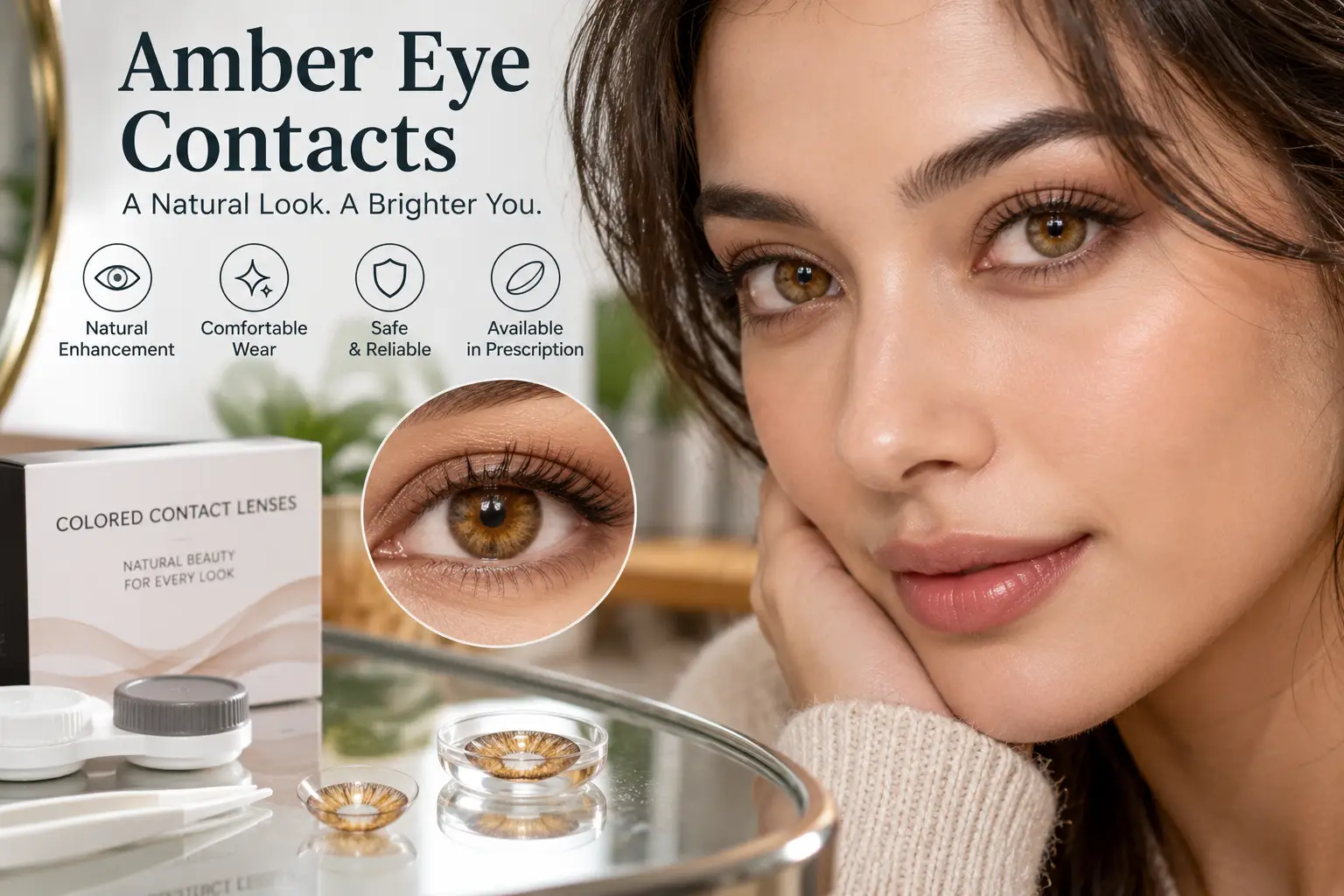
If you’ve ever scrolled past a photo of someone with warm, golden-brown eyes and wondered how they got that glow, chances are you were looking at amber eye contacts. Amber eye contacts are cosmetic or prescription lenses tinted in warm honey, copper, and gold tones designed to lighten dark eyes or add depth to lighter ones, and they’re one of the most requested colored lens shades in the US right now. Unlike a flat brown lens, a good amber tint plays with light instead of just sitting on top of your iris, which is exactly why the shade has such staying power in both everyday makeup routines and cosplay communities.
Here’s the part most shopping guides skip: not every “amber” lens on the market is actually amber. Some are really honey-brown, some lean hazel-gray, and some are theatrical-grade lenses meant for photos, not daily wear. Picking the wrong one means you either don’t see the color change you paid for, or you end up with a lens that’s uncomfortable for eight hours at your desk. This guide breaks down seven real, currently available amber eye contacts, explains what the spec sheets actually mean for your eyes, and walks through the buying decisions that Amazon listings never cover, including fit, oxygen permeability, and the FDA’s prescription rule that catches a surprising number of first-time buyers off guard. We’ll also cover how amber lenses compare to hazel and honey shades, what real wearers report after weeks of use, and how to avoid the mistakes that lead to returns or, worse, eye irritation.
This post contains affiliate links, and as an Amazon Associate, this site earns from qualifying purchases at no extra cost to you.
Amber Eye Contacts at a Glance: Quick Comparison
Before diving into full reviews, here’s a fast side-by-side look at how these seven amber eye contacts stack up on wear schedule, comfort profile, and who each one actually suits.
| Product | Wear Type | Water Content | Price Range | Best For |
|---|---|---|---|---|
| TTDeye Amber Brown | 12-month | 38% | $20–$30/pair | First-time buyers on a budget |
| Freshlook Colorblends Honey | Monthly | 55% | $25–$40/box | Daily-wear comfort seekers |
| Freshlook Colorblends Pure Hazel | Monthly | 55% | $25–$40/box | Lighter, subtler amber tint |
| Bella Amber Gray | 12-month | Not disclosed | $30–$45/pair | Cool-toned amber on dark eyes |
| EyeCandys Gemhour Demeter Amber Brown | Daily | Not disclosed | $35–$50/10-pack | Occasional or sensitive-eye wearers |
| Solotica Hidrocor Ocre | 12-month | 38% | $60–$90/pair | Premium natural-blend finish |
| ColorMax Amber | 12-month | Not disclosed | $25–$40/pair | Bold, costume-ready intensity |
Looking at the table, the pattern that jumps out is the trade-off between wear schedule and per-use cost: the daily disposable from EyeCandys Gemhour Demeter Amber Brown costs more upfront per box but eliminates the cleaning routine entirely, while the 12-month options from TTDeye Amber Brown and ColorMax Amber spread their cost out but demand a proper cleaning solution and case. If you wear colored lenses only a few times a month for events, a daily or a yearly lens with a long shelf life makes more financial sense than a monthly lens you’ll barely use before it expires.
💬 One click helps other shoppers make an informed choice too! 😊
Top 7 Amber Eye Contacts, Reviewed and Compared
Before you shop, it’s worth knowing that under FDA rules for decorative and cosmetic contact lenses, every lens on this list, including “plano” (non-corrective) versions, is legally classified as a medical device and requires a valid prescription from a licensed eye care professional in the US, regardless of your natural vision. Keep that in mind as you compare these seven picks.
1. TTDeye Amber Brown — best budget entry point
The TTDeye Amber Brown lens is where a lot of first-time colored contact wearers start, and it’s easy to see why: the price sits well below most competitors while still delivering visible color change on dark brown eyes. The lens uses a sandwich-print technology, meaning the pigment layer is embedded between two layers of lens material instead of sitting on the surface, which in practice means the tint doesn’t wear off with normal handling the way surface-printed lenses can. At 38% water content and a 14.0mm diameter, it’s built for a smaller, more concentrated color pop rather than a full sclera-style effect. Based on comparing the spec sheet to competitors in this price bracket, the trade-off is a slightly lower water content than premium options, which can mean more conscious blinking during long wear sessions for people prone to dry eyes. Reviews consistently report that the color shows up well on medium-to-dark brown eyes and that the lens feels comfortable for six to eight hours, though a handful of buyers mention mild dryness toward the end of a full day. This is a solid, low-risk way to test whether amber tones suit your coloring before spending more.
Pros:
- ✅ Noticeably lower price than most competitors
- ✅ Sandwich-print technology resists pigment fading
- ✅ FDA-compliant manufacturing per brand documentation
Cons:
- ❌ Lower 38% water content than premium picks
- ❌ Smaller diameter gives a subtler effect on lighter eyes
Priced in the $20–$30 range per pair, the TTDeye Amber Brown offers strong value for anyone testing the amber shade for the first time without committing to a premium price tag.
2. Freshlook Colorblends Honey — best daily-wear comfort
Made by Alcon, one of the largest contact lens manufacturers in the world, Freshlook Colorblends Honey uses a patented three-in-one color blend that layers three different pigment tones into a single lens instead of one flat color. What that means in practice is a warmer, more dimensional amber-honey look that shifts subtly depending on lighting, rather than the slightly flat appearance some single-tone lenses produce. At 55% water content, it’s a noticeably higher-hydration lens than most of the other entries here, which typically translates to better comfort during long wear, an important factor if you’re putting these in before a full workday. Based on comparing this spec against the rest of the field, the higher water content and monthly replacement schedule (versus 12-month lenses) mean fresher lenses more often, which some eye care professionals consider a plus for ongoing eye health. Reviews consistently highlight comfort as the standout feature, with aggregated feedback describing the lens as easy to forget about once inserted, alongside praise for how naturally the honey-amber tone blends with brown eyes. The main downside buyers report is the monthly replacement cost adding up compared to yearly lenses.
Pros:
- ✅ Alcon’s tri-tone technology adds real depth
- ✅ High 55% water content supports all-day comfort
- ✅ Trusted, long-established US contact lens brand
Cons:
- ❌ Monthly replacement costs more over a year than yearly lenses
- ❌ Less dramatic color pop than opaque theatrical lenses
At around $25 to $40 per box, Freshlook Colorblends Honey is a strong middle-ground pick for anyone prioritizing comfort and a natural blend over maximum color intensity.
3. Freshlook Colorblends Pure Hazel — best for a lighter, subtler amber
If the full honey-amber tone above feels too warm or too saturated, Freshlook Colorblends Pure Hazel is the lighter variant worth considering from the same Colorblends line. It uses the same tri-tone print technology as its sibling but with a cooler, more muted hazel-amber base, which in practice creates a softer color shift that reads more like a natural eye color variation than an obvious cosmetic change. This matters most for people who want the amber effect for everyday wear at work or school, where a dramatic shift can draw more attention than intended. What most buyers overlook with this model is that the lighter pigment tends to show up differently depending on your natural eye color: it creates a fuller transformation on lighter brown eyes and a more subtle gold fleck effect on very dark eyes. Reviews consistently mention that this shade photographs more naturally in daylight than in artificial indoor lighting, so it’s worth trying it out during the day before committing to it for an evening event. Like its sibling, it shares the 55% water content and monthly cycle, which keeps comfort high but requires more frequent reordering.
Pros:
- ✅ Softer, more office-appropriate amber-hazel tone
- ✅ Same high-comfort 55% water content formula
- ✅ Flatters both light and dark natural eye colors
Cons:
- ❌ Less visible color change on very dark brown eyes
- ❌ Monthly disposal adds up in cost over a year
Also priced between $25 and $40 per box, this is the pick for buyers who want the amber family of shades without the boldness of a full honey or theatrical tint.
4. Bella Amber Gray — best cool-toned amber for dark eyes
Bella Amber Gray takes a different approach than the warm-only lenses above by blending gray undertones into the amber base, creating a cooler, more muted gold-gray effect rather than a purely golden one. The practical effect of this blend is a lens that looks strikingly different depending on lighting: warmer and more amber in sunlight, cooler and grayer indoors, which is part of what makes this a favorite among buyers who want a shade that doesn’t read as one-note. A soft gray limbal ring (the darker outer ring around the iris) adds definition without looking harsh, which matters because overly dark limbal rings can look unnatural on lighter or medium skin tones. Based on the brand’s own aggregated review data, buyers consistently describe the lens as comfortable and note it photographs well, with multiple reviewers specifically calling out that the color “pops” more than expected on dark brown eyes. The most common critique in reviews is that the color payoff can vary noticeably between individual pairs, so it’s worth reading recent reviews close to your purchase date rather than older ones.
Pros:
- ✅ Unique gray-amber blend looks different across lighting
- ✅ Soft limbal ring adds natural-looking depth
- ✅ Consistently high aggregated comfort ratings
Cons:
- ❌ Color intensity can vary slightly between batches
- ❌ Brand doesn’t publish full water content specs
In the $30 to $45 per pair range, Bella Amber Gray earns its price for buyers specifically hunting for a less conventional, cooler-toned amber than the honey-forward options above.
5. EyeCandys Gemhour Demeter Amber Brown — best for occasional or sensitive-eye wearers
EyeCandys Gemhour Demeter Amber Brown is a daily disposable, which fundamentally changes the calculation for anyone who only wears colored contacts occasionally, like for weekend outings or photoshoots, rather than every day. The lenses are manufactured in Korea under health authority certifications including the KFDA (Korea’s version of the FDA) and CE marking, and the daily format means a completely fresh, sterile lens every single time, with zero cleaning solution or lens case required. In practice, that eliminates one of the most common causes of eye irritation among colored contact wearers: improperly cleaned or over-worn lenses. What the spec sheet doesn’t say, but the daily format implies, is that this is the lowest-risk option on this list for anyone with sensitive eyes or a history of dry eye, since you’re never wearing a lens that’s degraded from repeated handling and storage. Brand-aggregated feedback describes the amber-brown tone as one of the more natural-looking transformations in their lineup, specifically praised for working well on dark brown eyes without looking artificial. The trade-off is straightforward: paying a premium per-wear compared to monthly or yearly lenses.
Pros:
- ✅ Fresh sterile lens every wear, zero cleaning needed
- ✅ Korean health-authority certified manufacturing
- ✅ Lower irritation risk for sensitive or dry eyes
Cons:
- ❌ Highest per-wear cost of any option here
- ❌ Not economical for daily, long-term wear
At $35 to $50 for a 10-pack, this works out to a higher cost per wear, but for occasional use or first-time buyers who want to minimize risk, that premium buys real peace of mind.
6. Solotica Hidrocor Ocre — best premium, natural-blend finish
Solotica Hidrocor Ocre is the splurge pick on this list, and it comes from Solotica, a Brazilian manufacturer widely regarded within the colored contact lens community as producing some of the most natural-looking lenses available, largely because the Hidrocor line skips the dark limbal ring most other brands use. Without that ring, the color blends directly into your natural iris edge, which in practice creates a softer, more gradual transition that’s harder to spot as “obviously a colored lens” in casual conversation distance. The Ocre shade specifically leans into a grayish-amber tone rather than a pure gold, giving it a more muted, sophisticated look that differs meaningfully from the brighter honey tones earlier on this list. At 38% water content and a 14.2mm diameter with a 12-month replacement cycle, it’s built for long-term regular wear rather than occasional use. Aggregated reviews from long-time colored lens wearers consistently rank Solotica’s comfort and color realism above mass-market brands, with repeat purchases cited frequently as evidence of loyalty, though the lack of published US retail availability through major chains means buyers often source it through specialty importers.
Pros:
- ✅ No limbal ring for an exceptionally natural blend
- ✅ Muted grayish-amber tone reads as sophisticated
- ✅ Strong reputation for comfort among repeat buyers
Cons:
- ❌ Highest price point on this list by a wide margin
- ❌ Harder to source through major US retailers
Running $60 to $90 per pair, Solotica Hidrocor Ocre is the most expensive option here, but for buyers who prioritize realism above all else, the premium price reflects genuinely different lens construction, not just branding.
7. ColorMax Amber — best bold, costume-ready intensity
Where the previous six picks lean toward natural, everyday wear, ColorMax Amber is built for maximum visual impact, featuring a highly saturated amber-gold iris color paired with an intentionally dark limbal ring for dramatic definition. This is the lens to reach for if you’re aiming for a costume, photoshoot, or stage look rather than a subtle daily color shift, since the opacity is specifically engineered to show up on the darkest of eyes, including very dark brown and black. The brand markets it specifically for fashion-forward and event use rather than everyday wear, and the intensity level backs that positioning up. Aggregated customer reviews describe the color as vibrant and consistently note that it blends orange and yellow tones for a warm, attention-grabbing finish, with feedback specifically calling out that it “makes your eyes look deeper” against dark natural eye colors. Because it’s designed for shorter, occasion-based wear rather than all-day comfort, it’s worth pairing this pick with realistic expectations: this is not the lens for an eight-hour workday, it’s the lens for a night out or a themed event.
Pros:
- ✅ Maximum color intensity, even on the darkest eyes
- ✅ Dark limbal ring adds dramatic, photo-ready definition
- ✅ Consistently praised in reviews for vibrant color payoff
Cons:
- ❌ Too intense for subtle, everyday wear
- ❌ Not ideal for extended all-day comfort
At $25 to $40 per pair, ColorMax Amber delivers costume-grade drama at a mid-range price, making it the clear pick for events rather than daily rotation.
Full Spec Comparison: All 7 Amber Eye Contacts
| Product | Diameter | Replacement | Limbal Ring | Best Use Case |
|---|---|---|---|---|
| TTDeye Amber Brown | 14.0mm | 12 months | Moderate | First-time budget buyers |
| Freshlook Colorblends Honey | 14.5mm | Monthly | Tri-tone blend | Daily all-day comfort |
| Freshlook Colorblends Pure Hazel | 14.5mm | Monthly | Tri-tone blend | Subtle, office-appropriate tint |
| Bella Amber Gray | Not disclosed | 12 months | Soft gray | Cool-toned dramatic look |
| EyeCandys Gemhour Demeter | Not disclosed | Daily | Moderate | Occasional, sensitive eyes |
| Solotica Hidrocor Ocre | 14.2mm | 12 months | None | Maximum natural realism |
| ColorMax Amber | Not disclosed | 12 months | Dark, bold | Costume or event drama |
Reading across this table, the clearest dividing line is the limbal ring approach: Solotica Hidrocor Ocre skips it entirely for the most natural blend, while ColorMax Amber goes the opposite direction with a bold ring for maximum definition, and everything else on this list falls somewhere in between. If natural realism is your top priority, that limbal ring column matters more than price or wear schedule.
How to Choose the Right Amber Eye Contacts
Picking the right shade comes down to more than just liking a photo online. Here’s how to narrow it down in seven steps:
- Check your natural eye color first. Amber tints show up brightest and most true-to-photo on light-to-medium brown eyes; very dark brown or black eyes need an opaque, higher-pigment lens like ColorMax Amber or TTDeye Amber Brown to get a visible change.
- Decide how often you’ll actually wear them. Daily use favors monthly lenses like Freshlook Colorblends Honey for the balance of freshness and cost; occasional wear favors dailies like EyeCandys Gemhour Demeter Amber Brown.
- Factor in your eye sensitivity. If you have a history of dry eye or irritation, prioritize higher water content and daily disposables over 12-month lenses worn without a strict cleaning routine.
- Match intensity to occasion. Subtle, everyday tints like Freshlook Colorblends Pure Hazel suit work and school; bold, opaque tints like ColorMax Amber suit events and photoshoots.
- Budget for the full year, not just one box. A $20 pair of 12-month lenses can end up cheaper annually than a $30 monthly box, so calculate cost per month of actual wear before comparing sticker prices.
- Get properly fitted before you buy. Base curve and diameter affect comfort and safety as much as color does; a lens that fits a friend’s eyes may not fit yours.
- Confirm the seller requires a prescription. According to the American Academy of Ophthalmology, skipping this step is one of the leading causes of preventable colored-contact eye injuries.
Getting Started: Your First 30 Days With Amber Eye Contacts
The first month with any new colored lens is where most avoidable problems happen, so a little structure goes a long way. Start by wearing your new amber lenses for short two-to-three-hour stretches during the first few days rather than jumping straight to a full workday; this gives your eyes time to adjust to the slightly thicker profile that pigmented lenses have compared to clear ones. Insert lenses before applying makeup, not after, since makeup particles are a common source of contamination if they transfer onto the lens surface during handling. Build a consistent cleaning routine from day one if you’ve chosen a monthly or 12-month lens like Freshlook Colorblends Honey or Solotica Hidrocor Ocre: rub-and-rinse with fresh solution every single time, never top off old solution, and replace your case every three months. A common first-month mistake is sleeping in lenses that aren’t rated for overnight wear, which dramatically increases infection risk according to the CDC’s contact lens care guidance. If your eyes feel gritty, unusually red, or sensitive to light at any point, remove the lenses immediately and don’t reinsert them until the irritation has fully cleared. By week three or four, most wearers report the adjustment period is over and the lenses feel like a normal part of their routine.
Real-World Scenarios: Which Amber Contacts Fit Your Life
Matching a lens to your actual lifestyle matters more than matching it to a trend. If you’re a college student who wants a subtle daily color shift for classes and casual photos on a tight budget, TTDeye Amber Brown or Freshlook Colorblends Pure Hazel deliver visible results without a big financial commitment, and the lower per-unit cost forgives the occasional forgotten box. If you’re a working professional who wears lenses daily and values all-day comfort over dramatic transformation, Freshlook Colorblends Honey‘s higher water content and monthly freshness make it the more sustainable long-term choice, even though it costs more annually than a yearly lens. If you’re someone who only wears colored contacts a handful of times a year, for a convention, a themed party, or a single big event, paying a premium for a daily disposable like EyeCandys Gemhour Demeter Amber Brown or reaching for the high-drama ColorMax Amber makes more financial and hygienic sense than committing to a 12-month lens that will expire mostly unused. And if realism is non-negotiable and budget is flexible, Solotica Hidrocor Ocre‘s limbal-ring-free design is worth the premium specifically because it holds up to close-up scrutiny in a way cheaper lenses don’t.
✨ Not sure which amber shade fits your everyday look? 🔍 Compare the seven picks above against your own wear frequency and budget, then check current pricing and availability before you commit to a color.
Common Mistakes to Avoid When Buying Amber Eye Contacts
Even careful shoppers fall into a few predictable traps with colored lenses. The biggest one is buying based on the product photo alone: amber tints render very differently on camera flash versus natural daylight, and a lens that looks dazzling in a marketing image can look barely-there on your actual eye color. Another common mistake is assuming “one size fits all” with base curve and diameter; contact lenses are sized, and an ill-fitting lens can cause discomfort or slip out of position regardless of how good the color is. Buyers also frequently underestimate replacement schedules, wearing 12-month lenses well past their disinfection life or stretching daily disposables across multiple wears to save money, both of which meaningfully increase infection risk. Skipping the prescription and fitting step is the single most consequential mistake; as the FDA explains, decorative lenses obtained without a proper fitting have been linked to corneal ulcers and, in severe cases, permanent vision loss. Finally, many first-time buyers skip patch-testing a new brand before an important event, only to discover discomfort the night they need the lenses most; always trial a new pair at least a week ahead of any big occasion.
Amber Contacts vs. Hazel and Honey Contacts: What’s the Difference
“Amber,” “hazel,” and “honey” get used almost interchangeably in colored contact marketing, but they describe genuinely different color families, and knowing the difference will save you a returned order.
| Shade | Base Tone | Best Natural Eye Match | Example |
|---|---|---|---|
| Amber | Warm gold-copper | Light to medium brown | ColorMax Amber |
| Honey | Warm orange-brown | Medium to dark brown | Freshlook Colorblends Honey |
| Hazel | Mixed green-brown-gold | Any, most versatile | Freshlook Colorblends Pure Hazel |
Amber leans more purely golden and coppery, honey pulls warmer and more orange-toned, and hazel is technically a multi-tone blend that can shift between green, brown, and gold depending on lighting and what you’re wearing. In practice, if you have naturally dark brown eyes and want the boldest, most golden transformation, true amber lenses like ColorMax Amber or TTDeye Amber Brown will outperform honey or hazel options. If you want something more versatile that reads differently depending on the day, a hazel-leaning lens like Freshlook Colorblends Pure Hazel gives you more range. The takeaway: don’t assume every warm-toned lens labeled “amber” will look the same, read the specific undertone description, not just the category name.
What to Expect: Everyday Performance and Comfort
Specs on a page don’t tell you what eight hours of wear actually feels like, so here’s the translation. Higher water content lenses, like the 55% found in Freshlook Colorblends Honey and Freshlook Colorblends Pure Hazel, tend to feel noticeably more comfortable during long stretches at a screen, since dry, air-conditioned indoor environments pull moisture from lower-hydration lenses faster. Lenses in the 38% range, like TTDeye Amber Brown and Solotica Hidrocor Ocre, aren’t automatically uncomfortable, but they typically require more deliberate blinking or the occasional rewetting drop during long dry-eye-prone days. Diameter also affects everyday feel more than most buyers expect: a 14.5mm lens sits slightly differently on the eye than a 14.0mm one, and people with smaller irises sometimes find larger lenses feel looser at the edges. Color intensity has a real-world performance trade-off too, opaque, high-pigment lenses like ColorMax Amber can feel marginally thicker than lighter-tint lenses, which some new wearers notice in the first hour before adjusting. Across the board, aggregated review sentiment for every product on this list agrees on one thing: the first three to five wears are the real test, comfort tends to improve sharply after your eyes adjust to a new lens profile.
Amber Eye Contacts for Different Eye Colors and Skin Tones
Amber doesn’t perform identically across every starting eye color, and knowing this ahead of time sets realistic expectations. On light or medium brown eyes, amber tints show up closest to the marketing photos, since there’s less natural pigment to cover, making options like Freshlook Colorblends Honey and Freshlook Colorblends Pure Hazel especially effective without needing maximum opacity. On dark brown or near-black eyes, you’ll need a higher-opacity, more saturated lens to see a real shift; this is where TTDeye Amber Brown and ColorMax Amber are specifically engineered to perform, since their pigment layers are built for coverage over dark irises. Gray-eyed or hazel-eyed wearers often get a uniquely dimensional result from cooler-toned options like Bella Amber Gray, since the existing gray undertone interacts with the amber pigment differently than pure brown does. As for skin tone, warmer amber and honey shades tend to complement golden and olive undertones especially well, while cooler options like Bella Amber Gray or the muted Solotica Hidrocor Ocre often read as more flattering against cooler, pink-toned skin. None of this is a hard rule, personal preference matters more than any formula, but it’s a useful starting point if you’re choosing between two similar-looking shades online.
Safety, Regulations, and Standards
This is the section most product listings skip entirely, and it’s arguably the most important one. In the United States, every colored contact lens, prescription or not, is legally classified as a Class II medical device by the FDA, which means it requires premarket clearance and, critically, a valid prescription and professional fitting before sale. This isn’t a formality: according to the FTC’s Contact Lens Rule, sellers are required to verify prescriptions, and buying from a seller that skips this step is both illegal and genuinely risky for your eyes. The reason the rule exists is backed by real injury data: research cited by the American Academy of Ophthalmology found that wearers of non-prescription colored contacts were significantly more likely to develop keratitis, a serious corneal infection, than wearers of properly fitted prescription lenses. Beyond the legal requirement, look for lenses manufactured under recognized quality systems, several of the brands on this list reference FDA clearance, CE marking, or KFDA certification in their documentation, which signals the manufacturer is operating under an established regulatory framework rather than an unregulated import. Practically, that means always buying from a retailer that asks for your prescription details, never sharing lenses with another person even briefly, and replacing lenses and solution exactly on the schedule the manufacturer specifies, not when it’s convenient.
Problem → Solution: Fixing Common Amber Contact Lens Issues
Even with careful selection, a few issues come up often enough to plan for in advance.
Problem: The color barely shows up on your natural eye color. This usually means the lens opacity is too low for your iris darkness; switch to a higher-pigment option like ColorMax Amber or TTDeye Amber Brown rather than assuming the shade itself was wrong.
Problem: Lenses feel dry by the afternoon. Higher water content options like Freshlook Colorblends Honey tend to resolve this, along with keeping rewetting drops on hand and taking short breaks from screens.
Problem: The color looks different than the product photo. Lighting changes everything with translucent tints; check reviews and photos taken in natural daylight rather than relying solely on studio product shots before assuming the lens is defective.
Problem: Redness or irritation after a few hours. Remove the lenses immediately, switch to fresh solution and a new case, and if irritation persists beyond a day, stop wearing that pair and consult an eye care professional rather than pushing through it.
Problem: Struggling to tell your lenses apart from clear ones in the case. Store amber and any other colored pairs in clearly labeled cases; mixing up prescriptions or replacement schedules is a common and avoidable source of discomfort.
Frequently Asked Questions
❓ Do I need a prescription for amber eye contacts even if my vision is fine?
❓ Will amber contacts show up on very dark brown eyes?
❓ How long do amber eye contacts typically last?
❓ Are amber eye contacts comfortable for all-day wear?
❓ What's the best amber contact lens for a natural, everyday look?
Conclusion
Amber eye contacts range from budget-friendly daily options to premium, limbal-ring-free lenses built for close-up realism, and the right pick genuinely depends on how often you’ll wear them, how dark your natural eyes are, and how much drama you’re going for. For a low-risk first try, TTDeye Amber Brown offers real value without a big commitment. For daily, all-day comfort, Freshlook Colorblends Honey and its lighter sibling Freshlook Colorblends Pure Hazel balance hydration and natural color shift better than most competitors. If you want maximum realism and don’t mind paying for it, Solotica Hidrocor Ocre‘s limbal-ring-free design is hard to beat, and if you’re dressing for an event rather than an ordinary Tuesday, ColorMax Amber delivers the intensity to match. Whichever you choose, the single most important step isn’t picking a color, it’s getting properly fitted and prescribed by an eye care professional first; every other decision on this list is secondary to that one.
✨ Ready to find your amber shade? 🔍 Take your look to the next level with this carefully curated lineup. Click a highlighted pick to check current pricing and availability, and get eyes that turn heads without compromising comfort.
Recommended for You
- Amber Lens Glasses: 7 Best Picks for 2026 (Pros & Cons)
- Air Optix Gemstone Green: 7 Best Green Contacts to Try in 2026
- Air Optix Contact Lenses Color: 7 Best Picks for 2026
Disclaimer: This post contains affiliate links. As an Amazon Associate, I earn from qualifying purchases made through these links, at no additional cost to you.
✨ Found this article helpful? Share it with someone who needs it! 💬🤗