In This Article
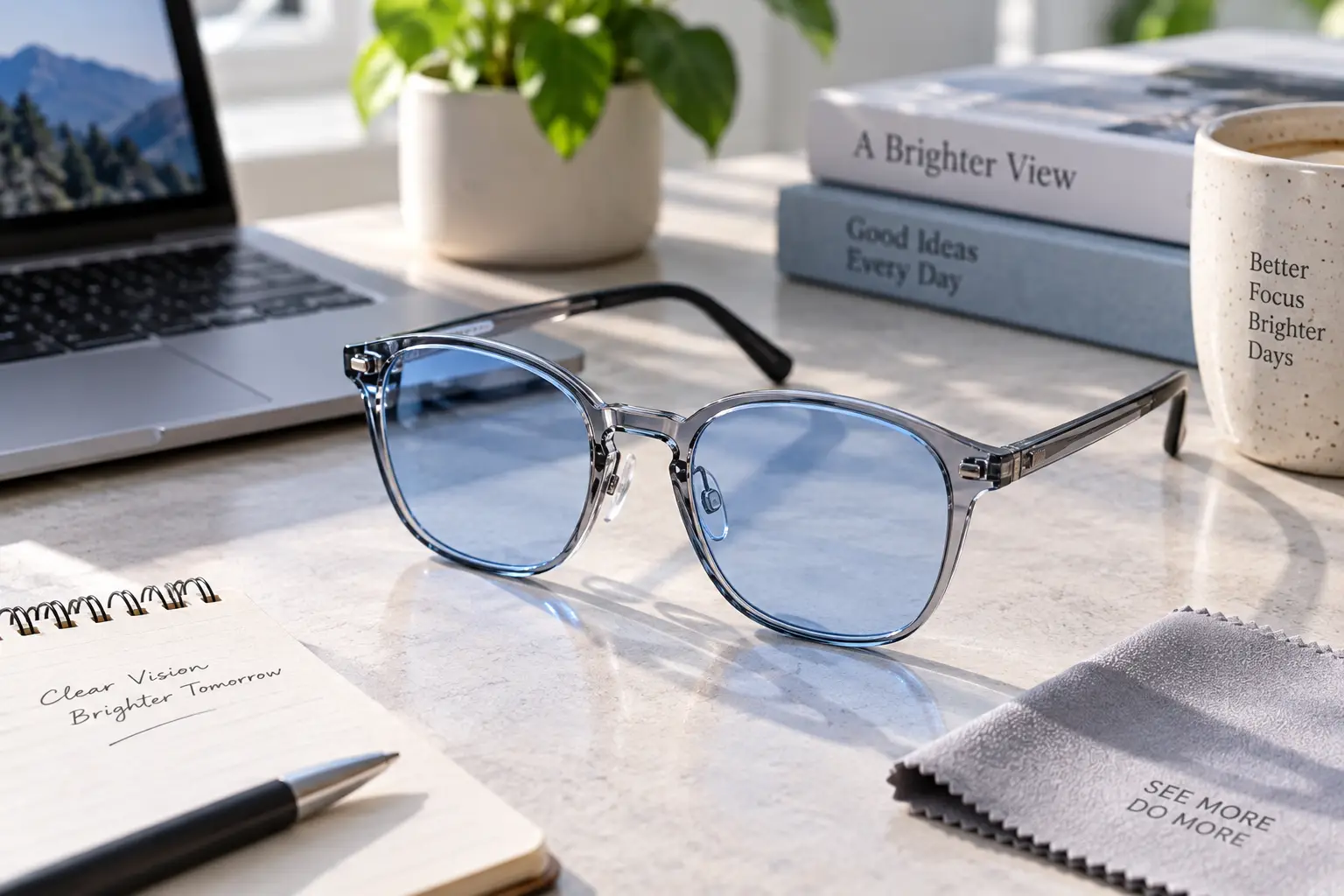
Scroll through any sunglasses aisle — online or in person — and you’ll notice blue tinted spectacles popping up everywhere, from $15 retro rounds to $300 polarized performance shades. That’s not an accident. Blue is one of the few lens colors that manages to look genuinely cool on almost every face shape while still doing real optical work, which is exactly why it’s become one of the fastest-growing categories in eyewear. So what is blue tinted spectacles, exactly? It’s an umbrella term for eyewear with lenses dyed or mirror-coated in shades ranging from icy pale blue to deep cobalt, worn both as fashion sunglasses and, less commonly, as lightly tinted everyday frames.
What most first-time shoppers don’t realize is that lens color and UV protection are two completely separate specs — a pair can look intensely blue and still offer zero real protection, or look almost clear and block 100% of UVA/UVB. That distinction matters more than the color itself, and it’s something we’ll unpack in detail below. Throughout this guide, we’ve researched seven real, currently available models spanning budget, mid-range, and premium tiers, pulled from actual spec sheets and aggregated customer feedback, so you can compare blue tinted sunglasses the way an optician would — not just by how they look in a thumbnail.
Disclosure: This post contains affiliate links, and as an Amazon Associate, we may earn from qualifying purchases at no extra cost to you.
Quick Comparison: Blue Tinted Spectacles at a Glance
Before diving into the full breakdown, here’s a fast snapshot of how the seven picks stack up on price tier, lens tech, and who each one suits best.
| Product | Price Range | Polarized | Best For |
|---|---|---|---|
| zeroUV Retro Round Blue Mirror | Under $20 | No | First-time buyers on a tight budget |
| FEISEDY Vintage Round Blue Mirror | Under $20 | Yes | Daily commuters who want polarization cheap |
| SOJOS Sierra Round Blue Mirror | $20–$30 | Yes | Style-conscious shoppers wanting a step up |
| Ray-Ban Original Wayfarer Blue Mirror | $160–$190 | Optional | Buyers who want an iconic, resellable frame |
| Ray-Ban Aviator Classic Flash Blue | $170–$200 | Optional | Fans of the classic pilot silhouette |
| Costa Del Mar Rincon Blue Mirror 580G | $280–$330 | Yes | Anglers, boaters, and outdoor pros |
| Maui Jim Kaolu Blue Hawaii | $260–$320 | Yes | Buyers who prioritize color clarity over all else |
Looking at this table, the split is pretty stark: the first three options compete almost entirely on price and style, while the last four are built around genuine optical performance you pay for. If you only wear sunglasses a few days a month for errands, the budget tier likely covers your needs; if you’re on the water, driving long distances, or wearing them daily for years, the jump to a performance lens pays for itself in comfort and durability.
💬 Ready to see these side by side? Tap any highlighted pick above to check current pricing and availability on Amazon.
Top 7 Blue Tinted Spectacles: Expert Picks for 2026
We selected these seven models to cover the full spectrum of blue tinted sunglasses shoppers actually search for — from disposable-budget fashion frames to glass-lens performance eyewear that’s built to outlast the warranty. Every entry below is a real, currently listed product with real specs, not a composite or a guess.
1. zeroUV Retro Round Blue Mirror Sunglasses — cheapest way to try the trend
If you just want to test whether blue tinted spectacles suit your face before committing real money, this is the low-risk entry point. The round metal frame is built by zeroUV, a Huntington Beach-based eyewear brand that’s built its whole catalog around budget-friendly retro styles.
Key features include a thin metal frame with a John Lennon-inspired silhouette, color-mirrored polycarbonate lenses, and UV400-rated coating. In practice, that UV400 label means the lenses block essentially all UVA and UVB radiation regardless of how light or intense the blue tint looks — a detail plenty of cheap sunglasses skip. This pair is best suited to casual, occasional wear rather than daily driving or outdoor sports, since the frame lacks the spring hinges and impact-rated lenses found on pricier options.
Reviews consistently report that the frame feels lighter than expected for the price and that the mirror coating holds up reasonably well for the first several months, though a recurring theme is that the coating can start to flake with heavy use. At under $20, this is a genuinely low-risk value pick if you mainly want the look for a season or two.
Pros:
- ✅ Extremely affordable entry point into the trend
- ✅ Lightweight metal frame is comfortable for long wear
- ✅ Genuine UV400 rating despite the low price
Cons:
- ❌ Mirror coating can degrade faster than pricier options
- ❌ No polarization, so glare cuts through on bright days
Priced under $20, the zeroUV Retro Round Blue Mirror Sunglasses deliver solid value for casual, low-commitment wear, though they’re not built for daily or high-glare use.
2. FEISEDY Vintage Round Polarized Blue Mirror Sunglasses — cheap polarization done right
FEISEDY has carved out a niche among lesser-known but consistently well-reviewed budget eyewear brands, and this round polarized pair is a good example of why. It undercuts most name brands on price while still including a genuinely useful feature: real polarization.
The polarized lens filters out horizontally reflected glare from pavement, water, and windshields, which in practice means noticeably less squinting during a sunny commute compared to the non-polarized zeroUV pick above. The frame uses a spring-hinge design, letting the temples flex outward slightly instead of snapping under pressure — a small engineering choice that meaningfully extends the life of budget frames. This model suits commuters and outdoor walkers who want functional glare reduction without spending on a premium brand name.
Aggregated customer feedback frequently highlights the spring hinges as a standout feature at this price, with buyers noting the frame survives drops and pocket storage better than expected. A smaller subset of reviews mention the nose pads feeling slightly narrow for wider face shapes.
Pros:
- ✅ Real polarization at a budget-friendly price point
- ✅ Spring hinges add real durability for the cost
- ✅ UV400 protection clearly stated on the listing
Cons:
- ❌ Nose bridge fit runs narrow for some face shapes
- ❌ Lens size may feel small for larger frames
In the $15–$20 range, the FEISEDY Vintage Round Polarized Blue Mirror Sunglasses offer one of the best value-per-dollar ratios in this whole lineup thanks to genuine polarization most competitors skip at this price.
3. SOJOS Sierra Round Polarized Blue Mirror Sunglasses — best style upgrade under $30
SOJOS has become one of Amazon’s most recognizable independent eyewear brands, and the Sierra round frame in blue mirror is a frequent pick among shoppers comparing style-forward blue lens sunglasses for women and men alike.
The acetate-and-metal hybrid frame gives it a noticeably more premium feel than pure metal frames at this price, while the polarized, gradient-mirrored lens adds visual depth that flat mirror coatings can’t match. What that gradient actually does in practice is darken the tint slightly at the top of the lens, which cuts overhead glare while keeping the lower field of view brighter — useful for reading a phone screen or menu without lifting the glasses. This pair is a strong fit for anyone who wants their sunglasses to double as a fashion statement, not just sun protection.
Reviews commonly praise the fit and the perceived “designer” look relative to the price, with several buyers noting they’ve been mistaken for a much pricier brand. A recurring critique is that the case included is fairly thin and doesn’t offer much drop protection.
Pros:
- ✅ Premium-feeling acetate frame at a budget price
- ✅ Gradient tint balances overhead glare and readability
- ✅ Popular, flattering shape for most face types
Cons:
- ❌ Included case offers minimal impact protection
- ❌ Gradient tint is less useful in low light
At around $20–$30, the SOJOS Sierra Round Polarized Blue Mirror Sunglasses land as the strongest style-to-price ratio in the budget tier, especially for buyers who want compliments as much as sun protection.
4. Ray-Ban Original Wayfarer Classic with Blue Mirror — the iconic, resellable choice
Once you cross into name-brand territory, the calculus changes: you’re paying not just for optics but for a design that’s stayed relevant since 1952 and holds resale value few fashion brands can match.
The Original Wayfarer’s acetate frame and G-15-derived blue mirror lens combine a durable, scratch-resistant lens coating with genuine 100% UV protection certified to Ray-Ban’s in-house standard. What that means practically is a frame that survives years of daily wear — being tossed in a bag, sat on occasionally, worn hiking — better than most budget acetate frames, which tend to develop hairline cracks near the hinges within a year or two. This model suits buyers who want one durable, iconic pair rather than cycling through cheaper frames every season.
Aggregated reviews across major retailers consistently mention the weight and rigidity of the frame as a highlight, alongside comments that the fit runs slightly wide on narrower faces. A common complaint in customer reviews is that non-polarized versions let more glare through on very bright days than buyers expect for the price.
Pros:
- ✅ Decades-proven design with strong resale value
- ✅ Sturdy acetate frame resists everyday wear and tear
- ✅ Certified 100% UV protection from a trusted brand
Cons:
- ❌ Non-polarized version underperforms on glare for the price
- ❌ Fit runs wide on narrower face shapes
Typically priced between $160 and $190, the Ray-Ban Original Wayfarer Classic with Blue Mirror commands a real premium, but the combination of durability and resale value makes it a legitimately different value proposition than the budget tier above.
5. Ray-Ban Aviator Classic RB3025 with Blue Flash Lenses — the pilot silhouette, reimagined
The Aviator Classic in blue flash is arguably the single most recognizable pair on this list, and it earns that recognition with a metal frame construction that’s held essentially the same shape since it was designed for U.S. military pilots in 1937.
The teardrop lens shape offers wider peripheral coverage than most round or square blue tinted spectacles, which practically translates to better side-glare blocking during driving without needing a full wraparound frame. The blue flash mirror coating sits over a green- or grey-based base lens, meaning color perception underneath stays closer to natural than some fully tinted alternatives. This pair is best suited to buyers who specifically want the aviator shape and don’t mind paying brand premium for it, since several budget alternatives replicate the silhouette for a fraction of the cost.
Reviews frequently mention that the blue lens adds a noticeable “wow factor” over the standard gold or green Aviator lens, while also noting it casts a mild color shift to the world that some buyers find takes a day or two to get used to. Buyers also commonly flag that the double-bridge design isn’t ideal for smaller face sizes.
Pros:
- ✅ Instantly recognizable, timeless aviator silhouette
- ✅ Wide lens coverage improves peripheral glare blocking
- ✅ Base lens preserves relatively natural color perception
Cons:
- ❌ Double-bridge fit is less ideal for smaller faces
- ❌ Mild color cast takes some adjustment
Expect to pay in the $170–$200 range for the Ray-Ban Aviator Classic RB3025 with Blue Flash Lenses — a fair price for buyers who specifically want the aviator shape in this finish rather than a generic dupe.
6. Costa Del Mar Rincon Blue Mirror Polarized 580G — built for water and wind
Costa Del Mar built its reputation in the fishing and boating community, and the Rincon in blue mirror with the brand’s proprietary 580G glass lens is where blue tinted spectacles stop being purely fashion and start being genuine performance gear.
The 580G lens uses glass rather than polycarbonate, which in practice delivers noticeably sharper optical clarity and better scratch resistance — a meaningful difference if you’re regularly setting sunglasses down on boat decks or rocky shorelines. Costa’s proprietary lens dye is engineered to filter specific wavelengths that enhance contrast on water, which functionally means it’s easier to spot fish, sandbars, or changes in water depth than with a standard tinted lens. This model is squarely aimed at anglers, boaters, and outdoor professionals who need durable eye protection more than they need a fashion statement, though the wraparound-adjacent shape has crossed over into everyday wear for many buyers.
Aggregated feedback from boating and fishing communities routinely praises the clarity and contrast enhancement on water as genuinely noticeable versus cheaper polarized lenses, while a recurring critique is that the glass lens adds meaningfully more weight than polycarbonate alternatives.
Pros:
- ✅ Glass 580G lens offers superior clarity and scratch resistance
- ✅ Contrast enhancement is genuinely useful on or near water
- ✅ Backed by Costa’s known durability and lifetime frame warranty
Cons:
- ❌ Noticeably heavier than polycarbonate-lens competitors
- ❌ Premium price puts it out of reach for casual buyers
Running roughly $280–$330, the Costa Del Mar Rincon Blue Mirror Polarized 580G is a specialist’s pick — expensive for casual use, but a legitimate long-term value if you spend real time outdoors on or near water.
7. Maui Jim Kaolu with Blue Hawaii Lens — best color clarity money can buy
Maui Jim’s Blue Hawaii lens finish has developed something of a cult following among sunglasses enthusiasts specifically because of how it renders color, and the Kaolu frame is one of the brand’s most popular vehicles for it.
The lens is built on a neutral grey base with a blue mirror finish layered on top, and Maui Jim’s PolarizedPlus2 technology is engineered to enhance color saturation rather than just dim overall brightness. In practical terms, that means blues and greens — sky, ocean, foliage — appear more vivid rather than muted, which is a genuinely different visual experience than a standard grey or brown tinted lens. This model is best suited to buyers who prioritize how the world looks through the lens over pure durability specs, since the mirror coating, while high quality, is applied to the outer lens surface and is the most scratch-vulnerable element of the pair.
Enthusiast reviews and community lens comparisons consistently rank the Blue Hawaii finish among the most color-accurate blue-tinted options on the market, frequently describing it as a middle ground between Maui Jim’s brighter fashion lenses and darker performance tints from competitors like Costa. A common caveat mentioned across owner discussions is that the mirror coating is not sandwiched between lens layers, making it somewhat more prone to fine scratches over years of use than encapsulated coatings.
Pros:
- ✅ Exceptional color enhancement and visual clarity
- ✅ 100% UVA/UVB/UVC blocking with PolarizedPlus2 tech
- ✅ Versatile brightness level for varied lighting conditions
Cons:
- ❌ Mirror coating is more scratch-prone than encapsulated finishes
- ❌ Among the priciest options in this roundup
Typically priced between $260 and $320, the Maui Jim Kaolu with Blue Hawaii Lens is the pick for buyers who see their sunglasses as a long-term investment in visual experience, not just sun protection.
Full Feature Comparison: All 7 Products Side by Side
| Product | Lens Material | Polarized | Frame Type | Price Range | Best For |
|---|---|---|---|---|---|
| zeroUV Retro Round Blue Mirror | Polycarbonate | No | Metal | Under $20 | Trying the trend |
| FEISEDY Vintage Round Blue Mirror | Polycarbonate | Yes | Metal | Under $20 | Budget commuters |
| SOJOS Sierra Round Blue Mirror | Polycarbonate | Yes | Acetate/Metal | $20–$30 | Style-first shoppers |
| Ray-Ban Original Wayfarer Blue Mirror | Polycarbonate | Optional | Acetate | $160–$190 | Iconic, durable pick |
| Ray-Ban Aviator Classic Flash Blue | Polycarbonate | Optional | Metal | $170–$200 | Aviator fans |
| Costa Del Mar Rincon Blue Mirror 580G | Glass | Yes | Nylon/Propionate | $280–$330 | Anglers and boaters |
| Maui Jim Kaolu Blue Hawaii | Glass/MauiPure | Yes | Acetate | $260–$320 | Color clarity seekers |
The pattern across this table is that price climbs almost in lockstep with lens material quality: polycarbonate dominates the budget-to-mid tier, while glass lenses only show up once you’re spending $250 or more. That’s a meaningful trade-off, not just a marketing tier — glass generally resists scratches better and stays optically clearer over years, but it also adds weight and fragility risk if dropped on hard surfaces. If your priority is all-day comfort for sports or travel, polycarbonate’s shatter resistance may actually beat glass despite the lower price tag.
How to Choose Blue Tinted Spectacles
Picking the right pair comes down to matching a handful of concrete specs to how you’ll actually use them, not just picking whichever blue looks best on camera. Here’s the framework we’d recommend working through in order.
- Confirm UV400 or 100% UV protection first. Regardless of tint color or darkness, this single spec determines whether the lens is actually protecting your eyes — the American Academy of Ophthalmology is explicit that color and darkness alone tell you nothing about UV blocking.
- Decide if you need polarization. If you drive, fish, or spend time near water or snow, polarized blue mirror sunglasses cut glare in a way non-polarized tints simply can’t.
- Match lens material to your use case. Polycarbonate suits sports, travel, and kids; glass suits buyers who want maximum clarity and don’t mind extra care and weight.
- Check frame material for your climate and activity level. Acetate looks premium but can loosen slightly in heat; nylon and propionate frames used in performance models resist warping better outdoors.
- Try the fit category before buying, even online. Wayfarer and round shapes tend to run wider; aviator and rectangular shapes tend to sit closer — check the listed lens width and temple length against a pair you already own.
- Set a realistic budget based on frequency of use. If you’ll wear them daily for years, a $200–$300 pair often costs less per wear than replacing a $20 pair three times a year.
- Read aggregated reviews for durability complaints specifically, not just star ratings — hinge failure and coating flaking are the most common long-term failure points across every price tier.
Blue Tinted Spectacles vs. Traditional Lens Colors
It’s worth understanding how blue tint actually compares functionally to the more traditional grey, green, brown, and amber tints that have dominated sunglasses for decades, since the differences go beyond looks.
| Lens Tint | Color Accuracy | Glare Reduction | Best Conditions |
|---|---|---|---|
| Blue mirror | Moderate-high | High (if polarized) | Bright sun, water, snow |
| Grey | Highest (true-to-life) | Moderate | All-purpose daily wear |
| Amber/yellow | Low (warms colors) | Low, boosts contrast | Overcast, low light |
| Brown/green | High | Moderate-high | Everyday and driving |
Blue tinted spectacles sit in an interesting middle ground: they generally preserve color accuracy better than amber or yellow tints, which the AAO notes are the lenses specifically associated with blue-light-blocking claims and tend to warm everything toward yellow-orange, but they don’t quite match true grey lenses for neutral color rendering. Where blue genuinely pulls ahead is bright, high-glare environments like open water or snow, especially in mirrored, polarized form — the reflective coating cuts a meaningfully higher percentage of visible light than a flat tint of the same darkness. For daily driving in mixed conditions, though, a classic grey or brown-green lens still edges out blue on pure versatility.
✨ Find your perfect shade today!
🔍 Take your eyewear collection to the next level with a pair matched to your lifestyle, not just your Instagram feed. Click a highlighted pick above to check current pricing and availability. The right pair will keep your eyes protected and your style sharp all year long!
Getting the Most From Your New Blue Tinted Spectacles
Buying the right pair is only half the equation — how you break them in and maintain them during the first month determines whether they last two years or twenty.
Start by cleaning the lenses only with the microfiber cloth included or a dedicated lens spray; paper towels and shirt hems introduce fine scratches almost immediately, especially on mirror-coated lenses like several picks above. In the first week, avoid setting the glasses lens-down on any hard surface — mirror coatings are applied to the outer lens face and are genuinely more vulnerable than the base tint underneath, something owners of the Maui Jim Kaolu with Blue Hawaii Lens specifically flag in long-term reviews. Store them in a hard case rather than a soft pouch when tossing them in a bag, since compression is one of the leading causes of frame misalignment in the first 30 days.
If the frame feels slightly loose at the temples after the first few wears, that’s normal for acetate models like the Ray-Ban Original Wayfarer Classic with Blue Mirror — the material softens marginally with body heat, and most opticians can do a quick, often free, heat adjustment to restore a snug fit. For metal-framed budget picks, periodically check and gently tighten the hinge screws with a micro eyeglass screwdriver, since loose hinges are the single most common early failure point across every price tier in this guide.
Real-World Scenarios: Matching the Pair to the Person
Seeing how these picks map onto actual buyer situations often makes the decision clearer than specs alone.
Consider a college student commuting by bike and on foot across a mostly overcast Midwest campus, working with a tight budget and needing glasses that survive being tossed in a backpack daily. The FEISEDY Vintage Round Polarized Blue Mirror Sunglasses fit this profile well — real polarization for the occasional bright day, spring hinges that survive backpack abuse, and a price low enough that losing a pair isn’t a financial disaster.
Now picture a weekend angler who fishes coastal waters twice a month and has grown frustrated with cheap sunglasses that scratch within a season. For that buyer, the Costa Del Mar Rincon Blue Mirror Polarized 580G is worth the jump in price — the contrast enhancement on water and glass-lens durability solve the exact problems that sent them shopping for an upgrade in the first place.
Finally, think about a design-conscious professional who wants a single, versatile pair for both commuting and weekend brunch, values brand recognition, and wears sunglasses almost daily for years. The Ray-Ban Aviator Classic RB3025 with Blue Flash Lenses matches that use case — durable enough for daily wear, recognizable enough to double as a style statement, and priced to make sense as a multi-year investment rather than a disposable accessory.
Problem → Solution: Fixing Common Blue Tinted Spectacles Issues
Even a well-chosen pair runs into predictable snags. Here’s how to solve the ones we see most often in aggregated customer feedback.
Problem: The mirror coating is flaking or wearing thin. This is most common on budget polycarbonate lenses like those on the zeroUV Retro Round Blue Mirror Sunglasses. Solution: always store the lenses face-up or in a hard case, and avoid cleaning with anything but a microfiber cloth — coating degradation is almost always accelerated by abrasive contact, not just age.
Problem: Glare still gets through on very bright days. This typically means the pair isn’t polarized, which applies to the base configurations of both Ray-Ban picks above. Solution: opt for the polarized version at checkout when available, or reserve non-polarized frames for driving and reserve polarized picks like the SOJOS Sierra Round Polarized Blue Mirror Sunglasses for water, snow, or open-road glare.
Problem: The frame feels loose after a few weeks. Almost always a hinge or acetate-softening issue. Solution: tighten hinge screws on metal frames, and for acetate frames, a quick in-store heat adjustment (often free at any optical shop, not just where you bought them) resolves it in minutes.
Problem: Colors look unnaturally shifted through the lens. This is expected with heavier mirror coatings and isn’t a defect — it’s a function of how the tint filters wavelengths. Solution: if true color accuracy matters more to you than style, a lighter or more neutral-based blue mirror like the Maui Jim Kaolu with Blue Hawaii Lens minimizes this shift far better than heavily mirrored budget options.
Common Mistakes to Avoid When Buying Blue Tinted Spectacles
The biggest mistake we see is assuming a darker or more intensely colored lens automatically means better sun protection — it doesn’t, and the AAO is direct about the fact that tint darkness has no bearing on UV blocking. A closely related error is skipping the UV400 label entirely because a listing photo looks convincing; always confirm that spec explicitly in the product description, not just the marketing copy.
Another frequent misstep is buying based purely on frame shape trends without checking lens width and temple length against glasses you already own comfortably, which is how buyers end up with a pair that looks great online but pinches at the temples. Shoppers also commonly underestimate how much polarization matters for their specific use case — skipping it to save $10–$20 on a pair meant for daily driving is a false economy once you’re squinting through glare on every commute. Finally, don’t assume all “blue tinted glasses” listings are sunglasses; a meaningful share of Amazon search results for this term are actually amber-lens computer glasses mislabeled or cross-listed under “blue light” terminology, so double-check the actual lens color in the photos before adding to cart.
What to Expect: Everyday Performance
On paper, a blue mirror lens and a grey lens might list similar VLT (visible light transmission) percentages, but they feel different in daily use. Blue tinted spectacles tend to feel slightly brighter and more energetic underfoot in overcast-to-partly-sunny conditions, since the tint doesn’t darken the whole visual field as uniformly as grey — that’s part of why the trend has taken off for everyday fashion wear rather than staying confined to sport-specific eyewear.
Where the difference becomes more noticeable is in transitional lighting, like walking from bright outdoor light into a dim store. Polarized options like the SOJOS Sierra Round Polarized Blue Mirror Sunglasses adjust more comfortably in these moments because they’re cutting glare rather than just dimming brightness uniformly, whereas non-polarized options like the base zeroUV Retro Round Blue Mirror Sunglasses can feel like they need a few extra seconds for your eyes to adjust. For anyone doing a lot of driving at dusk or in mixed light, this is worth testing in person before committing to a non-returnable purchase.
Blue Tinted Spectacles for Different Lifestyles
Different buyer profiles genuinely benefit from different picks in this lineup, and matching lifestyle to lens spec avoids a lot of buyer’s remorse.
For shoppers specifically searching blue tint glasses for men in a classic, professional-leaning silhouette, the Ray-Ban Aviator Classic RB3025 with Blue Flash Lenses consistently tests well across style guides for its versatility between business-casual and weekend wear. For those searching blue lens sunglasses for women with a softer, more fashion-forward shape, the SOJOS Sierra Round Polarized Blue Mirror Sunglasses and the zeroUV Retro Round Blue Mirror Sunglasses both lean into rounder, retro silhouettes that have trended heavily in recent seasons.
Outdoor and fitness-focused buyers — runners, cyclists, hikers — are generally better served by the lighter, more impact-resistant polycarbonate builds like FEISEDY or Costa Del Mar‘s performance-oriented Rincon, since glass lenses like the Maui Jim Kaolu with Blue Hawaii Lens, while optically excellent, carry more risk if dropped during high-movement activities. Buyers who mainly want a statement accessory for social settings, meanwhile, get the most return on the mid-tier acetate frames, where the visual “wow factor” per dollar spent is highest.
Long-Term Cost and Maintenance
It’s tempting to compare these seven picks purely on sticker price, but total cost of ownership tells a different story once you factor in replacement frequency and repair costs.
| Tier | Typical Lifespan | Replacement Frequency | Rough 5-Year Cost |
|---|---|---|---|
| Budget (zeroUV, FEISEDY, SOJOS) | 6–18 months | 3–5 pairs | $60–$100 |
| Mid (Ray-Ban) | 3–6 years | 1–2 pairs | $170–$300 |
| Premium (Costa, Maui Jim) | 5–10+ years | Rarely replaced | $260–$330 |
Run the math over five years and the gap narrows considerably: budget frames often cost nearly as much cumulatively as a single mid-tier Ray-Ban purchase, once you account for buying multiple replacement pairs as coatings flake or hinges fail. Premium picks like the Costa Del Mar Rincon Blue Mirror Polarized 580G front-load the cost but frequently outlast every other tier entirely, especially since brands like Costa and Maui Jim typically offer frame warranties and discounted lens replacement programs that budget brands don’t provide. If you know you’ll wear sunglasses daily for years, the premium tier is arguably the better long-term value despite the higher upfront number.
Safety, Regulations, and Standards
U.S. sunglasses, regardless of tint color, are subject to a baseline federal impact-resistance requirement enforced by the FDA, meaning every legitimately sold pair — including every product featured in this guide — must survive a standardized impact test without fracturing. That’s a separate standard from UV protection claims, which aren’t independently verified by a government body the way impact resistance is, making the UV400 or “100% UV protection” label on the product listing your main point of verification as a shopper.
Beyond the federal baseline, voluntary standards from the American National Standards Institute (ANSI Z80.3) guide how manufacturers test and label UV protection, lens haze, and impact resistance, and reputable brands across every price tier in this guide reference compliance with it. It’s also worth noting, per guidance from the American Optometric Association, that polarization and UV protection are independent features — a polarized lens does not automatically block UV rays unless the listing specifically states it does, so it’s worth confirming both specs separately rather than assuming one implies the other.
Frequently Asked Questions
❓ Are blue tinted spectacles good for driving?
❓ Do blue lenses block harmful blue light from screens?
❓ Can I get blue tinted spectacles with a prescription?
❓ Is polarization worth the extra cost for blue mirror sunglasses?
❓ How do I know if blue tinted spectacles actually block UV rays?
Conclusion
Blue tinted spectacles have earned their popularity honestly — done well, they genuinely combine distinctive style with real optical performance, not just a trendy color swap on an otherwise standard lens. The right pick for you comes down to matching a few concrete specs, not just the shade of blue, to how you’ll actually use them: budget polycarbonate frames like the zeroUV Retro Round Blue Mirror Sunglasses and FEISEDY Vintage Round Polarized Blue Mirror Sunglasses make smart entry points for casual or occasional wear, iconic acetate and metal frames from Ray-Ban offer a durable middle ground for daily use, and glass-lens performance picks from Costa Del Mar and Maui Jim reward buyers who wear sunglasses constantly and want a pair that lasts years rather than seasons.
Whichever tier fits your budget and lifestyle, the two specs worth verifying before you buy — every single time — are UV400 protection and, if glare matters to your daily routine, genuine polarization. Everything else, from frame shape to exact shade of blue, comes down to personal taste, and every pick in this guide gives you a real, honestly reviewed option to start from.
Recommended for You
- Sunglasses With Blue Lenses: 7 Best Picks for 2026 (Pros & Cons)
- 7 Best Square Circle Glasses for a Stylish Look in 2026
- Sleeping Glasses: 7 Best Picks to Finally Sleep Better in 2026
Disclaimer: This post contains affiliate links. As an Amazon Associate, I earn from qualifying purchases made through these links, at no additional cost to you.
✨ Found this article helpful? Share it with someone who needs it! 💬🤗