In This Article
Oncoming headlights hit different once you’re past 40 — that faint starburst around every LED suddenly feels like a spotlight aimed straight at your eyes. If you’ve searched for the best eyeglasses for night driving, you’re probably tired of guessing which pair actually cuts glare and which one is just a yellow-tinted placebo in a nice case. This guide skips the marketing copy and goes straight to what’s verifiable: real products sold on Amazon, real aggregated review sentiment, and — because this category has a genuinely controversial safety record — what eye doctors and federal regulators have actually found when they tested these claims.
You’ll find seven real, current options here, from budget-friendly clip-on sets to premium polarized wraparounds and one non-tinted alternative that ophthalmology sources tend to favor. Every pick is broken down by lens type, fit, and who it actually suits, plus honest pros and cons pulled from how people really use these glasses. We’ll also cover how to choose the best eyeglasses for night driving based on your specific vision needs, common buying mistakes, and — importantly — what the research says about whether yellow-tinted lenses help or quietly work against you. By the end, you’ll know exactly which pair (if any) fits your situation, and why.
Quick Comparison: Top Night Driving Glasses at a Glance
| Product | Lens Type | Best For | Price Range |
|---|---|---|---|
| Optix 55 Polarized Night Driving Glasses | Yellow polarized, Revo coating | Most drivers, all-around pick | Around $25–$35 |
| Headlight Glasses with Polarized LED GlareCut Technology | Yellow polarized fit-over | Prescription glasses wearers | Around $30–$45 |
| URUMQI Night Vision Driving Glasses | 5-lens interchangeable set | Versatility and value | Around $20–$30 |
| ZILLERATE Night Vision Driving Glasses | Yellow polarized, HD | Tight budgets | Under $20 |
| Kelinln Night Vision Driving Glasses | Yellow polarized, nano coating | Lightweight everyday wear | Around $15–$22 |
| BLUPOND Night Driving Glasses (Knight Visor) | Yellow wraparound | Sporty, wide field of view | Around $18–$26 |
| BLUEMOKY Blue Light Reading Glasses | Clear, anti-reflective | Skeptics of tinted lenses | Around $20–$30 |
Looking at the table above, the Optix 55 Polarized Night Driving Glasses land in the sweet spot most shoppers want: proven polarization, a reasonable price, and broad brand recognition on Amazon. If you already wear prescription glasses, the fit-over design of the Headlight Glasses with Polarized LED GlareCut Technology solves a problem the other picks don’t. And if you’d rather sidestep the tinted-lens debate entirely, the BLUEMOKY Blue Light Reading Glasses are worth a closer look before you buy anything yellow.
💬 Ready to see your options side by side? Scroll down to compare all seven picks in detail below!
Top 7 Eyeglasses for Night Driving: Expert Analysis
1. Optix 55 Polarized Night Driving Glasses — best all-around balance of glare control and price
The Optix 55 has built a reputation as one of the most consistently recommended options in this category, and it earns that spot through a fairly simple formula: yellow-tinted lenses paired with genuine polarization rather than a plain tint alone. The lenses use a Revo-style coating over a thin polarized layer, which is designed to knock down the horizontal glare that bounces off wet asphalt and windshields specifically — a different mechanism than the tint alone provides. In practice, this means the glasses are doing double duty: the yellow tint boosts perceived contrast against a dark background, while the polarization targets reflected glare from rain-slicked roads. That combination is why we’re recommending it as the default pick for most drivers rather than a niche pick for one condition. Buyers who mostly deal with wet-weather night drives or bright LED headlights tend to notice the difference more than someone doing dry, well-lit highway miles.
Reviews consistently mention the durable PC frame and rubberized temple grip holding up well over months of glove-box storage and daily on-off use, and the included EVA case gets called out often as sturdier than expected for the price. A recurring complaint in customer feedback is that the yellow tint is noticeably strong, which some wearers love and others find makes colors look washed out at first. That’s worth knowing going in rather than being surprised by it.
Pros:
- ✅ Genuine polarization, not just a yellow tint
- ✅ Durable frame that holds up to daily use
- ✅ Comes with a protective hard-shell-style case
Cons:
- ❌ Strong tint can mute color perception
- ❌ Not adjustable for prescription wearers without a fit-over
Priced around $25–$35 at the time of writing, the Optix 55 Polarized Night Driving Glasses deliver solid build quality and a real polarized lens for a price that undercuts most drugstore options — reasonable value if you’re going to wear them regularly rather than toss them in a drawer.
2. Headlight Glasses with Polarized LED GlareCut Technology — best for people who already wear prescription glasses
This pair is built specifically to solve the problem that trips up a lot of glasses wearers: most night driving glasses assume you have bare eyes underneath. The “GlareCut” fit-over design is sized generously enough to sit comfortably over the vast majority of standard prescription frames, so you’re not choosing between seeing clearly and cutting glare. The polarized yellow lens layer sits further from your eyes than a standalone pair, which reduces the risk of the lens fogging against your prescription lenses on cold nights — a small but genuinely practical detail for anyone who’s dealt with foggy glasses at a stoplight.
What most buyers overlook with fit-over designs generally is peripheral coverage, and this is where the wraparound shape earns its keep — it blocks stray light from the sides, not just straight ahead, which matters more than people expect once you’re actually driving with oncoming traffic in your peripheral vision. Aggregated reviews describe the fit as surprisingly comfortable for a fit-over style, though a subset of reviewers with larger or thicker prescription frames report a snugger fit than advertised, so it’s worth double-checking your current frame’s width before ordering.
Pros:
- ✅ Purpose-built to fit over prescription glasses
- ✅ Wraparound shape blocks peripheral glare too
- ✅ Reduced fogging risk versus tight-fitting fit-overs
Cons:
- ❌ Snug fit reported with wider prescription frames
- ❌ Bulkier profile than standalone glasses
At around $30–$45, the Headlight Glasses with Polarized LED GlareCut Technology cost more than most entries here, but for prescription wearers, the alternative is usually a second pair of prescription sunglasses running several times that price — which makes this a legitimately strong value proposition for the right buyer.
3. URUMQI Night Vision Driving Glasses — best value if you want options beyond just yellow
The URUMQI set stands out for a different reason than pure glare reduction: it’s sold as a multi-lens system, typically bundled with several tint options including the yellow lens built for night driving, alongside darker options for daytime glare. That versatility is the honest selling point here — you’re not locked into one tint if your needs change between a bright afternoon commute and a dim rural drive home. The lenses are also designed to work as both standalone glasses and as an over-glasses option, similar in spirit to the fit-over pick above but with more flexibility in tint choice.
Here’s what to weigh with a multi-lens bundle like this: you’re paying for the whole set, and if you only ever plan to use the yellow night-driving lens, you’re effectively paying a premium for tints you’ll rarely touch. On the other hand, if your household has multiple drivers with different glare sensitivities, or you want a spare pair for the car and one for the house, the bundle math works out better than buying single-tint glasses twice. Reviews reflect this split: buyers who use the full set rate it highly for versatility, while single-use buyers sometimes note it feels like overkill.
Pros:
- ✅ Multiple lens tints for different lighting conditions
- ✅ Works as standalone or over-glasses
- ✅ Strong value if you’ll use more than one tint
Cons:
- ❌ Overkill if you only want the yellow night lens
- ❌ Multiple lenses mean more pieces to keep track of
Running around $20–$30 for the full set, the URUMQI Night Vision Driving Glasses offer some of the best per-lens value in this roundup, provided you’ll actually rotate through the different tints rather than let most of them sit unused.
4. ZILLERATE Night Vision Driving Glasses — best budget entry point
If you’re not ready to commit real money to a category with a genuinely mixed research record (more on that later), the ZILLERATE is a sensible place to start. It sticks to the category basics — a yellow-tinted, polarized lens in an HD-branded coating, set in a lightweight frame — without the added bulk of a fit-over design or the cost of a multi-lens bundle. The polarization here follows the same principle as the pricier picks: it’s aimed at cutting reflected glare off wet roads and glossy surfaces, not just dimming everything uniformly like a plain sunglass tint would.
Because this is a budget pick, the honest trade-off shows up in the frame hardware rather than the lens concept — hinges and nose pads on inexpensive frames in this category tend to loosen faster with daily glove-box or bag storage than the pricier options above. Reviewers largely treat these as a low-commitment way to test whether tinted night glasses work for their eyes before spending more, which is a reasonable way to use this pick. If you find the effect genuinely helpful after a few weeks, upgrading to a more durable frame later is a low-risk decision.
Pros:
- ✅ Lowest price point in this roundup
- ✅ Same core yellow-polarized concept as pricier picks
- ✅ Lightweight, easy to keep in a glove box
Cons:
- ❌ Hinges and nose pads feel less durable long-term
- ❌ No fit-over option for prescription wearers
At under $20, the ZILLERATE Night Vision Driving Glasses are close to an impulse buy, and that’s the point — a low-risk way to find out if this category works for you before spending more.
5. Kelinln Night Vision Driving Glasses — lightest frame for everyday wear
The Kelinln pair leans into comfort over anything flashy, using a lightweight resin frame with one-piece nose pads specifically designed to avoid pinching hair or pressure points during long drives — a small detail that matters more than it sounds like on a two-hour night drive. The lens itself is listed at roughly +1.1mm polarized with a nano-factor coating, which the brand states filters around 20% of glare at night. That’s a specific, checkable claim rather than vague marketing language, and it lines up with how yellow polarized lenses in this price bracket generally perform — meaningful glare reduction, not elimination.
What most buyers overlook with lightweight frames like this is that they double as daytime polarized sunglasses too, since the same lens that cuts headlight glare at night also cuts glare off pavement and windshields during the day. That dual-use angle is a genuine practical upside if you only want to carry one pair of glasses in the car rather than switching between day and night eyewear. Aggregated reviews frequently mention the square, “futuristic” frame shape as a style plus, with occasional notes that the fit runs slightly narrow for larger head sizes.
Pros:
- ✅ Genuinely lightweight, comfortable for long drives
- ✅ Doubles as daytime polarized sunglasses
- ✅ Specific, checkable glare-reduction claim from the brand
Cons:
- ❌ Frame runs narrow for larger head sizes
- ❌ Square style won’t suit every face shape
At around $15–$22, the Kelinln Night Vision Driving Glasses offer strong comfort-per-dollar, especially if you want one pair that pulls double duty for day and night glare.
6. BLUPOND Night Driving Glasses (Knight Visor) — best wraparound for a wide field of view
The BLUPOND “Knight Visor” takes a different frame approach than the rest of this list: a wraparound shield-style lens rather than a traditional two-lens frame. The practical upshot is a noticeably wider field of coverage, which matters specifically for night driving because stray glare doesn’t just come from straight ahead — it comes from streetlights and oncoming high beams entering from the side of your vision too. A standard frame leaves gaps at the temples where that light can sneak in; a wraparound shield largely closes that gap.
Based on comparing the frame styles across this roundup, the trade-off for that wider coverage is a bulkier, more sport-glasses look that reads less like everyday eyewear and more like something you’d wear cycling — worth knowing if you care about how you look wearing these on a date-night drive versus a solo commute. Reviews tend to split along exactly that line: drivers who prioritize function over style rate it highly for coverage, while a smaller group notes they only wear it on longer road trips rather than daily.
Pros:
- ✅ Wide wraparound coverage blocks side glare
- ✅ Shield-style lens design in a single piece
- ✅ Well-suited to long highway or road-trip drives
Cons:
- ❌ Sportier look, less discreet than standard frames
- ❌ Bulkier to store in a jacket pocket
Priced around $18–$26, the BLUPOND Night Driving Glasses are a solid value pick specifically for drivers who log a lot of rural or highway night miles where side glare is a bigger factor.
7. BLUEMOKY Blue Light Reading Glasses — best non-tinted alternative for skeptics
This pick is intentionally the outlier on this list, and that’s by design. The BLUEMOKY glasses are not yellow-tinted at all — they’re a clear-lens, anti-reflective-coated pair originally marketed for blue-light filtering during screen use, which several independent product reviewers have since recommended as a night driving alternative precisely because they don’t darken your vision the way a tinted lens does. The spec sheet doesn’t say this outright, but the underlying idea lines up with what eye doctors tend to actually recommend: an anti-reflective coating without added tint, so you get some reduction in lens-surface glare without also cutting the total light reaching your eye — which is the core criticism leveled at yellow night-driving lenses (more on that in the safety section below).
Independent testing found these glasses have little effect on halogen headlights specifically, but a more noticeable dampening effect on the harsher glare from modern LED headlights, which matches what you’d expect from an anti-reflective coating rather than a tint doing the work. If you’ve read that tinted night glasses are controversial and want an option that sidesteps the debate entirely, this is the pick to consider — with the honest caveat that it won’t produce the dramatic “wow, everything looks brighter” effect that yellow lenses are marketed around, because it isn’t designed to.
Pros:
- ✅ No tint, so no reduction in overall light reaching your eyes
- ✅ Noticeable dampening of harsh LED headlight glare
- ✅ Doubles as daytime blue-light glasses for screens
Cons:
- ❌ Little to no effect on older halogen headlights
- ❌ Less dramatic perceived effect than tinted alternatives
At around $20–$30, the BLUEMOKY Blue Light Reading Glasses are a smart pick for the research-conscious buyer who wants a defensible, honest choice rather than the flashiest marketing claim on the shelf.
How to Get the Most Out of Your Night Driving Glasses
Buying the right pair is only half the equation — how you use them matters just as much. Start by wearing your new glasses on a familiar, low-traffic route the first few times rather than a busy unfamiliar highway, so you can judge the effect without added pressure. Keep the lenses genuinely clean; a smudged yellow lens amplifies glare rather than reducing it, which defeats the purpose almost entirely and is one of the most common reasons people report disappointing results.
If you wear prescription lenses, confirm your fit-over pair actually clears your frame without pinching before you’re on the road at night — test it parked in your driveway first. Store your glasses in the included case rather than loose in a glove box, since scratched lenses scatter light and make glare noticeably worse over time, not better. Finally, give any new pair a real two-week trial across a mix of conditions — dry highway, rainy back roads, dense city traffic — before deciding whether the effect is worth keeping up. A single test drive isn’t enough data to judge a $20–$40 purchase fairly, and your eyes need a few sessions to register whether the change is actually helping or just feels different.
Real-World Scenarios: Matching Glasses to Your Nighttime Habits
Picture three different drivers and how their needs actually diverge. First, a rural commuter who drives 40 minutes home each evening on unlit two-lane roads with frequent oncoming high beams — for this profile, the wide-coverage BLUPOND Night Driving Glasses make the most sense, since side-glare protection matters most on exactly this kind of road, which NHTSA research specifically flags as the worst-case scenario for nighttime glare.
Second, a glasses-wearing parent who only drives at night occasionally, mostly for evening pickups and the odd road trip — the fit-over Headlight Glasses with Polarized LED GlareCut Technology solve the core problem (wearing two pairs of glasses at once) without requiring a switch to contacts. Third, a budget-conscious rideshare driver logging several hours of night driving weekly across mixed conditions — here, the value case favors either the URUMQI Night Vision Driving Glasses multi-lens set for its day/night flexibility, or the research-friendly BLUEMOKY Blue Light Reading Glasses if that driver has read the mixed research and wants to avoid the light-reduction trade-off tinted lenses carry during long shifts.
What Is the Best Eyeglasses for Night Driving?
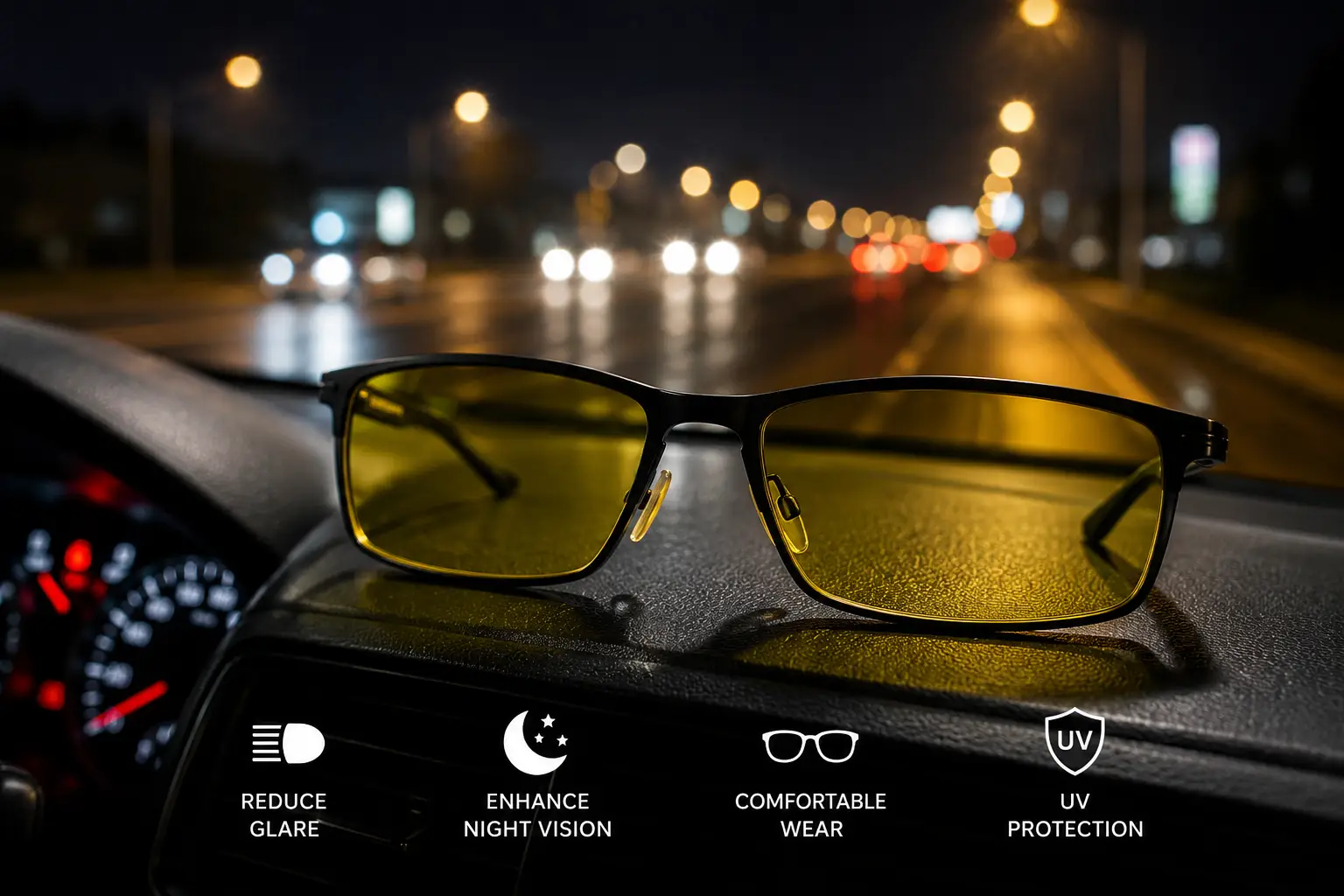
The best eyeglasses for night driving are non-prescription lenses — most commonly yellow-tinted, polarized, or clear with an anti-reflective coating — designed to reduce glare and improve contrast when driving after dark. They work by either limiting the amount of scattered or reflected light reaching your eyes or by boosting perceived contrast against a dark background, though their real-world effectiveness is genuinely debated among eye care professionals.
How to Choose the Best Eyeglasses for Night Driving
- Start with your baseline vision. If you already wear prescription glasses, decide upfront whether you want a fit-over design or non-prescription lenses ground to your prescription, since this eliminates half the options immediately.
- Match the lens type to your main complaint. If oncoming headlights specifically bother you, look at polarized options; if you’re more sensitive to overall dimness, consider a non-tinted, anti-reflective pair instead.
- Consider your typical road type. Frequent two-lane, rural, or unlit driving benefits more from wraparound coverage than city driving with consistent street lighting.
- Check the fit before you buy. Measure your current frame width if you’re considering a fit-over style, since an ill-fitting pair creates its own distracting glare from stray light at the edges.
- Read the aggregated reviews, not just the star rating. Look specifically for repeated mentions of frame durability and comfort over multiple weeks, not just first-impression comments.
- Set a realistic budget. Given the mixed research on this category (see below), it’s reasonable to start with a budget pick before committing to a premium pair.
- Talk to an eye doctor if your night vision has noticeably declined. Glasses of any kind won’t fix an underlying issue like early cataracts, and a comprehensive eye exam is the only way to rule that out.
Common Mistakes to Avoid When Buying Night Driving Glasses
The most common mistake is assuming a darker tint automatically means better glare protection — in reality, a lens that’s too dark for nighttime light levels can reduce your overall visibility rather than improve it, which is exactly the concern eye doctors raise about this category. A second frequent mistake is buying a fit-over pair without checking your current frame’s dimensions, leading to returns once the glasses arrive too tight or too loose.
Shoppers also commonly skip the “condition test” — trying the glasses across dry, rainy, and foggy nights before judging them — and instead form an opinion after a single short drive, which isn’t enough exposure to fairly evaluate a $20–$40 purchase. Finally, a subtler mistake is treating night driving glasses as a substitute for basic maintenance: a dirty windshield or misaligned headlights will undercut any pair of glasses you buy, so it’s worth ruling those out first.
Night Driving Glasses vs. Anti-Reflective Prescription Lenses
| Factor | Night Driving Glasses (Yellow/Polarized) | Anti-Reflective Prescription Lenses |
|---|---|---|
| Cost | Around $15–$45 | Often $50–$150+ as a lens add-on |
| Vision correction | None (non-prescription) | Corrects your actual prescription |
| Glare mechanism | Tint + polarization | Coating only, no tint |
| Light transmission | Reduced (tinted) | Minimal reduction |
| Eye doctor consensus | Mixed/controversial | Generally supported |
The table above highlights the core trade-off: non-prescription night driving glasses are cheaper and more convenient to try, but anti-reflective coating on your actual prescription lenses is the option eye care professionals more consistently support, since it cuts lens-surface glare without also darkening your overall vision. If you already wear prescription glasses full-time, asking your optometrist to add anti-reflective coating at your next lens replacement is arguably a better long-term investment than a separate pair of tinted glasses. For occasional night drivers without a prescription, though, a dedicated pair from this list remains the more practical and affordable starting point.
✨ Not sure which route fits your budget? Compare a few options above and see what matches your driving habits best!
Do Night Driving Glasses Actually Work? Safety, Regulations, and the Research
This is the section most articles in this space skip, and it matters. The effectiveness of yellow-tinted night driving glasses is genuinely disputed. The American Academy of Ophthalmology has published guidance warning that tinted or polarized lenses marketed for night driving reduce the total amount of light reaching your eyes — which can make it harder, not easier, to see in genuinely dark conditions, even if the glare from a single headlight feels more comfortable in the moment. A 2019 study published in JAMA Ophthalmology similarly found that yellow-lens glasses did not improve — and in some cases slightly slowed — pedestrian detection during simulated night driving with headlight glare.
This isn’t a new concern, either. Back in 1997, the Federal Trade Commission settled charges against a marketer of “NightSafe” glasses over unsubstantiated claims that the product made night driving safer, requiring the company to stop implying the glasses improved night vision. That history is worth knowing before you buy: no night driving glasses on the market today, including every pick in this article, are FDA-cleared or independently proven to make you safer at the wheel. What they can do, based on aggregated user experience, is make glare more comfortable for some drivers — comfort and proven safety improvement are not the same claim, and this article won’t blur that line.
Given that, the highest-leverage safety steps remain the boring but proven ones: the National Safety Council notes that depth perception, color recognition, and peripheral vision are all naturally reduced at night regardless of eyewear, and recommends keeping your windshield and headlights clean and getting your eyes checked annually as you age, since glare sensitivity tends to increase after 45. NHTSA research additionally found that two-lane roads present the worst-case scenario for glare due to closer oncoming traffic and lower ambient light — a useful data point if you’re deciding whether wraparound coverage like the BLUPOND pick is worth it for your specific commute. If your night vision has meaningfully worsened, that’s a conversation for an eye doctor, not a glasses aisle.
Features That Actually Matter (and Ones That Don’t)
Cutting through the marketing, a few features are worth prioritizing: genuine polarization (not just a tinted lens, which is a meaningfully different mechanism), a comfortable and secure fit that won’t slip during driving, and — if you wear a prescription — confirmed fit-over compatibility with your actual frame size. An anti-reflective coating on the lens surface itself is also worth looking for, since it addresses a different type of glare (reflections off the lens) than tint or polarization does.
On the other hand, a few commonly advertised features add less than the marketing implies. “Night vision enhancement” language should be read skeptically — no non-prescription lens amplifies available light like true night-vision optics; at best, tinted lenses change contrast perception. Multi-color lens bundles are a nice-to-have for versatility but don’t make the core night-driving lens itself more effective. And branding around “HD” or “4K” vision, borrowed from unrelated tech categories, is marketing language rather than a measurable optical spec — don’t let it be a deciding factor over the fundamentals above.
Frequently Asked Questions
❓ Do yellow night driving glasses actually reduce glare?
❓ Are polarized glasses safe to wear while driving at night?
❓ Can I wear night driving glasses over my prescription glasses?
❓ How much should I expect to pay for decent night driving glasses?
❓ Is an anti-reflective coating better than yellow-tinted lenses for night driving?
Conclusion
If you take one thing from this guide, let it be this: night driving glasses are a genuinely mixed bag, and the honest answer to “which pair is best” depends heavily on what you actually need. For most drivers wanting a reliable, well-reviewed default, the Optix 55 Polarized Night Driving Glasses remain the safest bet in this roundup. Prescription wearers get real, practical value from the Headlight Glasses with Polarized LED GlareCut Technology, while budget shoppers can reasonably start with the ZILLERATE Night Vision Driving Glasses before committing more money. And if you’ve read the research above and want to sidestep the tinted-lens debate altogether, the BLUEMOKY Blue Light Reading Glasses offer a defensible, research-aligned alternative.
Whichever pair you choose, treat it as one part of a broader approach to safer night driving — clean headlights, a clear windshield, and regular eye exams matter at least as much as what’s sitting on your nose. Compare the options above against your own driving habits, budget, and vision needs, and pick the pair that actually solves your specific problem rather than the one with the flashiest packaging.
✨ Ready to find your pick? Check current pricing and availability on any of the seven options above and start seeing clearer on your next night drive!
Recommended for You
- Green Contacts on Brown Eyes: 7 Best Picks (2026)
- 7 Best Glasses Frames Without Prescription: 2026 Expert Style Guide
- 7 Best Non Rx Glasses in 2026: Expert Tested Clear Lens Frames
Disclaimer: This post contains affiliate links. As an Amazon Associate, I earn from qualifying purchases made through these links, at no additional cost to you.
✨ Found this article helpful? Share it with someone who needs it! 💬🤗