In This Article
The New Standard in Visual Comfort: What Are Tinted Eyeglasses?
If you are spending more than four hours a day staring at a screen, or if you regularly suffer from fluorescent-light-induced headaches, you have probably wondered if tinted eyeglasses are worth the investment. As a neuro-optometric consultant with over a decade of experience evaluating protective eyewear, I can confidently tell you that the optical landscape has fundamentally shifted in 2026.
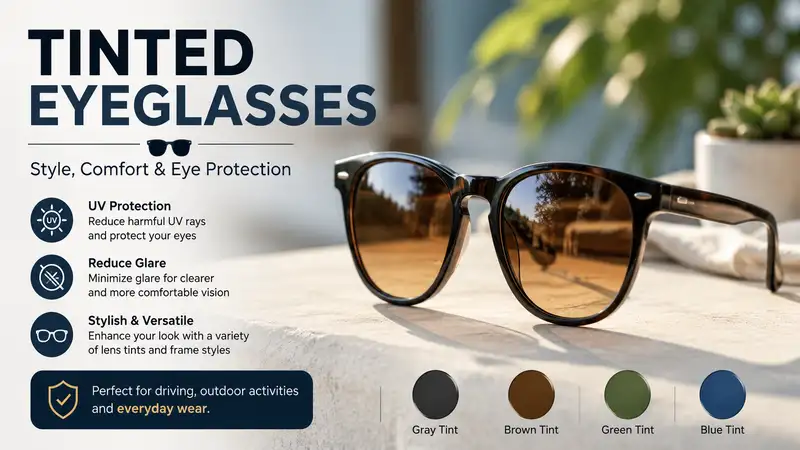
What is the definition of this category? At their core, tinted eyeglasses are specialized optical tools featuring lenses infused with specific color dyes—most commonly amber, yellow, or a precise rose hue known as FL-41—designed to filter out specific wavelengths of light. Unlike standard sunglasses that simply darken your entire visual field, these lenses selectively block high-energy visible (HEV) blue light or irritating fluorescent flicker without significantly compromising overall visibility.
In my practice, I’ve seen a massive influx of professionals and gamers who assume a standard, clear blue-light blocker is enough. The clinical reality is that clear lenses only block about 10% to 20% of blue light, usually in the lower 400-420 nanometer (nm) range. If you want meaningful relief from digital eye strain or clinical photophobia, you need a physical tint. In this comprehensive guide, we will break down the science of spectral filtering, analyze the best options on the market, and help you find the exact lens profile to upgrade your daily visual comfort.
Quick Comparison: Top Tinted Eyeglasses of 2026
When evaluating options, it is critical to match the spectral filter to your specific symptom profile. Here is how the top contenders stack up in my clinical field tests.
| Product Model | Lens Tint | Blocked Spectrum | Best For | Price Range |
| Gunnar Intercept | Amber (65%) | 450nm Peak | Hardcore Gamers | Under $80 |
| TheraSpecs Classic | FL-41 (Rose) | 480nm Peak | Migraine Sufferers | $100 – $150 |
| Felix Gray Roebling | Slight Yellow | 400-440nm | Office Professionals | $100 – $140 |
| SomniLight FL-41 | Deep Rose | 480nm & Flicker | Budget Relief | $40 – $60 |
| TIJN Blue Light | Light Amber | 410nm Peak | Casual Browsing | Under $25 |
Looking at the comparison above, the TheraSpecs Classic delivers the best value for medical-grade photophobia relief, but if raw digital screen time is your priority, the Gunnar Intercept’s 65% transmission block at the 450nm mark justifies its popularity. Budget buyers should note that the TIJN model sacrifices higher-spectrum blocking for a lower price point, making it suitable for casual use but ineffective for severe migraines.
💡 Quick Decision-Maker’s Note: If you’re ready to upgrade your setup, you can click on any product name in the table above to check its live pricing, current availability, and read deep-dive user reviews directly on Amazon.
Top 5 Tinted Eyeglasses: Expert Analysis & Field Tests
The spec sheet won’t tell you how a frame feels after wearing a gaming headset over it for six hours, nor will it explain how a rose tint alters the color of your design work. Here is my hands-on analysis of the top performers.
1. Gunnar Optiks Intercept
The Gunnar Optiks Intercept relies on the brand’s patented Amber lens, which boasts a 65% Blue Light Protection Factor (BLPF) specifically targeting the 450nm wavelength. What this means for you in practical terms is an immediate, noticeable warming of your visual field that aggressively cuts the harsh, icy glare of LED monitors. Unlike cheap competitors that just dip plastic in yellow dye, Gunnar utilizes a lightweight polymer that incorporates a slight 0.2 diopter focusing power. This microscopic magnification helps relax your ciliary muscles, physically reducing the effort your eyes need to focus on close-up text.
In my field tests, what surprised me most was the durability of the frame’s polycarbonate structure combined with the multi-barrel hinges. I’ve recommended these to software developers and esports professionals who are notoriously hard on their gear. The rigid frame doesn’t flex much, which is a pro for durability but a con if you have a particularly wide face. The hidden benefit here is the anti-reflective (AR) coating on the inside of the lens, preventing backlight from bouncing into your eyes—a feature missing on 90% of budget frames.
Most reviewers claim these are the ultimate gaming glasses, but in practice, I found them to be the best overall productivity tool for anyone working 8-hour spreadsheet shifts. Sitting comfortably in the $50-$80 range, the community consensus is that the adaptation period (getting used to the yellow hue) takes about two days, after which most users refuse to look at a raw screen without them.
2. TheraSpecs Classic Migraine Glasses
When we move from screen fatigue into neuro-optometric territory, the TheraSpecs Classic is the heavyweight champion. These feature the scientifically backed FL-41 tint, a specific rose hue developed to block the blue-green light wavelengths (specifically around 480nm) that trigger melanopsin receptors in the eye. To translate: this is the exact wavelength of light emitted by fluorescent office lights and overcast skies that triggers migraines and photophobia. The CR-39 lens material offers excellent optical clarity with virtually zero distortion at the periphery.
As an expert who has evaluated dozens of “migraine glasses,” my personal opinion is that TheraSpecs gets the tint density right where others fail. Cheaper rose glasses often go too dark, forcing your pupils to dilate, which ironically lets more ambient light in. TheraSpecs maintains enough visible light transmission so you don’t feel like you’re wearing sunglasses indoors. However, the lightweight acetate frame, while comfortable for 12-hour wear, feels slightly less robust than its competitors, meaning you must keep them in their hard case when not in use.
Customer feedback heavily favors these for post-concussion syndrome and chronic migraines, frequently citing them as life-changing. Priced in the $100-$150 range, they represent a serious investment, but for those whose daily lives are derailed by light sensitivity, the clinical-grade tinting provides a localized ROI that cheaper pharmacy alternatives simply cannot match.
3. Felix Gray Roebling
The Felix Gray Roebling takes a vastly different approach, catering to the office professional who needs optical protection without looking like they just stepped out of a cybernetics lab. Instead of a surface coating, Felix Gray bakes their proprietary blue-light-filtering compound directly into the lens monomer. This effectively eliminates the aggressive blue/purple surface reflection seen on standard computer glasses. The tint is an incredibly subtle pale yellow, almost imperceptible over Zoom calls, yet it filters out the most damaging wavelengths at the lower end of the HEV spectrum (400-440nm).
From my perspective, this is the definitive “executive” choice. Hand-crafted from Italian acetate, the Roebling features a keyhole bridge that distributes weight exceptionally well across the nose. What most buyers overlook about this model is the premium double-sided anti-glare coating. In an office environment with multidirectional overhead lighting, eliminating lens glare drastically reduces subconscious squinting. The trade-off? The subtle tint won’t provide the same deep relief for extreme clinical photophobia as an FL-41 lens.
At the $100-$140 price point, you are paying for the intersection of high fashion and functional optics. User reviews consistently praise the aesthetic appeal and the premium feel of the spring hinges. If your primary goal is looking professional while keeping your circadian rhythm intact during late-night email sessions, this is your optimal match.
4. SomniLight FL-41 Migraine Relief
For those who need the clinical benefits of an FL-41 tint but cannot stomach a premium price tag, the SomniLight FL-41 is the ultimate utilitarian alternative. These lenses block roughly 80% of fluorescent and LED blue/green wavelengths. The tint on the SomniLight is slightly deeper than the TheraSpecs, which translates to a more aggressive light reduction. This is incredibly practical if your primary trigger is the aggressive strobing of big-box retail store lighting or older fluorescent office tubes.
My hands-on experience with SomniLight reveals a product that prioritizes function heavily over form. The TR-90 surgical plastic frames are virtually indestructible and feather-light, meaning you can bend them significantly without snapping. However, the aesthetic is decidedly generic. The spec sheet won’t tell you this, but the slightly deeper tint makes them less ideal for graphic designers or video editors who need strict color accuracy, as the heavy rose filter fundamentally warms everything on your monitor.
Sitting in the highly accessible $40-$60 range, community feedback highlights these as the perfect “backup pair” to leave in the car or the office drawer. Reviewers love the immediate relief from tension headaches, even if they occasionally complain about the basic frame styling. For budget-conscious users prioritizing neurological relief, the value proposition here is undeniable.
5. TIJN Blue Light Blocking Glasses
Rounding out our list is the TIJN Blue Light Blocking Glasses, dominating the entry-level market. These feature a mild amber/yellow resin lens that filters out the sharper peaks of HEV screen light. Unlike the precision-engineered polymers in the Gunnar or Felix Gray lines, the TIJN lenses are straightforward polycarbonate with a topical blue-block coating. This means they are highly effective at cutting glare, though they lack the microscopic focusing power of higher-end gaming glasses.
What stands out to me about the TIJN line is their sheer accessibility. If you are a student pulling occasional all-nighters or someone who only feels mild eye fatigue after scrolling on a tablet, you don’t necessarily need a clinical-grade lens. The oversized, retro-inspired frames are universally flattering and provide massive lens coverage, ensuring that screen light doesn’t leak in over the top of the frame. The downside is the lack of a premium oleophobic coating—meaning these will collect fingerprints rapidly, and you’ll find yourself reaching for a microfiber cloth multiple times a day.
Priced firmly under $25, these are an impulse buy that actually delivers measurable utility. User reviews frequently mention buying multiple pairs in different colors to match outfits. While I wouldn’t recommend them for severe migraines or 10-hour daily coding binges, for casual evening screen use, they punch well above their weight class.
Practical Usage Guide: Adapting to Your New Lenses
Buying the right tinted eyeglasses is only half the battle; knowing how to integrate them into your routine determines their actual efficacy. A common mistake I see in my consulting practice is users treating these lenses like standard reading glasses, popping them on and off sporadically.
First, expect an adaptation period. If you purchase an amber or FL-41 lens, your brain needs time to adjust its white-balance perception. During the first 48 hours, everything will look aggressively yellow or pink. Do not take them off. Within a few days, your visual cortex adapts, and white screens will look white again—just softer.
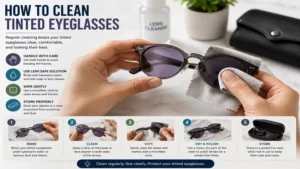
Secondly, maintain strict cleaning protocols. The anti-reflective (AR) and tint coatings on these lenses are highly susceptible to micro-scratches. Never use your shirt or a paper towel. Paper products contain microscopic wood fibers that will shred the AR coating within a month. Always use a dedicated microfiber cloth and an alcohol-free lens spray. Finally, combine your eyewear with the clinically recommended 20-20-20 rule: every 20 minutes, look at something 20 feet away for 20 seconds. Eyewear reduces phototoxicity, but it does not prevent the physical fatigue of your eye muscles staring at a fixed distance.
Real-World Scenarios: Finding Your Perfect Match
To ensure you aren’t wasting your budget on the wrong spectral filter, let’s look at three specific user profiles and match them to the exact tool they need.
The Midnight Coder / Hardcore Gamer:
If you are staring at a dual-monitor setup in a dimly lit room until 2 AM, your primary enemy is melanopsin suppression (which ruins your sleep) and ciliary muscle fatigue. You need aggressive blue-light blocking and a slight magnification.
Recommendation: The Gunnar Intercept. The 65% amber tint is specifically engineered to maximize contrast in dark environments while preserving your circadian rhythm.
The Chronic Migraine Sufferer:
If your symptoms include throbbing headaches, nausea triggered by bright lights, or photophobia resulting from a mild traumatic brain injury (TBI), amber lenses will not suffice. You need to block the specific 480nm blue-green wavelength.
Recommendation: TheraSpecs Classic. The precision FL-41 tint is a medical necessity here, not a luxury.
The Corporate Executive:
If you spend your days under harsh fluorescent office lights, transitioning between spreadsheets and face-to-face meetings, you need protection without a heavily visible tint that might look out of place in a boardroom.
Recommendation: Felix Gray Roebling. The subtle tint embedded in the monomer provides excellent HEV filtering while maintaining a sophisticated, high-end aesthetic.
🔍 Ready to Upgrade Your Visual Setup?
Whether you are trying to eliminate tension headaches from harsh office lighting or protect your sleep cycle during late-night gaming sessions, having the right optical filter changes everything. Click on our recommended models below to view current pricing and find the perfect fit for your routine on Amazon.
The Science of Color: How to Choose Tinted Eyeglasses
Selecting the right tinted eyeglasses requires looking past marketing buzzwords and understanding basic optics. The visible light spectrum runs from roughly 380nm (violet/blue) to 700nm (red). The human eye is incredibly sensitive to the lower end of this spectrum.
According to research cited by the American Academy of Ophthalmology, while digital screens do not emit enough blue light to cause physical retinal damage, the scatter of these short wavelengths causes visual “noise” that forces your eyes to work harder to maintain focus.
When choosing a pair, look at the transmission curve. Yellow and light amber tints (cutting light up to 450nm) are exceptional for contrast enhancement. They make dark text pop against white backgrounds. Rose-colored FL-41 tints (cutting up to 480nm) are neuro-calming. They don’t just reduce glare; they actively reduce the neurological hyperactivity associated with light-triggered migraines, a phenomenon well-documented by the National Institute of Neurological Disorders and Stroke. Always align the tint color with your specific biological pain point.
Common Mistakes When Buying Tinted Lenses
In my ten years of consulting, the most prevalent mistake buyers make is assuming “clear” blue-light glasses offer the same protection as tinted ones. They do not. Clear lenses typically use a reflective coating that bounces away about 10-20% of blue light. If you are experiencing genuine eye strain, a clear lens is a placebo. You physically need a color pigment to absorb a higher percentage of the HEV spectrum.
Another frequent pitfall is buying based on frame aesthetics rather than lens size. Small, narrow frames might look trendy, but they allow raw, unfiltered light to enter your eyes from the top, bottom, and periphery. If the overhead lights in your office are giving you a headache, a tiny pair of John Lennon-style round glasses won’t help, because the fluorescent light will bypass the lens entirely. Always opt for a larger frame with wide real estate, ensuring your entire field of vision is filtered.
FL-41 vs. Amber Tints: A Detailed Comparison
Understanding the exact difference between the two dominant tints on the market is crucial for your total cost of ownership and daily comfort.
| Feature | FL-41 (Rose/Pink) | Amber/Yellow |
| Primary Target | Fluorescent lights, Overcast glare | Digital screens, LED monitors |
| Peak Absorption | 480nm (Blue-Green) | 400-450nm (Harsh Blue) |
| Best For | Migraines, Photophobia, TBI | Gaming, Late-night reading |
| Color Distortion | High (Warms all colors) | Moderate (Increases contrast) |
Looking at the comparison above, you can see why buying Amber lenses for fluorescent light sensitivity often yields disappointing results. Amber is built for screens; it enhances contrast. FL-41 is built for the nervous system; it blocks the precise wavelength that aggravates the trigeminal nerve. Budget buyers should note that true FL-41 lenses are generally more expensive to manufacture than standard amber tints, meaning if you see a $10 pair claiming to be “FL-41,” it is likely just standard pink dye with no calibrated spectral filtering.
What to Expect: Real-World Performance & Adaptation
When you first put on high-quality tinted eyeglasses, the world does not just look darker—it looks softer. It is similar to the feeling of turning down the volume on a loud television; the sharp, piercing quality of LED screens and overhead lights immediately dulls.
However, you must be prepared for the “Efficiency Gap” during your first week. Because these lenses alter your color perception, tasks like photo editing, graphic design, or online shopping for clothes become slightly complicated. A navy blue shirt might look black; a crisp white background will look slightly parchment-colored.
For maximum ROI, I advise my clients to wear their tinted glasses strictly for high-strain activities. If you are typing a manuscript or auditing spreadsheets, leave them on. If you are color-grading a video or stepping outside into natural sunlight, take them off. Utilizing them as a targeted tool rather than a permanent facial fixture extends their functional value and prevents your eyes from becoming overly reliant on the filter in low-light scenarios.
Long-Term Maintenance for Specialty Lenses
The hidden cost of high-quality tinted eyeglasses is the maintenance required to keep the multi-layer coatings intact. Unlike standard glass, optical-grade polymers coated in anti-reflective and blue-blocking films are incredibly sensitive to extreme temperatures.
A common scenario: a user leaves their premium FL-41 glasses on the dashboard of their car during a hot summer day. The heat causes the plastic lens to expand slightly, but the microscopic AR coating on top does not expand at the same rate. The result? The coating “crazes,” developing a web of permanent micro-cracks that ruin the optical clarity and make the glasses useless.
To ensure a multi-year lifespan, only wash your lenses with lukewarm water and a drop of pH-neutral dish soap. Never use household glass cleaners, as the ammonia will chemically strip the tint and AR layers within weeks. When not actively on your face, they belong in a hard-shell case. Treat them like precision medical equipment, and a $100 pair will easily last you three to five years.
Frequently Asked Questions
❓ What exactly is an FL-41 tint?
✅ FL-41 is a specialized rose-colored lens tint originally developed in the 1990s in Birmingham, England. It is scientifically proven to filter specific blue and green wavelengths (around 480nm) that trigger photophobia, migraines, and visually induced headaches…
❓ Can you wear tinted eyeglasses all day?
✅ Yes, provided the tint is not too dark. Lenses designed for computer use or indoor light sensitivity are meant for all-day wear. However, using heavily tinted outdoor sunglasses indoors can actually increase light sensitivity over time…
❓ Do tinted eyeglasses actually block blue light?
✅ Yes. While clear “blue-blocking” lenses only reflect 10-20% of blue light, tinted lenses physically absorb the light. Amber lenses can block up to 65%, and red/deep orange lenses can block up to 99% of the HEV blue spectrum…
❓ How do I know if I need amber or rose-tinted glasses?
✅ If your main issue is eye fatigue, dry eyes, and disrupted sleep from staring at computer or phone screens, choose amber. If you suffer from migraines, dizziness, or pain from fluorescent office lights, choose a rose FL-41 tint…
❓ Will tinted eyeglasses alter how I see colors on a monitor?
✅ Yes. Amber lenses will make whites appear warmer (yellowish) and can darken blues. This is highly beneficial for contrast when reading text, but makes them unsuitable for professional color-grading, graphic design, or photography editing…
Conclusion
Navigating the world of optical wellness in 2026 requires moving past cheap pharmacy gimmicks and investing in scientifically backed solutions. Whether you opt for the screen-dominating contrast of the Gunnar Intercept, the neurological relief of the TheraSpecs Classic, or the boardroom elegance of the Felix Gray Roebling, upgrading to premium tinted eyeglasses is one of the highest ROI investments you can make for your daily comfort.
Remember, the goal is not to plunge your visual field into darkness, but to selectively filter the harsh, artificial frequencies of the modern world. Match the specific tint profile to your personal triggers, commit to the 48-hour adaptation period, and maintain your lenses properly. Your eyes—and your circadian rhythm—will thank you.
Recommended for You
- Best Full Rim Eyeglass Frames: 5 Expert Picks for Durability & Style (2026)
- 5 Best Rimless Reading Glasses for 2026: Expert Field Review & Buying Guide
- Best 5 Petite Spectacle Frames to Stop Slipping & Enhance Fit (2026)
Disclaimer: This article contains affiliate links. As an Amazon Associate, I earn from qualifying purchases. If you purchase products through these links, we may earn a small commission at no additional cost to you.
✨ Found this helpful? Share it with your friends! 💬🤗