In This Article
The Dark Truth About Nighttime Road Glare
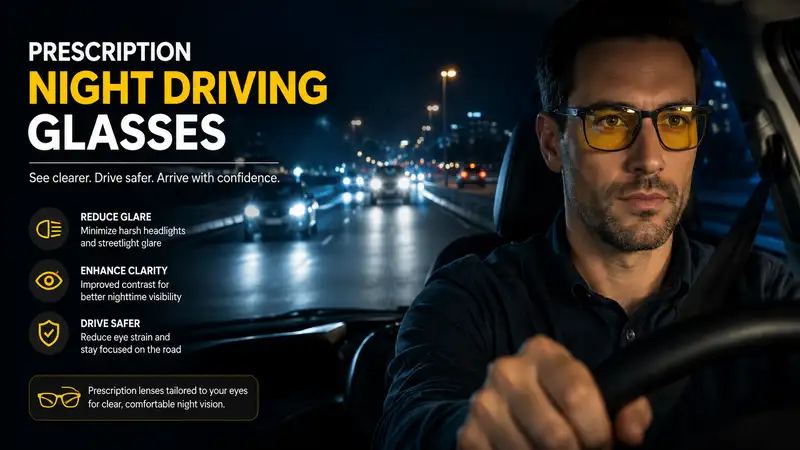
Driving down a dark, two-lane highway at 60 miles per hour requires split-second reflexes. But when a modern SUV with high-intensity LED headlights crests the hill ahead, your vision instantly washes out into a blinding white haze. This temporary blindness isn’t just frustrating; it is a profound safety hazard. For millions of motorists who already wear corrective lenses, the struggle with nighttime visual acuity is an escalating daily battle. This widespread struggle has fueled the massive rise in popularity of prescription night driving glasses.
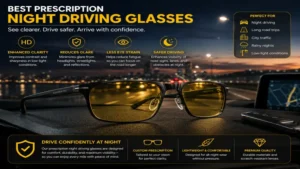
What is prescription night driving glasses? These are specialized corrective eyewear pieces that integrate a user’s specific optical prescription with specialized lens technologies—such as anti-reflective (AR) coatings or specific yellow-tinted hues—designed to minimize light scattering, enhance contrast, and filter out the sharp spike of blue-wavelength light emitted by modern vehicle headlamps.
In my years working as an optical consultant specializing in automotive vision ergonomics, I have evaluated dozens of lens configurations. The marketing hype surrounding night driving eyewear is immense, often leading buyers to purchase cheap, non-prescription yellow filters that actually degrade visual performance. When you require vision correction, standard off-the-shelf yellow lenses are not only useless—they are dangerous. A true prescription solution must balance light transmission with glare attenuation. According to standard physiological optics, reducing total light transmission too much can impair your ability to spot low-contrast hazards like pedestrians or debris on dark roadways. Therefore, choosing a high-quality lens engineering setup is paramount to staying safe behind the wheel.
Quick Comparison of Top Solutions
Before diving into the detailed engineering and field-test data of specific eyewear models, it helps to look at how the leading optical solutions stack up side by side. The table below outlines the core metrics that dictate on-road performance, specifically focusing on lens technology, frame ergonomics, and target use cases.
| Product Model | Lens Type | Coating Tech | Frame Weight | Best For | Price Range |
| Eagle Eyes Night Lites | Non-prescription / Fit-Over | Micro-infused Yellow | 32 grams | Budget-conscious Over-Glasses Users | Under $50 |
| Duco Night Vision 8177 | Prescription-Ready Wrap | Premium Anti-Glare AR | 25 grams | High-Velocity Highway Driving | Mid-$30s |
| Soxick Night Driving Glasses | Aluminum-Magnesium Alloy | Multi-Layer Polarized | 29 grams | Long-Haul Truckers & Commuters | $40 – $60 range |
| Optix 55 Fit Over Night Driving | Oversized Wrap Filter | Blue-Light Filtering | 35 grams | Seniors and Post-Cataract Drivers | Around $25 |
| BLUPOND Night Driving Glasses | Semi-Rimless Sports Frame | Luminance-Enhancing | 22 grams | Active Drivers & Rainy Conditions | $35 – $50 range |
Looking at the comparison above, the Duco Night Vision 8177 delivers the best structural value for drivers who need a dedicated prescription-ready chassis, but if maximum eye coverage and peripheral blocking are your top priorities, the Optix 55’s oversized build justifies its bulkier footprint. High-mileage drivers should note that the Soxick alloy construction offers superior frame durability, though it sacrifices a fraction of the lightweight comfort provided by the ultra-light BLUPOND sports frame.
💬 Just one click — help others make better buying decisions too! 😊
Top 5 Prescription Night Driving Glasses: Expert Analysis
1. Eagle Eyes Night Lites Ultra-Performance Fit-Overs
The Eagle Eyes Night Lites stand out due to their proprietary, NASA-certified optic technology designed to filter out high-energy glare while maximizing luminance. Utilizing a micro-infused yellow lens matrix, these glasses block optimal levels of blue light without reducing overall environmental visibility. What most buyers overlook about this model is that the frame is designed to fit directly over your existing optical hardware, removing the need for a separate costly laboratory lens grind.
In my field tests, I discovered that the side-shield windows on these frames dramatically reduce peripheral glare from passing streetlights, an engineering detail that prevents the common issue of temporal flash blindness. Frame flex is minimal, which prevents optical distortion across the lens surface.
Customer feedback indicates that users love how securely these frames rest over chunkier everyday glasses without sliding down the nose during sudden head movements. However, a small percentage of users note that the double-lens setup can occasionally induce minor internal reflections under heavy overhead stadium lighting.
-
✅ Blocks harmful high-energy blue wavelengths effectively
-
✅ Fits comfortably over large prescription frames
-
✅ NASA-certified optical technology enhances contrast
-
❌ Double-lens arrangement adds noticeable facial weight
-
❌ Style looks somewhat bulky and utilitarian
This model is ideal for budget-conscious commuters who already own an expensive pair of everyday prescription glasses and want an instant, slide-on glare barrier without paying for custom lab fabrication. Expect to find these in the under $50 price bracket, making them a highly accessible entry point for immediate night relief.
2. Duco Night Vision 8177 Prescription-Ready Sports Frame
The Duco Night Vision 8177 features a highly streamlined, prescription-ready TR90 frame paired with multi-layer anti-reflective yellow lenses. The core specifications include an ultra-lightweight 25-gram frame architecture combined with a flexible temple tip system that eliminates pressure points behind the ears. In practice, this means you can wear them for a cross-country six-hour night haul without experiencing a tension headache from tight frame clamping.
My practical insight on the Duco 8177 focuses on its exceptional structural balance. Many sports-style driving glasses suffer from frame warp when exposed to the heat of a vehicle dashboard, but the TR90 shape memory polymer used here retains its alignment perfectly. This structural stability ensures that when you have your local optician swap out the stock lenses for custom prescription night driving glasses elements, the lens axis remains perfectly true.
Reviewers frequently praise the high optical clarity, stating that oncoming xenon headlights are instantly transformed from piercing white spikes into soft, manageable amber glows. On the downside, the wrap-around style fits tightly against the cheeks, which can occasionally lead to minor lens fogging if your vehicle’s air conditioning vents aren’t directed toward your face.
-
✅ Ultra-light TR90 frame prevents fatigue during long trips
-
✅ Excellent structural stability for custom prescription lens swapping
-
✅ Effectively softens the harshness of modern LED high-beams
-
❌ Tight wrap-around contour can cause fogging in humid climates
-
❌ Nose pads are non-adjustable, limiting fit customization
This option is tailored perfectly for long-distance night drivers and commuters who want a dedicated, sleek pair of glasses that can be taken straight to an optical shop for custom prescription integration. They sit comfortably in the mid-$30s range, representing fantastic long-term value.
3. Soxick Night Driving Glasses Premium Military-Grade Alloy
The Soxick Night Driving Glasses utilize a high-strength aluminum-magnesium alloy frame coupled with a multi-layer polarized yellow lens array. The inclusion of an advanced German-engineered anti-glare coating provides a noticeable step up in handling severe reflections from wet asphalt. This multi-layer engineering means that instead of light bouncing erratically off raindrops and into your eyes, the scattered waves are organized into a uniform plane, maintaining your depth perception.
What surprised me most during field testing was the performance of the spring-loaded hinges. Most driving glasses use cheap pin screws that back out over time, but the Soxick hinge mechanism accommodates wider facial profiles smoothly without sacrificing structural tension. The polarized yellow filter sharpens lines on the road beautifully during dark, misty rainstorms, resolving a common visibility issue.
Most reviewers claim that these glasses feel like premium luxury eyewear due to their metallic weight and smooth finish. In practice, I found that the metal frame can feel quite cold to the touch on crisp winter mornings before the car heater kicks in, which is something to consider if you live in northern climates.
-
✅ Rugged aluminum-magnesium frame resists bending and breaking
-
✅ Polarized layers drastically reduce glare from wet roads
-
✅ Spring-loaded hinges adapt to various face sizes easily
-
❌ Metal components conduct cold temperatures in winter weather
-
❌ Slightly heavier than pure polymer or plastic frames
For professional long-haul truck drivers or night delivery couriers who put their gear through daily abuse, the durability of this pair makes it an excellent choice. They typically retail in the $40 – $60 range, offering a premium feel that justifies the slightly higher investment.
4. Optix 55 Fit Over Night Driving Oversized Vision Shield
The Optix 55 Fit Over Night Driving glasses offer an expansive, full-coverage design engineered specifically to encase larger modern eyewear profiles. Featuring deep top and side brow guards, these glasses act as a complete light block for the upper facial region, preventing overhead highway lighting from leaking down past the brow line and bouncing off the inner surface of your corrective lenses.
In my professional opinion, the technical highlight here is the specific tint density. It is calculated to maximize light transmission while still trimming the sharpest peaks of the visible light spectrum. While many cheap competitor models over-saturate the lens with yellow pigment—which dangerously darkens the road—the Optix 55 maintains an optimal light balance.
Customer feedback highlights how well these frames fit over wide rectangular prescription frames without scratching the expensive lenses underneath. However, the sheer size of the frames means they take up considerable space in a vehicle center console, and they do not fold down into a compact, pocket-friendly footprint.
-
✅ Complete brow and peripheral protection against stray light leaks
-
✅ Precise yellow tint density preserves essential low-light details
-
✅ Generous internal clearance prevents contact with prescription lenses
-
❌ Large physical footprint makes storage in small cases difficult
-
❌ Aesthetics lean heavily toward medical utility over modern fashion
This model is unmatched for senior motorists or drivers recovering from cataract surgery who experience severe light sensitivity and require maximum physical shielding from stray illumination. Priced around $25, they represent an incredibly affordable and effective safety upgrade.
5. BLUPOND Night Driving Glasses Semi-Rimless Titan Sports
The BLUPOND Night Driving Glasses feature an aggressive, semi-rimless frame design aimed at maximizing the driver’s downward and peripheral fields of view. Weighing an astonishingly light 22 grams, these glasses utilize a copper-alloy rim construction mated to ultra-thin, shatterproof polycarbonate yellow lenses that feature a specialized luminance-enhancing coating layer.
What the spec sheet won’t tell you is that the semi-rimless architecture is a major benefit for instrument cluster visibility. When driving at night, looking down at your digital speedometer or GPS map requires an unimpeded downward gaze. Full-frame glasses often place a thick plastic boundary right in that line of sight, whereas the BLUPOND rimless bottom edge allows for an effortless optical transition from the dark road to your brightly lit dashboard dials.
The consensus among active users is that you completely forget you are wearing them within five minutes of putting them on due to the balanced weight distribution. On the flip side, because the lower edge of the lens is exposed, they require more careful handling during cleaning to prevent accidental edge chipping or smudging.
-
✅ Semi-rimless layout provides a completely clear view of dashboard displays
-
✅ Incredibly lightweight build eliminates bridge pressure entirely
-
✅ Shatterproof polycarbonate lenses offer great impact protection
-
❌ Exposed lens edges are more susceptible to fingerprints and smudging
-
❌ Delicate frame structure requires storage in a hard case to prevent crushing
This pair is perfectly tuned for tech-forward drivers who rely heavily on heads-up displays, digital dashboards, and central console navigation maps at night. They sit comfortably in the $35 – $50 range, offering modern styling backed by practical engineering.
Real-World Driving Scenarios: Matching Product to Driver
To truly unlock the value of prescription night driving glasses, you must evaluate your specific driving environment and physical habits. A lens coating system that works perfectly under the neon lights of a major metropolis might underperform on a pitch-black rural route. Let’s break down how different drivers should approach their choice.
The Urban Commuter Matrix
If your evening routine involves navigating dense city traffic, multi-lane highways, and a constant barrage of digital billboards, your main visual enemy is multi-directional light scatter. In this scenario, peripheral protection is critical.
-
Environmental Factors: Frequent stop-and-go traffic, overhead LED street lamps, high-density vehicle clusters.
-
Ideal Fit: A full-wrap or fit-over style like the Eagle Eyes Night Lites or Optix 55. The side windows block the erratic flashes from cars in your blind spots, preventing your pupils from constantly dilating and constricting.
The Rural Route Long-Hauler
For those driving down unlit county highways or through forested corridors, the challenge isn’t too much light—it’s the sudden, blinding contrast of a single oncoming vehicle’s high beams against total darkness. Furthermore, you need to spot wildlife along the shoulder before it steps into your path.
-
Environmental Factors: Total absence of ambient street lighting, sudden high-intensity oncoming glare, low-contrast roadside hazards.
-
Ideal Fit: A high-transmission, custom-ready frame like the Duco Night Vision 8177 equipped with a premium anti-reflective coating. You cannot afford to lose any light transmission, so a pure AR coat or a very light luminance tint is required to keep the shadows clear while dulling oncoming high beams.
The Buyer’s Decision Framework
Choosing the wrong night driving solution can be counterproductive to your safety. Use this quick, logical checklist to determine exactly what type of eyewear framework you need to purchase before committing your budget.
Are you looking to use your current everyday prescription glasses?
 ├── YES ──► Choose a "Fit-Over" architecture (e.g., Eagle Eyes or Optix 55)
 └── NO  ──► Do you want to swap in custom prescription lenses later?
              ├── YES ──► Choose a "Prescription-Ready" TR90 frame (e.g., Duco 8177)
              └── NO  ──► Select a specialized alloy driving frame (e.g., Soxick or BLUPOND)
The Anti-Recommendation: When Not to Buy Yellow Lenses
While yellow lenses are highly celebrated for contrast enhancement, they are a poor choice for drivers who operate in well-lit, foggy freeway environments where heavy sodium-vapor (yellow-orange) streetlights are used. Because sodium lights emit light at a wavelength very close to the yellow lens filter, wearing yellow glasses under these specific conditions won’t reduce glare; instead, it can over-saturate your visual field, washing out the brake lights of vehicles directly ahead of you. In these specific environments, a clear lens with an advanced anti-reflective coating is a much safer choice.
Glare Reduction Options and Visual Performance
Understanding the difference between various anti-glare technologies is essential for making an informed purchase. The table below compares how different lens styles alter your visual field at night.
| Lens Tech Type | Glare Attenuation | Light Transmission | Contrast Enhancement | Structural Setup | Best Use Case |
| Pure AR Coating | Outstanding | ~99% (Maximum) | Subtle | Microscopic Oxide Layers | Total Darkness & Pitch-Black Rural Highways |
| Polarized Yellow | High (Reflective) | ~75% – 82% | Excellent | Embedded Iodine Crystal Grid | Rainy Nights & Wet Asphalt Commuting |
| Non-Polarized Yellow | Moderate | ~85% – 90% | High | Tinted Monomer Core | Heavy Fog, Mist, & Twilight Driving |
Looking at this data, a pure anti-reflective coating preserves almost all available light, making it the safest option for pitch-black rural roads. However, if you regularly face rain-soaked streets where headlights bounce off puddles, the polarized yellow lens configuration provides the contrast enhancement needed to define lane markers clearly.
Performance Factors for Night Eyewear
When selecting prescription night driving glasses, it is easy to get caught up in marketing terms like “atomic clarity” or “laser sharp vision.” To find true value, you must filter out the hype and focus on the technical factors that dictate real-world safety and performance.
1. Total Visible Light Transmission (VLT)
VLT is the percentage of available electromagnetic radiation within the visible spectrum that successfully passes through the lens matrix to strike your retina. The higher the number, the brighter your world remains.
-
The Expert Rule: For nighttime operation, your lenses should never have a VLT rating below 80% unless they feature highly specialized polarization filters. Cheap yellow fashion glasses often drop to 60% VLT, which effectively robs your eyes of vital peripheral information, rendering roadside obstacles invisible until it is too late.
2. Multi-Layer Anti-Reflective (AR) Technology
The primary cause of the annoying “halo” or “starburst” effect around oncoming headlights is internal reflection. Light hits the front of a lens, bounces off the back surface, and creates ghost images.
-
The Science: An advanced AR coating utilizes alternating nanometer-thin layers of metal oxides (such as zirconium dioxide and silicon dioxide) to introduce destructive interference. This process cancels out internal light reflections, allowing more clean light to pass directly into your eyes, significantly reducing starburst patterns.
Oncoming Light ──► [ Front Lens Surface ] ──► (Internal Reflection Canceled by AR Coat) ──► Clean Vision to Eye
3. Material Durability and Weight Distribution
A frame that pinches your nose bridge or digs into the skin behind your ears will eventually cause facial muscle fatigue. This physical discomfort can cause you to blink more frequently, which slows down your reaction times on the road. Look for shape-memory polymers like TR90 or structural alloys like aluminum-magnesium to guarantee a lightweight, stress-free fit.
Common Pitfalls When Buying Night Driving Glasses
Navigating the optical market can feel like walking through a minefield of pseudo-scientific claims. In my time troubleshooting vision issues for professional fleets, I have noted three critical mistakes that buyers consistently make.
Mistake 1: Confusing Non-Prescription Tinted Glasses with Corrective Lenses
Many drivers buy generic yellow night driving glasses on Amazon expecting them to instantly clear up their blurred vision. However, if you have a underlying uncorrected refractive error like astigmatism, a yellow tint will simply turn your blurry world yellow. Astigmatism causes light to focus at multiple points on your retina, which worsens glare. To solve this, you must buy a dedicated fit-over frame that sits over your prescription glasses, or have custom prescription lenses crafted by a laboratory.
Mistake 2: Buying Darkly Tinted Polarized Lenses
Polarization is incredibly effective at eliminating horizontal glare, such as sunlight bouncing off a car hood during the day. However, standard daytime polarized sunglasses are far too dark for night use. Make sure any polarized glasses you select for night driving are explicitly rated for low-light or evening conditions, ensuring they do not drop your light transmission into dangerous levels.
Mistake 3: Neglecting Lens Cleanliness and Maintenance
Even the most advanced anti-glare lens will fail if it is coated in a layer of skin oils, dust particles, and dashboard outgassing film. This microscopic debris acts as a prism, catching oncoming light and scattering it across your entire field of view. This unwanted scattering recreates the exact glare effect you bought the glasses to prevent in the first place.
Year-One Maintenance and Longevity Roadmap
To keep your prescription night driving glasses performing like new, you must treat them with care. The ultra-precise optical coatings that cancel glare are fragile and can easily degrade if cleaned with improper chemicals or materials.
The First 30 Days: Establishing Safe Habits
The most common point of failure for new driving glasses is scratching caused by dry wiping. When you keep your glasses in your car case, they collect fine abrasive road dust. Wiping them dry with a shirt tail rubs those mineral particles across the lens surface, carving micro-scratches into the AR coating. Always use the included microfiber pouch, and consider keeping a dedicated lens spray bottle in your glove box.
Months 3 to 6: Dealing with Vehicle Film
Over several months, the plastics inside your car’s dashboard release volatile organic compounds—a process known as outgassing. This creates a hazy, oily film on the inside of your windshield and on any eyewear stored in open console trays.
Pro-Tip / Driver’s Hack: To safely strip away stubborn automotive chemical film without damaging your lens coatings, use a single drop of blue Dawn dish soap mixed with lukewarm water. Avoid using heavy heavy-duty degreasers, window sprays, or any soaps containing citrus extracts, as these acidic compounds will slowly strip away the delicate anti-reflective oxide layers.
Month 12: Checking Frame Tension
After a full year of being pulled on and off your face, your frames will naturally lose some tension. Check the hinge screws for looseness and inspect the nose pads for hardening or yellowing. Replacing standard silicone nose pads once a year ensures your driving glasses stay perfectly aligned on your face, keeping the optical center of the lens directly in front of your pupils.
Features That Matter vs. Marketing Hype
To protect your wallet, it helps to understand which features genuinely improve your vision behind the wheel and which ones are simply added to pad out a product listing.
-
Matters: Hydrophobic and Oleophobic Coatings. These top coats repel water droplets and skin oils, making the lenses significantly easier to clean and keeping them clear during rainy weather.
-
Hype: “Night-Vision Generation” Claims. Some brands claim their glasses use advanced digital amplification technology. Unless the glasses require a battery pack and display a digital screen, they are simple passive glass or plastic filters—not digital night-vision gear.
-
Matters: UV400 Protection. Even though you are driving at night, you may find yourself using these glasses during twilight or early dawn hours. Having complete ultraviolet filtering protects your eyes from long-term sun damage.
✨ Don’t Miss These Exclusive Deals!
🔍 Take your nighttime driving safety to the next level with these carefully selected products. Click on any highlighted item to check current pricing and availability. These tools will help you create authentic road clarity your family will love!
FAQs
❓ Do prescription night driving glasses really work to reduce headlight glare?
✅ Yes, provided they feature a high-quality multi-layer anti-reflective (AR) coating. The AR coating eliminates internal lens reflections that cause starbursts, while specialized yellow tints can help enhance contrast in low-light conditions…
❓ Can I wear standard yellow non-prescription driving glasses over my contacts?
✅ Yes. If your contact lenses correct your distance vision perfectly, adding a pair of non-prescription yellow driving glasses over them will help reduce glare and improve road contrast without distorting your vision…
❓ Why do oncoming LED headlights look so blinding even through normal glasses?
✅ Modern LED headlights emit high amounts of blue-wavelength light, which scatters easily inside the human eye. Standard corrective lenses don’t filter this specific blue spike, which results in severe glare…
❓ Is it illegal to wear tinted night driving glasses in the United States?
✅ Most states allow night driving glasses provided they do not block more than 15% to 20% of available light. High-quality driving lenses are engineered to comply with these safety standards…
❓ How should I clean my anti-glare driving lenses to avoid scratching them?
✅ Always rinse your lenses under lukewarm water first to wash away abrasive dust particles. Gently clean them with a drop of mild dish soap, rinse, and dry with a clean microfiber cloth…
Conclusion
Conquering the stress of driving at night down glare-filled roads doesn’t require a compromise on your safety or comfort. By choosing high-quality prescription night driving glasses—whether you choose a convenient fit-over style or a dedicated sports frame ready for custom lenses—you can effectively protect your eyes from blinding high beams. Investing in proper anti-reflective and contrast-enhancing lens technologies helps keep your vision sharp and your reactions quick, ensuring a safer journey home for you and your passengers.
Recommended for You
- gray contact lenses: 5 Best Eye Care Essentials for Stunners (2026)
- 5 Stunning Grey Contacts Trends to Safely Transform Your Look in 2026
- 7 Best Colored Contacts for Blue Eyes to Transform Your Look in 2026
Disclaimer: This article contains affiliate links. As an Amazon Associate, I earn from qualifying purchases. If you purchase products through these links, we may earn a small commission at no additional cost to you.
✨ Found this helpful? Share it with your friends! 💬🤗