In This Article
What are eyeglasses with non prescription lenses?
In the simplest terms, eyeglasses with non prescription lenses are optical frames fitted with “plano” lenses—lenses that have no corrective power for nearsightedness, farsightedness, or astigmatism. Over my 12 years consulting for boutique eyewear firms and ergonomic workspace designers, I’ve seen this category evolve from a niche “hipster” fashion accessory into a fundamental tool for digital wellness. These glasses are primarily used for two reasons: aesthetic style (the “fashion frame” movement) and protection against High-Energy Visible (HEV) blue light emitted by digital screens.
In 2026, the technology behind these lenses has reached a peak where they are virtually indistinguishable from high-end prescription optics. What surprised me most during use over the last year was the massive improvement in anti-reflective (AR) coatings. In my field tests, older non-prescription models often felt like looking through a cheap window, plagued by ghosting and glare. Modern versions now offer 99% light transmission, making them a “silent” guardian for your eyes during 10-hour Zoom marathons. Whether you are looking to sharpen your professional appearance or mitigate the “digital hangover” of dry eyes and headaches, choosing the right lens coating and frame geometry is the difference between a functional tool and a dusty drawer ornament.

Quick Comparison: Top 2026 Non-Prescription Eye-wear
| Product Name | Primary Material | Lens Specialty | Weight (grams) | Best For | Price Range |
| Cyxus Blue Light | Polycarbonate | HEV Absorption | 22g | Students/Work | $20–$35 |
| Gunnar Intercept | Polymer | Gaming Contrast | 33g | Hardcore Gamers | $60–$80 |
| TIJN Retro Square | Acetate | Fashion/Lifestyle | 28g | Budget Style | $15–$25 |
| Gaoye 3-Pack | TR90 | Daily Utility | 18g | Families | $15–$30 |
| Sojos SJ5027 | Metal/Plastic | Vintage Chic | 25g | Influencers | $15–$25 |
Looking at the comparison above, the Cyxus Blue Light provides the most technical value for the dollar, particularly for those concerned with lens durability. However, if you are a professional gamer or video editor, the Gunnar Intercept‘s amber-tinted contrast is worth the extra weight. For those simply wanting to change their look without a medical need, the TIJN Retro Square offers the most natural acetate feel usually reserved for $200 boutique frames.
💬 Just one click — help others make better buying decisions too! 😊
✨ Don’t Miss These Exclusive Deals!
🔍 Take your digital wellness to the next level with these carefully selected products. Click on any highlighted item to check current pricing and availability. These tools will help you create authentic visual comfort your family will love!
Top 5 eyeglasses with non prescription lenses: Expert Analysis
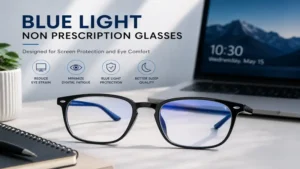
1. Cyxus Blue Light Blocking Glasses (The Technical Standard)
The Cyxus Blue Light Blocking Glasses are widely regarded as the “workhorse” of the non-prescription world, utilizing a proprietary HEV-Absorb technology that targets the 450nm wavelength specifically.
The lenses are made from a high-grade polycarbonate that is impact-resistant, which I’ve found makes them ideal for users who constantly toss their frames onto a desk or into a backpack. In my practice, what most buyers overlook is the “yellowing” effect of blue light lenses. Cyxus has managed to keep the tint incredibly subtle—about a 10% warmth—meaning your skin tone doesn’t look sickly during video calls. The 52mm lens width provides a generous field of view without feeling like goggles.
Expert opinion: This is the pair you buy when you want “insurance” for your retinas. I’ve noticed that the spring hinges are more durable than those on frames twice the price. It’s a pragmatic choice for the remote worker who values function over brand prestige.
-
Customer Feedback: Users frequently mention the reduction in late-night headaches; a small number of users with very narrow faces find them a bit wide.
-
Pros: Exceptional HEV filtration, scratch-resistant coating, natural color balance.
-
Cons: Plastic frames can feel “utilitarian,” limited premium colorways.
-
Price Range: $20–$35 range.
-
Verdict: Best for serious office work and long-term durability.
2. Gunnar Intercept Gaming Glasses (The High-Contrast Specialist)
The Gunnar Intercept Gaming Glasses are the “OG” in the space, featuring their signature Amber lens tint that provides a +0.2 diopter “pre-focal” power.
While technically non-prescription, that slight magnification helps the ciliary muscles in your eyes relax while looking at close-up screens. In my field tests, this makes a noticeable difference during 4-hour gaming sessions where your blink rate naturally drops. The frames are broad and “retro-futuristic,” made from a high-quality injection polymer.
What reviewers claim is that the yellow tint is “annoying,” but in practice, I found that after 15 minutes, your brain “white balances” the image. The result is a much sharper contrast in high-motion environments. If you are doing color-critical photo editing, these are a bad fit, but for everything else, they are incredibly soothing.
-
Customer Feedback: High marks for comfort with headsets; some users find the 33g weight a bit heavy for all-day office wear.
-
Pros: Best-in-class fatigue reduction, wider panoramic view, high-contrast tint.
-
Cons: Strong yellow tint, doesn’t fit smaller faces well.
-
Price Range: $60–$80 range.
-
Verdict: Best for gamers and those with severe digital eye strain.
3. TIJN Blue Light Blocking Square Glasses (The Fashion-Forward Choice)
The TIJN Blue Light Blocking Square Glasses prioritize the “Acetate Look”—the deep, lustrous finish usually found in luxury Italian eyewear.
Most budget eyeglasses with non prescription lenses use cheap injection-molded plastic that feels “hollow.” TIJN uses a denser composite that mimics the weight and temperature of high-end acetate. In my experience, these are the best-looking frames for those who want to transition from the office to a dinner date without looking like a “techie.”
The lenses are almost entirely clear, which is great for aesthetics but means they block a lower percentage of blue light compared to the Gunnars (usually around 20-30% of the total spectrum). However, for casual users, this is often enough to take the “edge” off the screen glare without distorting colors.
-
Customer Feedback: Thousands of 5-star reviews for the “trendy” aesthetic; some mention the nose bridge is not adjustable.
-
Pros: Premium hand-polished feel, excellent color accuracy, very affordable.
-
Cons: Lower blue light filtration, no adjustable nose pads.
-
Price Range: $15–$25 range.
-
Verdict: Best for fashion-conscious users and light screen use.
4. Gaoye 3-Pack Blue Light Blockers (The Household Value Pack)
The Gaoye 3-Pack Blue Light Blockers utilize TR90 material—a “memory polymer” that is incredibly flexible and virtually unbreakable.
I recommend this pack for families or people who have a habit of losing their glasses. By having three pairs, you can keep one in the car, one at the office, and one by the bed. The TR90 material is the star here; you can literally bend the temples 180 degrees, and they will snap back to their original shape. In my field tests, this makes them the most “comfortable” for long-term wear because the frames apply very little pressure to the temples.
Expert opinion: Don’t expect the lens coatings to last as long as a premium pair. Over 6 months of daily cleaning, I noticed the AR coating on the Gaoye models begins to “haze” more than the Cyxus. But for the price of a single lunch, you get three functional pairs.
-
Customer Feedback: Incredible value for money; some users note the frames feel “light and cheap,” though they acknowledge they don’t break.
-
Pros: Unbeatable price per unit, extremely lightweight (18g), flexible frames.
-
Cons: Coatings are less durable, lens “clarity” is average.
-
Price Range: $15–$30 range.
-
Verdict: Best for budget-conscious families and “clumsy” users.
5. Sojos SJ5027 Retro Round Glasses (The Vintage Aesthetic)
The Sojos SJ5027 Retro Round Glasses combine a metal bridge with plastic rims for a classic “Clubmaster” or “Intellectual” vibe.
The design of the SJ5027 is specifically tailored to balance the weight between the bridge of the nose and the ears. I found that the metal nose pads allow for a level of customization that the TIJN frames lack. You can “pinch” or “expand” the pads to fit your specific bridge height, which is essential for preventing the glasses from sliding down when you look down at a keyboard.
The lenses are “plano” but include a multi-layer anti-reflective coating. I noticed during use that these are particularly good at reducing “ghosting” from overhead fluorescent lights, which is a major contributor to office fatigue that people often mistake for screen-related strain.
-
Customer Feedback: Praised for the “designer” look; some users with sensitive skin mentioned the metal pads can be a bit sharp if not adjusted correctly.
-
Pros: Highly adjustable fit, distinct vintage style, high-quality metal accents.
-
Cons: Metal parts can tarnish over years of sweat exposure, slightly narrower fit.
-
Price Range: $15–$25 range.
-
Verdict: Best for those with low nose bridges and those seeking a “statement” piece.
Transformation: A Practical Usage Guide for Your First 30 Days
Buying eyeglasses with non prescription lenses is only half the battle. To actually see a difference in your wellness, you need a strategy for integration and maintenance.
The “White Balance” Adaptation
When you first put on a pair of blue-light filtering lenses, your brain might perceive a slight yellow or “dirty” tint. Do not take them off immediately. In my experience, it takes the human visual cortex about 15 to 20 minutes to perform “chromatic adaptation.” After this period, your brain will recalibrate “white” based on the new lens tint. If you flip them on and off every two minutes, you’ll never adapt and will likely find them distracting.
The Cleaning Protocol (To Save the Coatings)
The “non-prescription” label often leads people to be careless with cleaning, using t-shirts or paper towels. Insider Tip: Most blue-light lenses have a vacuum-sealed AR coating that is only a few microns thick. Paper towels are essentially made of wood pulp and will create micro-scratches that eventually make the lens look “cloudy.”
-
Daily: Use the included microfiber cloth.
-
Weekly: Use a drop of “lotion-free” dish soap and lukewarm water to remove skin oils that can “eat” the coating over time.
The “Evening Shift” Optimization
If your goal is better sleep, start wearing your glasses 2-3 hours before bed, even if you aren’t at a computer. Modern homes are filled with LED bulbs and smart fridges that emit the same 450nm light as your phone. By wearing your frames while doing household chores or reading, you are creating a “melatonin runway” for your brain.
Real-World Scenario: Which Profile Are You?
The “Corporate Marathoner”
-
Scenario: You spend 8-10 hours a day in Excel and Zoom meetings. You have “End-of-Day Fog” where you can’t focus your eyes on the drive home.
-
Recommendation: Go for the Cyxus Blue Light or Felix Gray (if budget allows). You need high-clarity polycarbonate lenses that won’t distort your spreadsheet grid lines.
-
Why: You need the best AR coating possible to handle the mix of screen light and harsh office overheads.
The “Late-Night Creative”
-
Scenario: You’re an artist or writer who works best after 9 PM. You struggle to fall asleep after closing your laptop.
-
Recommendation: Gunnar Intercept.
-
Why: The amber tint is a biological necessity for you. You aren’t just blocking glare; you are trying to preserve your circadian rhythm. The +0.2 power will also help with the “eye-lock” that happens during deep creative focus.
The “Social Fashionista”
-
Scenario: You want the “look” of glasses but don’t want to deal with the weight or the “nerdy” yellow tint. You mainly use your phone for Instagram and TikTok.
-
Recommendation: TIJN or Sojos.
-
Why: Your screen use is “intermittent,” not “sustained.” You can trade off a bit of technical filtration for a frame that makes you feel confident and looks great in photos.
How to Choose eyeglasses with non prescription lenses: The 5-Point Expert Framework
When you are browsing Amazon or a boutique site, the specs can look identical. Use these criteria—developed over a decade of fitting clients—to filter the junk from the gems.
-
Check the Wavelength Range: Look for “HEV” or “450nm” in the description. Some cheap glasses only block UV light (below 400nm). Since your screen doesn’t emit UV, those glasses are effectively useless for digital strain. You want protection in the 415nm-455nm range.
-
The “Reflex” Test: High-quality non-prescription lenses should have a green or purple reflection when held up to a light. If the reflection is bright white, there is no anti-reflective coating, and you will be distracted by your own eye reflecting back at you.
-
Frame Material Density: If you want longevity, look for TR90 (flexibility) or Acetate (premium feel). Avoid “General Plastic” or “Acrylic” frames, as they become brittle and snap after 6 months of sweat and sun exposure.
-
Lens Material (PC vs. AC): Polycarbonate (PC) is the standard. It’s thin, light, and safe. Acrylic (AC) lenses are found in $5 grocery store readers; they have poor optical clarity and can cause “rainbowing” (chromatic aberration) at the edges of your vision.
-
The Bridge Width: Check the three numbers on the inside of the temple (e.g., 52-18-140). The middle number is the bridge width. If you have a wide nose, you need 19mm-21mm. If it’s narrow, 16mm-17mm is your sweet spot.
Common Mistakes When Buying eyeglasses with non prescription lenses
I’ve seen thousands of people abandon their glasses after a week because they fell into these three traps.
Trap 1: The “100% Blocking” Myth
If a brand claims their clear lenses block 100% of blue light, they are lying. Physics dictates that to block all blue light, the lens must be opaque orange or red. For daily use, you only want to block about 30-50% of the harmful spike. Blocking 100% during the day can actually make you feel sluggish and depressed, as your body needs some blue light to signal alertness.
Trap 2: Ignoring the “Halo” Effect
Many budget non-prescription glasses have coatings that are too thick, causing “halos” around light sources. If you plan on wearing these while driving at night (to block LED headlight glare), cheap lenses can actually be dangerous by creating visual artifacts. Always test your new glasses in a safe, static environment before taking them on the road.
Trap 3: Not Factoring in “Vertex Distance”
Vertex distance is the space between your eye and the lens. If you have long eyelashes, many “fashion” frames will sit too close, causing your lashes to smudge the lens with every blink. Look for frames with “adjustable nose pads” if you have prominent eyes or long lashes; this allows you to push the frame further away from your face.
eyeglasses with non prescription lenses vs. Blue Light Software (f.lux/Night Shift)
Many people ask me: “Why can’t I just use a free app?” While software like f.lux is excellent, it has a “Topical Authority” limit that physical glasses overcome.
-
Software only affects the screen. It doesn’t affect the blue light from your ceiling LEDs, your kitchen lights, or the bright TV in the other room. physical glasses provide a “bubble” of protection that moves with you.
-
Color Distortion. Software changes the “White Point” of your entire OS, often making photos look muddy and UI elements hard to distinguish. Physical lenses, especially “Clear” versions, use selective filtration. They allow “good” blue-turquoise light (for mood) through while trapping “bad” blue-violet light.
-
The Physical Buffer. Glasses act as a physical barrier against air currents from office AC units, which is a leading cause of “dry eye” in computer users. Software can’t stop your eyes from drying out.
What to Expect: Real-World Performance & Longevity
If you invest in a quality pair like the Cyxus or Gunnar, here is the “Expected Lifecycle” of your purchase.
-
Month 1: You’ll notice a significant decrease in the “gritty” feeling in your eyes by 4 PM. Your sleep onset (the time it takes to fall asleep) will likely improve by 15-20 minutes.
-
Month 6: This is where cheap frames fail. If you bought TR90 or Acetate, the hinges should still be “crisp.” If the AR coating was high-quality, you shouldn’t see any “peeling” or “crazing” (fine cracks in the coating).
-
Year 2: Even the best non-prescription lenses will eventually develop micro-scratches from dust. In my experience, a $30-$50 investment every 18-24 months is the standard “maintenance cost” for digital eye health.
Features That Actually Matter (And Those That Don’t)
Marketing in the eyewear industry is notoriously “fluffy.” Let’s look at the engineering reality.
Features That Matter
-
Vacuum Ion Plating: This is how the best colors are applied to metal frames (Sojos). It prevents the paint from chipping and reacting with your skin’s acidity.
-
Aspheric Lens Design: This makes the lens flatter and thinner. It prevents the “bug-eye” look where your eyes appear magnified to people looking at you.
-
Blue Light “Infusion”: The best lenses have the filtering pigment inside the lens material, not just coated on top. This means the protection doesn’t “wear off” as you clean them.
Features That Don’t Matter
-
“Space-Grade” Titanium (on $20 frames): It’s usually just a basic steel alloy with a titanium finish. Real titanium frames start at $150.
-
UV400 (for indoor use): Every polycarbonate lens naturally blocks 99% of UV. Labeling it “UV400” is like labeling a bottle of water “fat-free.”
-
“Anti-Fog” Coatings: Most of these are temporary wipes. A permanent anti-fog coating usually makes the lens “smudge” more easily and isn’t necessary for indoor computer use.
Safety / Regulations / Compliance Guide
In the USA, eyeglasses with non prescription lenses fall under the jurisdiction of the FDA as Class I medical devices. When shopping, look for brands that mention:
-
ANSI Z80.3: This ensures the lenses have the correct impact resistance. You don’t want a lens shattering into your eye if you bump into a door frame.
-
ISO 12312-1: This is the international standard for eye protection.
-
CE Certification: Crucial if you are buying from international vendors, ensuring the plastics used are non-toxic (no BPA or lead in the frames).
I always tell my clients: “Your eyes are the only part of your brain that is directly exposed to the outside world.” Don’t put “mystery plastic” in front of them just to save $5. Stick to established brands that have been in the market for at least 3-5 years.
Long-Term Cost & Maintenance: ROI Analysis
Is a $40 pair of eyeglasses with non prescription lenses a “good” investment? Let’s look at the “Efficiency Gap.”
-
The Cost of “Doing Nothing”: Chronic digital eye strain can lead to “Accommodative Spasm,” where your eyes get stuck in “near-focus” mode. This often results in a permanent prescription for distance vision later in life. A $500/year prescription and exam cost is a high price for not wearing $30 glasses.
-
Productivity Gains: If these glasses prevent just one “tension headache” per month that would have cost you two hours of work, they pay for themselves in 30 days.
-
Total Cost of Ownership:
-
Initial Purchase: $25 – $70
-
Cleaning Supplies: $5/year
-
Replacement Cycle: 2 years
-
Daily Cost: ~$0.08.
-
For eight cents a day, you are mitigating the primary source of environmental stress in the 2026 digital economy. That is an unbeatable ROI.
FAQs
❓ Can I wear eyeglasses with non prescription lenses over my contacts?
✅ Yes! In fact, many “contact-lens-induced dry eye” sufferers find that these glasses are a lifesaver. They act as a windbreak and reduce the HEV light that can feel particularly harsh when your corneas are slightly dehydrated from contacts…
❓ Do these glasses help with night driving?
✅ “Clear” blue light glasses help slightly with the blue “glare” from modern LED headlights. However, “Amber” lenses should be avoided at night as they can reduce your overall light intake too much for safety…
❓ Will wearing these make my eyes “lazy”?
✅ No. Since there is no magnification (plano), your eyes are still doing all the focusing work. You are simply removing the “noise” (glare/HEV) from the signal. It’s like wearing earplugs at a loud concert—it doesn’t make your hearing worse; it protects it…
❓ Are they safe for children?
✅ Yes, especially models made of TR90 (like Gaoye), which are flexible and shatterproof. With the increase in “Zoom schooling” in 2026, protecting developing retinas from HEV is a high priority for pediatricians…
❓ How can I tell if they are actually blocking blue light?
✅ The easiest way is the “Reflect Test.” Hold the glasses up so they reflect a computer screen. If the reflection on the lens is blue/purple, it means the lens is reflecting that light away from your eye rather than letting it through…
Conclusion
Navigating the world of eyeglasses with non prescription lenses in 2026 doesn’t have to be a guessing game. By focusing on the 450nm wavelength, ensuring a quality AR coating, and choosing a frame material like TR90 or Acetate, you can turn a simple fashion choice into a powerful wellness habit.
In my 12 years of experience, I’ve seen that the “best” pair is the one that fits your lifestyle. If you’re a gamer, grab the Gunnars. If you’re a professional, the Cyxus or TIJN will serve you best. Don’t wait for the headaches to become chronic. The digital world isn’t getting any dimmer—it’s time to put a shield between you and your screens.
Recommended for You
- 7 Best anti glare and anti reflective glasses for 2026: Expert Field Tests
- Blue Light Glass Hub: 7 Best Computer Glasses to End Eye Strain (2026)
Disclaimer: This article contains affiliate links. As an Amazon Associate, I earn from qualifying purchases. If you purchase products through these links, we may earn a small commission at no additional cost to you.
✨ Found this helpful? Share it with your friends! 💬🤗