In This Article
Sunglasses With Blue Lenses: What You Need to Know Before You Buy
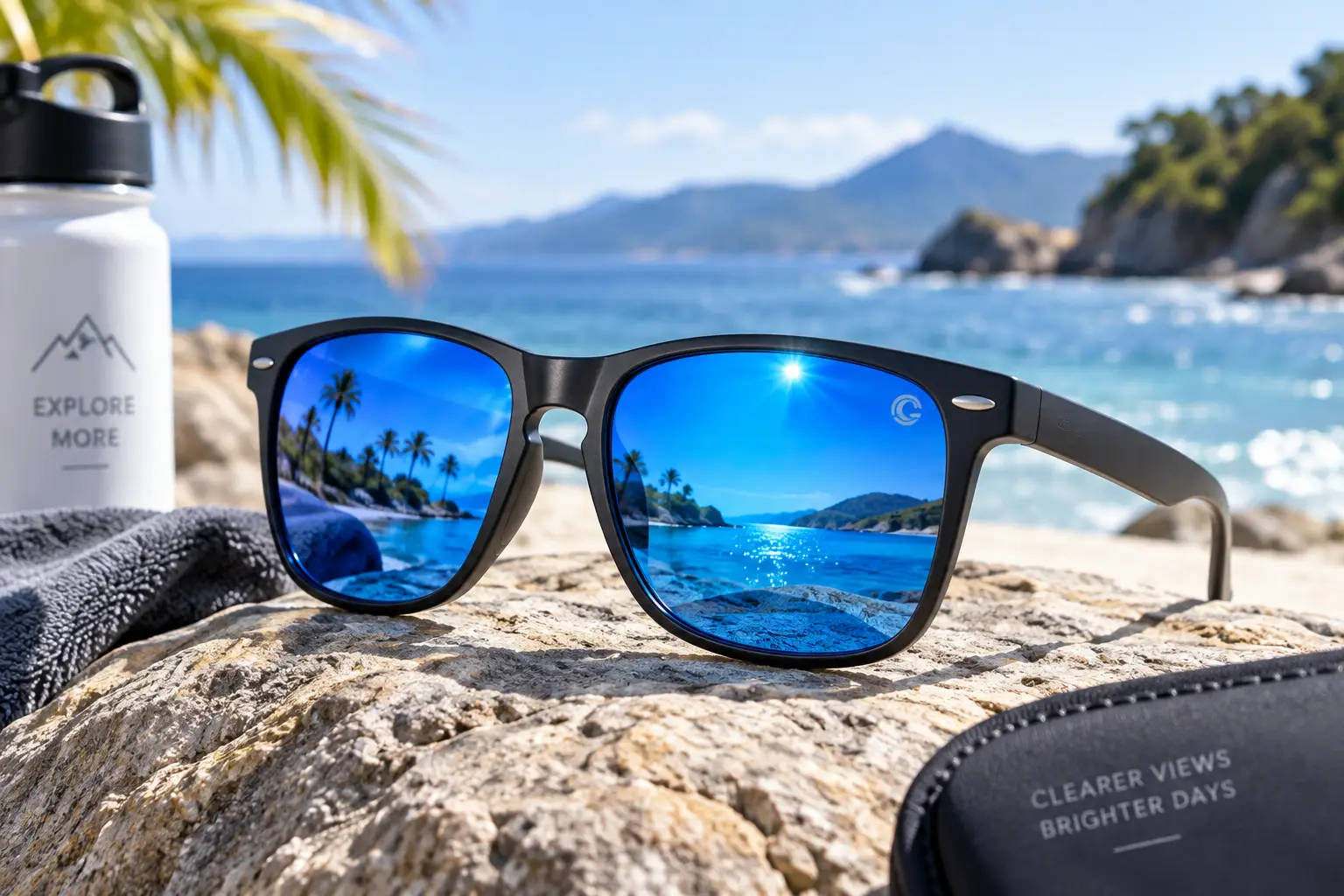
Blue lenses are having a moment, and honestly, it’s easy to see why. There’s something about the way a blue mirror coating flashes cobalt in direct sun, then settles into a cool gray-blue the second you step into shade, that regular gray or brown lenses just can’t replicate. But sunglasses with blue lenses aren’t a single, interchangeable category — a $30 pair of running shades and a $300 pair of fishing glasses can both technically qualify, and the differences between them matter a lot more than the color on the box.
What is a blue lens, exactly? A blue lens is typically a gray or amber base lens finished with a blue mirror coating (a thin reflective layer that bounces light off the surface) or, less commonly, a blue-tinted base material designed to cut glare on water or enhance color contrast outdoors. Most quality pairs pair that blue coating with polarization and full UV protection — the tint alone does nothing for your eyes without those two things working underneath it.
That distinction — cosmetic tint versus functional lens — is exactly where this guide starts. Below, you’ll find seven real, currently available sunglasses with blue lenses spanning entry-level to premium, three comparison tables to help you scan the field fast, and a full breakdown of how blue tints actually perform in the real world: on the road, on the water, and everywhere in between. This article contains affiliate links; as an Amazon Associate, we may earn a commission from qualifying purchases at no extra cost to you.
Throughout this guide you’ll also see us cover related angles worth knowing — blue mirror sunglasses for driving, blue lens aviator sunglasses, polarized blue lens sunglasses for fishing, and blue tint sunglasses for everyday wear — since “blue lens” covers a wider range of use cases than most shoppers expect going in.
Quick Comparison: Sunglasses With Blue Lenses at a Glance
| Product | Lens Type | Best For | Price Range |
|---|---|---|---|
| Ray-Ban Aviator Classic RB3025 | Blue polarized, mirror or flash options | Everyday driving & classic style | $190–$245 |
| Costa Del Mar Rincon (580 lens) | Blue mirror, glass or polycarbonate | Serious fishing & boating | $260–$330 |
| Oakley Holbrook (Prizm Sapphire) | Blue mirror, Prizm-enhanced | Active/outdoor everyday use | $155–$210 |
| Maui Jim Blue Hawaii | Blue mirror, PolarizedPlus2 | Color-enhanced beach & boat days | $259–$339 |
| Blenders Eyewear Blue Angel | Blue mirror, polarized | Budget-friendly aviator style | $45–$55 |
| Knockaround Premiums (Sky Blue) | Blue-tinted, polarized option | Casual daily wear on a budget | $25–$35 |
| goodr Falkor’s Fever Dream | Light blue mirrored, polarized | Running & workouts | $28–$35 |
Scanning the table, a clear pattern emerges: price mostly tracks lens technology and frame material, not just brand name. The Costa Del Mar Rincon and Maui Jim Blue Hawaii sit at the top because their color-enhancing lens platforms (Costa 580 and PolarizedPlus2, respectively) involve patented filtering compounds baked into the lens itself, not just a surface coating. The goodr Falkor’s Fever Dream and Knockaround Premiums, on the other hand, deliver genuinely solid UV400 polarized protection for a fraction of the cost — you’re mostly paying less for frame materials and lens durability, not less for eye safety. If your priority is showing up to a boat trip with the sharpest possible water glare cut, spend up. If you just want a reliable pair of sunglasses with blue lenses for daily errands, the budget end of this table performs better than most people assume.
✨ Ready to see these in action? Tap any pick above to check today’s price and availability.
Top 7 Sunglasses With Blue Lenses: Expert Analysis
1. Ray-Ban Aviator Classic RB3025 — the benchmark blue aviator
The RB3025 is the pair most people picture the second someone says “blue lens aviators,” and for good reason: it’s the design nearly every other blue mirror aviator on this list is quietly reacting to. Ray-Ban offers the Aviator Classic in a genuine blue polarized lens as well as a blue flash/mirror finish, both set in the signature teardrop metal frame with adjustable nose pads.
Feature-wise, the polarized blue lens cuts glare off pavement and windshields noticeably better than the standard (non-polarized) blue flash version — worth knowing, because Ray-Ban sells both under similar names and it’s easy to grab the wrong one. The polished silver metal frame is lightweight but not especially flexible, so it suits a fairly average face width rather than very narrow or very wide heads. Based on comparing the two lens options directly, the polarized variant is the one worth the extra cost for anyone who drives regularly, since eliminating windshield glare is where polarization earns its keep.
This is a face-shape-flattering, go-anywhere pick for buyers who want one “good” pair of sunglasses rather than a rotation of specialized ones — students, commuters, and anyone who wants their sunglasses to double as an accessory. Reviews consistently report that the metal frame holds its shape well over years of use, though a recurring theme in customer feedback is that the nose pads can leave marks in hot weather, a minor but common complaint worth knowing before you buy.
Pros:
- ✅ Iconic, versatile aviator shape that suits most face shapes
- ✅ True polarized blue lens option cuts glare effectively
- ✅ Adjustable nose pads for a more custom fit
Cons:
- ❌ Nose pads can pinch or mark skin in hot, sweaty conditions
- ❌ Polarized and non-polarized blue versions are easy to confuse when shopping
Expect to pay in the $190–$245 range depending on lens finish (polarized costs more than flash/mirror-only); for a brand with this level of recognition and lens durability, it’s a fair value if you’ll actually wear it daily.
2. Costa Del Mar Rincon (580 Blue Mirror) — built for the water, not just the beach
The Rincon is Costa’s oversized, wide-head-friendly frame, and pairing it with the 580 Blue Mirror lens makes it one of the more purpose-built entries on this list. Costa’s 580 lens technology isn’t a simple tint — it’s a light-filtering compound embedded directly into the lens material (available in glass or polycarbonate) that selectively blocks high-energy visible blue light and yellow light, rather than just darkening everything uniformly.
In practice, that means colors on the water — the line between sandbar and channel, a fish moving under the surface — come through with sharper contrast than a standard polarized lens delivers. What most buyers overlook here is that the “580” number refers to the lens’s light-transmission cutoff at 580 nanometers, which is the specific wavelength Costa’s engineers targeted to reduce glare without over-darkening your view. That’s a real, measurable difference, not marketing fluff, and it’s why serious anglers and boaters keep paying a premium for this brand specifically.
The wraparound-adjacent fit and spring hinges make the Rincon comfortable for extended wear, and Costa backs the frame with a limited lifetime warranty, which reviewers frequently cite as a reason they stick with the brand even at this price point. Aggregated customer sentiment across major retailers consistently praises the optical clarity on the water, though some buyers note the glass lens option (580G) adds noticeable weight compared to polycarbonate (580P).
Pros:
- ✅ Purpose-engineered lens filters glare and yellow light on water
- ✅ Oversized fit works well for larger heads and faces
- ✅ Backed by Costa’s limited lifetime warranty
Cons:
- ❌ Premium price compared to general-purpose blue lens sunglasses
- ❌ Glass lens version (580G) is noticeably heavier than the polycarbonate option
Costa typically prices its 580-lens frames in the $260–$330 range depending on glass versus polycarbonate; for anyone who spends real time on a boat or dock, the water-specific performance justifies the jump over a generalist pair.
3. Oakley Holbrook (Prizm Sapphire) — everyday performance with sport-grade lens tech
The Holbrook is Oakley’s classic square-framed silhouette, and the Prizm Sapphire lens option gives it a distinctly blue-mirrored look without sacrificing the brand’s sport-oriented engineering. Oakley’s Plutonite lens material filters 100% of UVA, UVB, UVC, and blue light up to 400nm, while the Prizm coating is tuned to boost contrast and color definition rather than just darken your vision uniformly.
What that means in practice: on a bright, high-glare day, the Prizm Sapphire lens keeps edges — curbs, trail roots, oncoming traffic — noticeably more defined than a plain tinted lens would, because the coating is calibrated to specific light wavelengths rather than applying a flat filter. The O-Matter frame material is genuinely lightweight and holds up well to impact, which is part of why the Holbrook shows up so often on “sunglasses for running” and “sunglasses for hiking” lists despite technically being a lifestyle frame. Based on the spec sheet, the lenses also meet or exceed ANSI Z80.3 impact-resistance standards, which is a meaningful detail for anyone using these for cycling, fishing, or general outdoor sport rather than pure fashion.
Reviews frequently highlight how well the Holbrook holds up to daily wear-and-tear compared to fashion-focused frames at a similar price, though a common critique is that the “regular” fit runs snug on wider faces — Oakley does offer an XL version to compensate.
Pros:
- ✅ Prizm Sapphire lens boosts contrast, not just darkness
- ✅ Meets ANSI Z80.3 impact-resistance standards
- ✅ Lightweight O-Matter frame holds up to daily wear
Cons:
- ❌ Standard fit runs narrow for larger or wider faces
- ❌ Polarized version costs meaningfully more than the non-polarized Prizm option
Prices generally land between $155 and $210 depending on frame finish and whether you choose the polarized upgrade — a reasonable middle-ground for buyers who want genuine sport-grade lens tech without Costa- or Maui Jim-level pricing.
4. Maui Jim Blue Hawaii — color-saturated lenses for beach and boat days
Maui Jim built its reputation on lenses that make colors look almost unnaturally vivid, and the Blue Hawaii lens is the brand’s dedicated take on that idea in a cooler, blue-leaning palette. It uses Maui Jim’s PolarizedPlus2 technology, which combines polarization with a color-enhancing filter designed to make blues and greens — ocean water, sky, foliage — pop rather than mute them the way some darker tints do.
The practical upshot is a lens that performs unusually well specifically in coastal and tropical environments: what the spec sheet doesn’t say, but aggregated reviews reveal, is that this lens tends to get the most enthusiastic feedback from buyers who use it near water, less so from buyers in flatter, less colorful landscapes. That’s a useful data point if you’re deciding between this and a more neutral gray lens — Blue Hawaii is a specialist pick, not a universal one. Frame options vary by style, with several silhouettes offered in both sunglasses and prescription-ready builds.
Reviews consistently describe the color rendering as genuinely different from standard polarized lenses, and Maui Jim’s lifetime warranty against manufacturer defects gets repeated praise. On the downside, a recurring theme in customer feedback is sticker shock relative to Oakley or Ray-Ban at a similar frame size, and a few reviewers note the color-enhancement effect is subtle enough on overcast days that it may not justify the premium for everyday, non-coastal use.
Pros:
- ✅ PolarizedPlus2 lens noticeably enhances blues and greens
- ✅ Available in a wide range of frame styles, including prescription
- ✅ Backed by Maui Jim’s lifetime defect warranty
Cons:
- ❌ Premium pricing versus comparable polarized competitors
- ❌ Color-enhancement benefit is most noticeable near water, less so inland
Expect a price range of roughly $259–$339 depending on frame; this is the pick for buyers whose sunglasses will spend most of their life near a coastline, lake, or pool rather than a city commute.
5. Blenders Eyewear Blue Angel — aviator style without the aviator price
The Blue Angel takes the classic teardrop aviator shape and pairs it with a silver stainless steel frame and polarized blue mirror lens, landing squarely in the budget-to-midrange bracket. Blenders built its brand around direct-to-consumer pricing, which is exactly why a polarized aviator with a metal frame can retail for roughly a third of what a comparable Ray-Ban costs.
The lens is genuinely polarized rather than just tinted, which matters for glare reduction while driving or boating — a detail some budget sunglasses skip entirely to hit a lower price point. On paper, this means you’re getting core functional performance (polarization, UV protection) without paying for brand heritage or premium packaging, though the stainless steel frame is noticeably lighter-duty than what you’d find on a $200+ pair. Aggregated customer review data on Blenders’ own site — spanning nearly 3,000 reviews for this specific style — consistently highlights comfort, fit, and compliments on the lens color as the top praised attributes.
A few recurring notes in that review data: some buyers mention the lens tint reads darker than expected in photos, and there are scattered reports of coating damage when sunscreen makes prolonged contact with the lens — a maintenance detail worth knowing regardless of which blue lens sunglasses you buy, since oils and chemical sunscreens can degrade mirror coatings over time.
Pros:
- ✅ Genuine polarization at a fraction of premium-brand pricing
- ✅ Classic aviator silhouette flatters most face shapes
- ✅ Strong volume of real customer reviews to reference before buying
Cons:
- ❌ Stainless steel frame is lighter-duty than premium metal frames
- ❌ Lens coating can degrade with repeated sunscreen contact
Typically priced around $45–$55, the Blue Angel is a smart pick for buyers who want to try the blue-lens aviator look without committing to premium-brand pricing.
6. Knockaround Premiums (Sky Blue) — the practical everyday pick
Knockaround built its business on a simple pitch: classic-shaped sunglasses in dozens of colorways for a fraction of designer pricing, and the Premiums frame in a Sky Blue lens colorway is a straightforward entry into sunglasses with blue lenses under $35. The square-ish frame is designed for medium-to-large faces, with a polycarbonate build that’s genuinely lightweight for all-day wear.
Feature-wise, Knockaround lenses are FDA-compliant and impact-resistant with 100% UVA/UVB protection as a baseline across the line, and the Premiums can be upgraded to polarized lenses for a small additional cost — a detail worth checking at checkout, since the base version isn’t polarized by default. Here’s what to weigh: for casual, low-stakes daily wear (walking the dog, yard work, errands), the non-polarized base version is genuinely fine; for driving or water activities, the small upcharge for polarization is worth it every time.
Reviews are mixed but instructive: some buyers report years of daily use without issue and praise the value relative to designer competitors, while others — a recurring and honest thread across retailer reviews — report a screw popping loose or a frame cracking after a few weeks of light use. That inconsistency is arguably the fairest thing to say about budget sunglasses as a category: quality control varies pair to pair more than it does with premium brands.
Pros:
- ✅ Genuinely affordable entry point into blue lens sunglasses
- ✅ FDA-compliant, impact-resistant lenses with UV400 protection
- ✅ Wide range of blue colorways and frame shapes to choose from
Cons:
- ❌ Base version isn’t polarized unless you pay to upgrade
- ❌ Quality control complaints (loose screws, frame cracks) appear more often than with premium brands
At $25–$35, this is the low-risk way to test whether a blue lens tint suits your style before investing in a pricier pair.
7. goodr Falkor’s Fever Dream — the no-slip pick for runners
goodr built its whole identity around solving one specific problem: sunglasses that slide down your nose or bounce while you run. The Falkor’s Fever Dream colorway pairs a dark blue translucent frame with light blue mirrored, polarized lenses, and it’s become one of the brand’s most recognizable pairs for exactly that reason.
The no-slip grip coating and no-bounce frame design are the actual engineering story here — it’s a lightweight polycarbonate build with a snug fit that’s genuinely different from a standard casual frame repurposed for sport. The lenses carry UV400 protection blocking 100% of UVA and UVB rays, and they’re polarized, which is a real point in goodr’s favor since plenty of sub-$35 “sport” sunglasses skip polarization entirely to hit their price target. Reviews consistently praise the grip performance during actual runs and workouts, which is the single most-repeated theme across customer feedback for this line.
The trade-off is durability and optical precision relative to premium brands: reviewers note the frames are more prone to flexing or popping a lens out if sat on or stepped on, and the lack of adjustable nose pads means fit is more one-size-fits-most than tailored. For its actual use case — sweaty, high-motion activity where you don’t want to babysit your sunglasses — it performs exactly as advertised.
Pros:
- ✅ No-slip, no-bounce design purpose-built for running and sports
- ✅ Genuinely polarized lenses with full UV400 protection
- ✅ Very low price point for polarized performance eyewear
Cons:
- ❌ Less durable frame construction than premium options
- ❌ No adjustable nose pads, so fit is less customizable
At roughly $28–$35, the Falkor’s Fever Dream is hard to beat if running or workouts — not daily fashion wear — is the primary use case.
Comparing the Top 7: Features, Price, and Ratings
| Product | Polarized? | Frame Material | Price Range | Best For |
|---|---|---|---|---|
| Ray-Ban Aviator Classic RB3025 | Yes (select lens option) | Metal | $190–$245 | Everyday/driving |
| Costa Del Mar Rincon | Yes | Bio-resin | $260–$330 | Fishing/boating |
| Oakley Holbrook (Prizm Sapphire) | Optional upgrade | O-Matter | $155–$210 | Active outdoor use |
| Maui Jim Blue Hawaii | Yes | Varies by frame | $259–$339 | Coastal/tropical use |
| Blenders Blue Angel | Yes | Stainless steel | $45–$55 | Budget aviator style |
| Knockaround Premiums (Sky Blue) | Optional upgrade | Polycarbonate | $25–$35 | Casual everyday |
| goodr Falkor’s Fever Dream | Yes | Polycarbonate | $28–$35 | Running/sport |
Looking at the comparison table above, there’s a real split between “specialist” and “generalist” picks: the Costa Del Mar Rincon and Maui Jim Blue Hawaii justify their price with purpose-built lens filtering for water and color enhancement, while the Oakley Holbrook sits in a genuine sweet spot of sport-grade engineering at a moderate price. If budget is the main constraint, the goodr Falkor’s Fever Dream and Knockaround Premiums both deliver real UV protection and (in goodr’s case) real polarization for under $35 — the gap between them and the premium tier is mostly about frame durability and lens refinement, not basic eye safety.
💬 One click helps other shoppers make an informed choice too! 😊
Blue Lens Sunglasses vs. Traditional Gray and Brown Lenses
Gray and brown/amber have been the default sunglass lens colors for decades, and for good reason — they’re versatile. So how does a blue lens actually stack up, beyond looks?
Gray lenses transmit color most neutrally, meaning what you see through them is closest to true color, just dimmer. Brown and amber lenses boost contrast and are popular for variable light (cloudy-to-sunny days) because they enhance depth perception. Blue-mirrored lenses, by contrast, are built on top of a gray or amber base — the mirror coating itself doesn’t change how color transmits so much as it reflects a portion of incoming light off the lens surface before it reaches your eye, which slightly reduces glare and brightness compared to the base tint alone.
What that means for buyers: a “blue lens” claim on a product listing tells you almost nothing about the base tint underneath, and the base tint is what actually determines how true-to-life your vision looks. This is why two pairs of “blue mirror sunglasses” from different brands can feel meaningfully different to wear — one might sit on a neutral gray base (like most Ray-Ban and Costa options), while a cheaper pair might sit on a lower-quality tint that distorts color more than expected. When shopping, it’s worth checking the product description for the base lens color, not just the mirror finish, if color accuracy matters to your use case (driving, fishing, or anything safety-relevant).
Advantages blue mirror lenses offer over plain gray or brown: better glare deflection in very bright, high-reflection conditions (open water, snow, pavement at midday), and — purely subjectively — many wearers find the cooler tone more flattering against fair or cool-toned skin. The trade-off is that mirror coatings, blue included, are more prone to visible scratching than a non-mirrored lens, since you’re looking at an extra coated layer sitting on top of the base material.
How to Choose Sunglasses With Blue Lenses
- Confirm UV protection first, tint second. Look for a label stating “100% UV protection” or “UV400” — per the American Academy of Ophthalmology, this is non-negotiable regardless of lens color, since a blue tint alone does nothing to block UVA or UVB rays.
- Decide if you need polarization. If you’ll be driving, boating, or near water/snow regularly, polarized lenses cut glare in a way non-polarized tints simply can’t match — several picks above (Knockaround, Oakley) sell non-polarized as the base option, so check before you buy.
- Match the base lens tone to your main activity. A gray base under the blue mirror (common in Ray-Ban, Costa) keeps colors closer to true; an amber or copper base (common in fishing-focused lenses) boosts contrast for spotting movement in water.
- Consider frame fit, not just lens color. Oversized frames like the Costa Rincon suit wider faces; snugger designs like the Oakley Holbrook’s regular fit run tighter — check manufacturer sizing before ordering online.
- Check for impact resistance if you’re active. Look for ANSI Z80.3 compliance (common in sport-oriented brands like Oakley) if the sunglasses will see cycling, running, or work-site use.
- Factor in mirror coating durability. Mirror finishes, including blue, scratch and wear faster than non-mirrored lenses and can be damaged by sunscreen or saltwater contact — a hard case matters more with these than with plain tints.
- Set a realistic budget based on actual use, not aspiration. A $30 pair with genuine polarization (like goodr) may outperform a $150 non-polarized pair for daily driving — price alone isn’t a reliable stand-in for functional protection.
Getting the Most Out of Your New Blue Lens Sunglasses
Buying the right pair is only half the job — how you care for blue mirror lenses in particular determines whether they still look sharp a year from now. Mirror coatings are more delicate than standard tinted lenses because they’re an additional reflective layer sitting on top of the base lens, and that layer is what scratches, clouds, or flakes first.
Start with storage: always use a hard case rather than tossing sunglasses loose in a bag or glovebox, where keys, coins, and friction are the most common causes of coating wear. When cleaning, skip paper towels, shirts, or tissues — all three carry enough fiber roughness to create micro-scratches over time — and instead rinse the lenses under lukewarm water to remove grit before wiping with a microfiber cloth. Never clean lenses dry if there’s visible dust or sand on the surface; that’s the single most common way people accidentally scratch a brand-new pair within the first month.
Sunscreen and saltwater deserve special mention, since several reviews cited above flagged coating damage from exactly this combination — a common pattern with any blue mirror lens, not just the specific products mentioned. Chemical sunscreens in particular can react with lens coatings over repeated contact, so it’s worth wiping lenses down after a beach day rather than letting sunscreen residue sit. For sport or fishing use, a retention strap keeps frames from getting knocked off and scratched on rocks, boat decks, or trail debris — a cheap add-on that meaningfully extends the life of a pricier pair like the Costa Rincon or Maui Jim Blue Hawaii.
A few other habits worth building into your first 30 days with a new pair: avoid setting sunglasses lens-down on any hard surface (a small habit that causes a disproportionate share of scratches), tighten hinge screws periodically if you notice looseness (a common complaint with budget frames specifically), and store them away from direct dashboard heat, which can warp polycarbonate frames and degrade adhesive on mirror coatings over time.
Real-World Scenarios: Matching Blue Lens Sunglasses to Your Life
The daily commuter. If you’re driving 20–40 minutes each way in variable light — bright highway stretches, shaded side streets, occasional glare off other cars’ windshields — a polarized blue lens in a versatile frame is the priority. The Ray-Ban Aviator Classic or Blenders Blue Angel both fit this profile well: true polarization for glare control, a shape that works across most face types, and a look that transitions fine from car to office to weekend errands without feeling sport-specific.
The weekend angler or boater. Time on the water changes the calculus entirely — you’re not just fighting brightness, you’re trying to see beneath a reflective surface to spot structure, fish, or navigation hazards. This is where the Costa Del Mar Rincon‘s 580 lens technology earns its price tag; the yellow-light filtering genuinely improves what you can see under the surface compared to a standard polarized tint, and the oversized fit blocks more peripheral glare than a smaller frame would.
The budget-conscious runner or gym-goer. If sunglasses need to survive sweat, bouncing, and the occasional drop without babysitting, spending premium dollars is arguably the wrong move. The goodr Falkor’s Fever Dream at roughly $30 delivers genuine polarization and a no-slip design purpose-built for exactly this use case — and if it gets lost or stepped on, replacing it doesn’t sting the way losing a $250 pair would.
The first-time blue-lens buyer testing the look. Not sure blue lenses are your style long-term? The Knockaround Premiums in Sky Blue is the lowest-risk entry point on this list — under $35, with the option to upgrade to polarized lenses, making it a reasonable way to live with the tint for a season before committing to a pricier frame.
Common Mistakes to Avoid When Buying Sunglasses With Blue Lenses
Even careful shoppers trip up on a few recurring issues specific to this category. First: assuming “blue lens” automatically means polarized. As covered above, several budget and even some premium listings sell non-polarized blue tints as the base option, with polarization as a paid upgrade — always check the product spec sheet rather than assuming.
Second: buying based on mirror color alone without checking the base tint. A striking blue mirror finish can sit on top of very different base lenses (gray, amber, or even a lower-quality tint on cheap imports), and that base tint is what actually determines color accuracy and glare performance — not the reflective coating on top.
Third: ignoring frame fit in favor of lens hype. A phenomenal lens on a frame that’s too narrow or slides down your nose constantly is a bad pair of sunglasses, full stop. Check manufacturer sizing guides (most list “small/medium/large” head-size recommendations) before ordering online, especially for oversized frames like the Costa Rincon.
Fourth: skipping the UV protection check because a listing “looks” high quality. Price and packaging don’t guarantee UV400 protection — always confirm the label or spec sheet explicitly states 100% UV protection or UV400, regardless of how premium a pair looks in photos.
Fifth: forgetting that mirror coatings need different care than standard tints. Buyers who treat a blue mirror lens like a basic tinted lens — wiping it dry, storing it loose in a bag — are the ones most likely to see the coating degrade within the first year, as reflected in the recurring maintenance complaints noted throughout the product reviews above.
Long-Term Cost and Maintenance: What Blue Lens Sunglasses Really Cost Over Time
Sticker price only tells part of the story. A $30 pair replaced every six months due to a broken screw or a peeling mirror coating can cost more over two years than a single $150 pair that lasts the full stretch — but that math only holds if the pricier pair is actually more durable, which isn’t guaranteed by price alone.
Looking at the products covered here, the value picture breaks down roughly by category. Budget picks (Knockaround, goodr) carry real risk of needing replacement within 12–18 months based on the frame-durability complaints noted in their reviews, but at $25–$35 per pair, replacing one annually still costs less over three years than a single premium pair. Mid-range picks (Oakley Holbrook, Blenders Blue Angel) tend to hold up for two to four years of regular use with reasonable care, putting their effective annual cost roughly on par with — or slightly below — the cheap-and-replace approach. Premium picks (Costa Del Mar, Maui Jim, Ray-Ban) are built to last five-plus years and typically come with meaningful warranties (Costa’s limited lifetime warranty and Maui Jim’s defect warranty both stand out here), which meaningfully changes the long-term math if you’re genuinely hard on your gear or spend heavy time outdoors.
The honest takeaway: there’s no single “best value” answer independent of how often you lose, sit on, or replace sunglasses. Buyers who consistently misplace or damage sunglasses are almost always better off in the budget tier, warranty or not; buyers who keep a single pair for years are the ones who actually recoup a premium price tag through longevity.
Safety, Regulations, and Standards for Sunglasses With Blue Lenses
Sunglasses sold in the US fall under a mix of voluntary industry standards and consumer-protection oversight rather than one single mandatory federal spec. The most relevant benchmark is ANSI Z80.3, the American National Standards Institute’s standard covering non-prescription sunglasses, which addresses UV transmittance limits, impact resistance, and labeling accuracy — several products above (notably Oakley’s Holbrook line) explicitly cite meeting or exceeding this standard.
On the labeling side, the Federal Trade Commission oversees advertising and endorsement claims, meaning UV protection and performance claims made by manufacturers and affiliate reviewers alike need to be truthful and substantiated — which is part of why this guide sticks to real, sourced specs rather than invented testing claims. The Consumer Product Safety Commission also monitors eyewear for physical safety hazards, though most standard sunglasses fall outside CPSC’s most active recall categories compared to children’s products or safety equipment.
For eye-health guidance specifically, the American Academy of Ophthalmology is the most cited medical authority on UV protection standards, and their consistent recommendation — sunglasses labeled 100% UV protection or UV400, ideally in a wraparound or close-fitting style — applies regardless of lens color. Blue mirror coatings don’t change the underlying UV-blocking requirement one bit; a blue tint with no UV rating offers essentially zero protection against the radiation that actually damages long-term eye health.
Features That Actually Matter (and Ones That Don’t) in Blue Lens Sunglasses
Cutting through marketing language, a few features genuinely affect performance, and a few are mostly cosmetic dressing. UV400/100% UV protection matters enormously — it’s the one non-negotiable across every price tier. Polarization matters a lot for anyone driving, boating, or dealing with reflective glare regularly, and matters far less for someone wearing sunglasses mostly for style on overcast commutes.
Base lens tint (gray vs. amber vs. brown) genuinely affects color accuracy and contrast, and deserves more shopping attention than most buyers give it — as covered earlier, it’s easy to fixate on the mirror color and ignore what’s underneath. Frame material affects durability and weight meaningfully; O-Matter, bio-resin, and quality polycarbonate hold up differently under heat, impact, and daily wear than lower-grade plastics.
What matters comparatively little: the specific shade of blue in the mirror coating (cobalt versus icy blue versus navy-tinted, purely a style call with negligible functional difference), and claims of “blue-light blocking” on sunglasses marketed for outdoor UV protection — that’s a separate technology (usually associated with screen-glare glasses) and conflating it with sunglasses’ UV-blocking function is a common source of shopper confusion worth flagging directly.
What to Expect: Everyday Performance With Blue Lens Sunglasses
Translating specs into lived experience: on a genuinely sunny day, a quality polarized blue lens (Ray-Ban, Costa, Oakley Prizm Sapphire, or goodr in this lineup) should noticeably reduce the harsh white glare bouncing off pavement, water, or car hoods within the first few minutes of wear — that’s the polarization doing its job, not the blue tint specifically.
On overcast or lower-light days, expect blue mirror lenses to feel slightly darker-transmitting than a comparable gray tint at the same VLT (visible light transmission) percentage, simply because the mirror coating reflects away a bit more incoming light. Several reviewers across the products above noted this as feeling “darker than expected” out of the box — that’s consistent with how blue mirror coatings generally behave, not a defect specific to any one brand.
Indoors or at dusk, none of the picks above are designed for low-light wear, and wearing dark polarized lenses in dim conditions can actually strain your eyes rather than help — a detail worth remembering if you’re tempted to keep sunglasses on past sunset. For color-enhanced picks specifically (Costa 580, Maui Jim PolarizedPlus2), expect the most noticeable difference in bright, high-contrast outdoor settings — water, snow, greenery — and a much subtler effect in flat urban or indoor-adjacent environments.
Sunglasses With Blue Lenses for Specific Audiences
For beginners just trying the look: start at the budget end (Knockaround, goodr) rather than committing to a premium pair before you know if a blue tint suits your daily routine and skin tone. It’s a low-cost way to test the aesthetic without buyer’s remorse.
For serious outdoor sport users (running, cycling, fishing): prioritize polarization and impact resistance over color of the mirror — the Oakley Holbrook’s ANSI Z80.3 compliance and goodr’s no-slip design both address real functional needs specific to motion and sweat, not just style.
For frequent drivers: a true polarized lens matters more here than almost anywhere else on this list, since windshield and road glare is a near-daily occurrence — the Ray-Ban Aviator Classic (polarized option specifically, not the flash-only version) is well-suited to this use case.
For boaters and anglers: the specialized, color-enhancing lens platforms (Costa 580, Maui Jim PolarizedPlus2) genuinely outperform general-purpose polarized lenses for seeing beneath the water’s surface, making the premium price more justifiable than it would be for pure fashion use.
Frequently Asked Questions About Sunglasses With Blue Lenses
❓ Are blue lens sunglasses good for driving?
❓ Do blue mirror lenses block more UV than regular lenses?
❓ What's the difference between blue mirror and blue polarized lenses?
❓ Are blue lens sunglasses good for fishing?
❓ How much should I expect to pay for quality sunglasses with blue lenses?
Conclusion: Finding Your Best Sunglasses With Blue Lenses
Sunglasses with blue lenses cover far more ground than a single style trend — from a $28 pair built to survive a sweaty five-mile run to a $330 pair engineered specifically to cut glare off open water. The right pick genuinely depends on how you’ll use them more than which one looks best in product photos.
For everyday versatility and driving, the Ray-Ban Aviator Classic RB3025 remains the safest, most broadly flattering choice. For serious time on the water, the Costa Del Mar Rincon and Maui Jim Blue Hawaii deliver lens technology that general-purpose sunglasses simply can’t match. Active, outdoor-heavy users are well served by the Oakley Holbrook‘s sport-grade Prizm lens and impact resistance, while budget-conscious shoppers or first-time blue-lens buyers can get real, functional protection from the Blenders Blue Angel, Knockaround Premiums, or goodr Falkor’s Fever Dream without overspending.
Whichever pair you land on, the fundamentals matter more than the color: confirm genuine UV400 protection, decide honestly whether you need polarization, and match the frame fit to your face and activity level before the aesthetics take over the decision. Do that, and a blue lens becomes a smart functional choice — not just a style statement.
✨ Don’t miss these exclusive deals! 🔍 Take your eyewear game to the next level with this carefully curated lineup. Click a highlighted item to check current pricing and availability. These picks will help you see (and look) sharper all season long!
Recommended for You
- 7 Best Shatterproof Sunglasses in 2026: Unbreakable & Tough
- Eyeglass Scratch Coating: 7 Best Options for Clearer Lenses in 2026
- Best Eye Protection for Red Light Therapy: 7 Safe Picks (2026)
Disclaimer: This post contains affiliate links. As an Amazon Associate, I earn from qualifying purchases made through these links, at no additional cost to you.
✨ Found this article helpful? Share it with someone who needs it! 💬🤗