In This Article
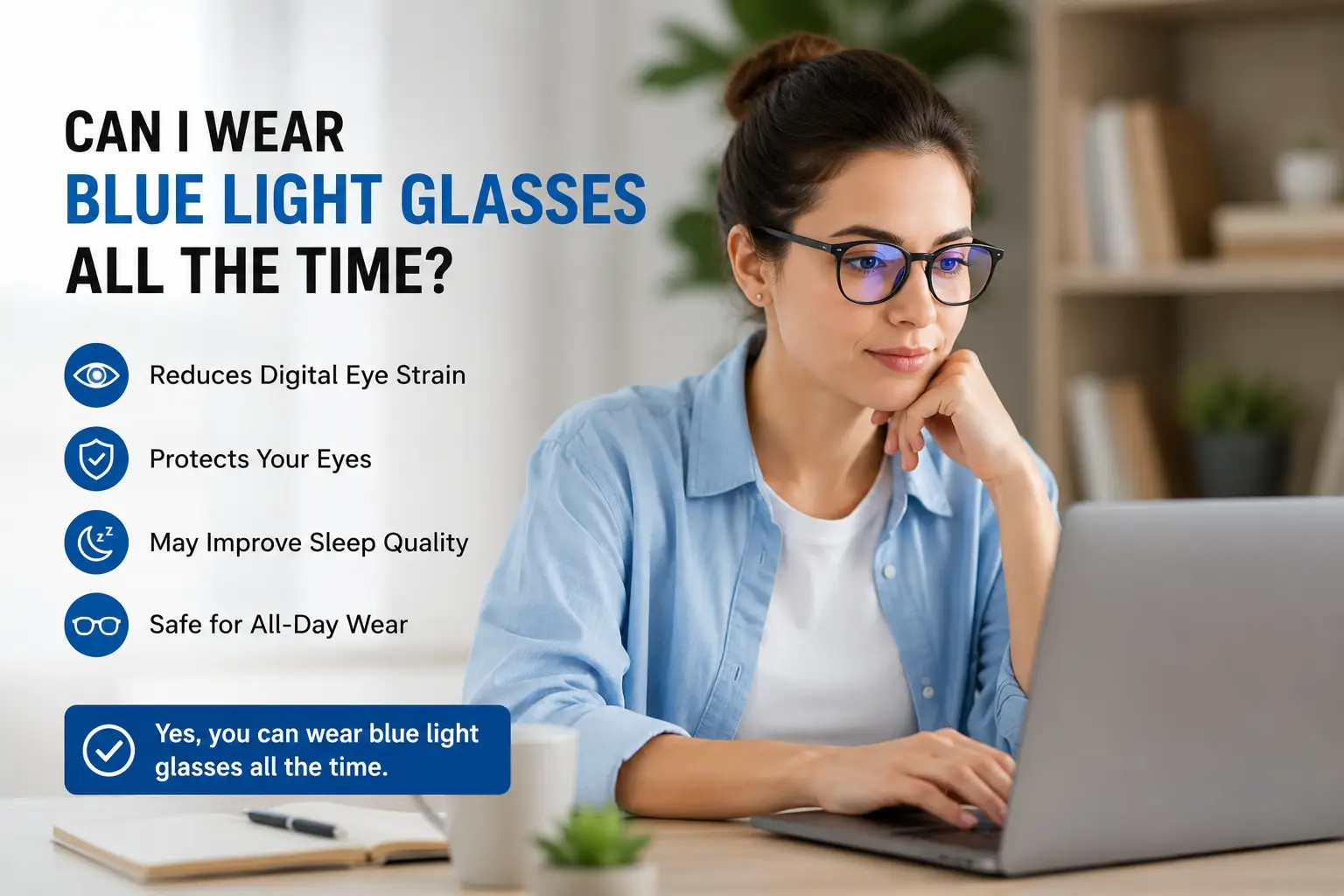
If you’ve typed “can i wear blue light glasses all the time” into a search bar at 11 p.m. with tired, gritty eyes, you’re in good company. Somewhere between a global shift to remote work and kids doing homework on tablets, blue light glasses went from a niche gadget-store item to something you’ll spot on half your coworkers by 3 p.m. The short answer is yes, you can wear blue light glasses all day, every day — they’re not medical devices and there’s no dosage limit — but “can” and “should” aren’t quite the same question, and the honest answer is a little more nuanced than the marketing copy on most product pages.
This guide walks through what the research actually says about all-day wear, seven real pairs of blue light glasses you can find on Amazon right now (from budget two-packs to premium prescription-ready frames), and the practical details — fit, lens tint, when to actually put them on — that most listings skip entirely. We’ll also flag where the evidence is thin, because an honest recommendation means telling you when a product’s marketing claims outrun the science, not just repeating them.
One quick disclosure before we dive in: this post contains affiliate links, and as an Amazon Associate we may earn from qualifying purchases at no extra cost to you. That doesn’t change which products we recommend or how we describe them — it just funds the research that goes into guides like this one.
Blue Light Glasses at a Glance
Before the deep dive, here’s a fast snapshot of how the main options stack up. If you only read one table, make it this one.
| Type | Best For | Blue Light Blocked | Price Range |
|---|---|---|---|
| Clear-lens computer glasses | All-day office wear, video calls | 15%-50% | Under $150 |
| Amber/yellow-tint glasses | Evening screen use, sleep prep | 65%-99% | Under $100 |
| Prescription blue-light add-on | Anyone who already needs corrective lenses | 30%-60% | $145-$300+ |
| Budget two-packs | Casual users, kids, backup pairs | 90%-95% (clear lens) | Under $30 |
This table simplifies a fragmented market, but the pattern that matters is this: the more amber or yellow a lens looks, the more of the high-energy blue-violet spectrum it’s actually filtering, while clear lenses trade blocking power for something you can wear on a Zoom call without looking jaundiced. If your main goal is comfort during the workday, a clear or lightly-tinted lens like the ones from Felix Gray or Benicci makes more sense than an amber pair. If your goal is protecting your sleep after a late gaming session, a heavier amber lens like GUNNAR‘s Amber Max does more of the job that blue light glasses can actually do.
💬 Found this comparison useful? Bookmark this page so you have it handy while you shop.
Top 7 Blue Light Glasses Worth Buying in 2026
We looked at spec sheets, lens technology, and aggregated customer feedback across budget, mid-range, and premium tiers to land on this list. Every pick below is a real product you can find on amazon.com — no invented names, no placeholder brands.
1. livho 2 Pack Blue Light Blocking Glasses — cheapest way to try the category
If you just want to see whether blue light glasses do anything for you before committing real money, this is the low-risk entry point. The two-pack format alone tells you what this brand is optimizing for: volume, not luxury.
livho’s clear lenses are rated to filter a meaningful chunk of blue-violet wavelengths and carry UV400 protection, which in practice means they cut glare from fluorescent office lighting almost as much as they cut screen light. The nylon frames flex instead of snapping, which matters if you’re the type of person who sits on their glasses at least once a month. In practice, that flexibility is the difference between a pair that survives a backpack and one that needs replacing every few weeks.
Who it’s for: students, backup pairs for the office, or anyone testing the waters before spending $100+ on a premium frame. It’s not the pair to reach for if you need all-day optical clarity for a demanding prescription, since these are non-prescription only.
Reviews consistently report strong value for the price, with the most common complaints centered on minor lens fogging or scratching on some color variants rather than the blue-light performance itself. A handful of reviewers note the frames run slightly loose on smaller faces.
Pros:
- ✅ Extremely low price for two full pairs
- ✅ Flexible nylon frames resist snapping
- ✅ UV400 protection included at this price point
Cons:
- ❌ No prescription option available
- ❌ Some color variants report lens fogging issues
Expect to pay well under $30 for the two-pack, and at that price, the value proposition holds even if you only wear one pair regularly and keep the second as a spare.
2. Prospek Elite Blue Light Blocking Glasses — strongest blocking for the price
Prospek built its whole brand around a single number: how much blue light the lens actually filters, and its amber-lens models claim to block up to 99% of the spectrum most linked to screen discomfort and evening melatonin suppression.
The lens itself uses a multi-layer coating stack that combines blue-light filtering with anti-glare treatment, which in practice means fewer of those halo reflections you get from monitor light bouncing back at you during a long spreadsheet session. Because the amber tint is fairly pronounced compared to clear-lens competitors, colors on screen will shift noticeably warmer — a trade-off worth knowing before you buy rather than discovering after your first Photoshop session.
Who it’s for: heavy evening screen users, night-shift workers, and anyone whose main complaint is trouble winding down after late-night scrolling rather than daytime eye fatigue. It’s a poor fit for graphic designers or anyone doing color-sensitive work, where that amber cast becomes a real problem.
Aggregated customer reviews frequently mention noticeably easier evenings after switching devices off, alongside praise for the lightweight frame. A recurring critique across reviews is inconsistent build quality between frame colors, with some buyers reporting a flimsier feel on certain styles than others.
Pros:
- ✅ High blue-light blocking percentage on amber models
- ✅ Anti-glare coating reduces screen reflections
- ✅ Lightweight frame comfortable for hours of wear
Cons:
- ❌ Amber tint noticeably distorts on-screen colors
- ❌ Frame quality reportedly inconsistent across color options
Prices generally land in the $25-$45 range depending on the style, which makes this one of the better dollar-for-blocking-percentage values in the whole lineup.
3. Benicci Stylish Blue Light Blocking Glasses — best all-day, near-invisible option
Benicci’s whole pitch is that you shouldn’t have to choose between eye protection and looking like you’re wearing safety goggles, and the nearly colorless lens is what sells that promise.
The lens coating filters a moderate portion of blue-violet light without the yellow cast that amber lenses bring, so what you see on screen stays close to true color — a real advantage if you’re on video calls all day and don’t want to explain why your face looks tinted. The included blue-light test card is a nice, honestly rare touch: it lets you shine a blue-light source through the lens and see the filtering effect for yourself instead of taking the brand’s word for it.
Who it’s for: office workers and hybrid employees who want a pair they can wear from their first meeting to their last email without anyone noticing they’re wearing “computer glasses” at all. Fashion-forward buyers may find the frame color selection limiting.
Real customer feedback tends to emphasize comfort during multi-hour wear and a genuinely lightweight feel, with a smaller subset of reviewers wishing for more frame styles or bolder color choices.
Pros:
- ✅ Nearly colorless lens preserves true screen colors
- ✅ Comfortable for extended, all-day wear
- ✅ Includes a blue-light test card for verification
Cons:
- ❌ Limited frame color and style options
- ❌ Lower blocking percentage than amber-lens alternatives
Typical pricing sits in the $20-$35 range, which is a strong value for a frame this comfortable and this close to invisible on video.
4. GUNNAR Intercept (Amber Max Lens) — best for gamers and night owls
GUNNAR essentially invented the gaming-glasses category, and the Intercept with the Amber Max lens is the brand leaning hardest into its “maximum protection” tier, aimed at people whose screen sessions run long and late.
The lens uses GUNNAR’s patented technology paired with what the company calls its Blue Light Protection Factor rating, which functions like an SPF number for blue light — the Amber Max version is rated to block roughly 98% of peak blue light near the 450nm range, alongside 100% UV protection. In practice, that heavy filtering is genuinely built for evening and nighttime sessions rather than daytime desk work, since the amber cast is strong enough to notably shift how monitor colors render.
Who it’s for: gamers doing marathon sessions, shift workers on screens after dark, and anyone whose sleep is disrupted by pre-bed scrolling. It’s a poor daytime pick for anyone doing color-accurate creative work, and the retro frame styling won’t suit every office.
Customer reviews commonly cite genuine comfort during multi-hour gaming sessions and note the glasses stay put during head movement, a detail that matters more than it sounds for competitive gaming. Some reviewers mention the amber tint takes a session or two to get used to visually.
Pros:
- ✅ Among the highest published blue-light blocking percentages
- ✅ Ergonomic frame stays secure during movement
- ✅ Backed by a one-year warranty and 30-day returns
Cons:
- ❌ Strong amber tint unsuitable for color-sensitive daytime work
- ❌ Retro gamer aesthetic isn’t for every workplace
GUNNAR’s Intercept typically runs in the $60-$90 range depending on the exact lens tint, positioning it as a mid-range investment for genuinely heavy screen users rather than casual buyers.
5. Felix Gray Jemison Blue Light Glasses — best clear-lens option for professionals
Felix Gray built its reputation on a proprietary filtering technology infused directly into the lens material rather than a surface coating, which the brand claims filters substantially more of the specific high-energy blue-violet wavelengths than typical clear-lens competitors, without the coating wearing off over time.
That “infused, not coated” detail actually matters in practice: surface coatings on cheaper glasses can degrade with cleaning over months, while a lens treatment built into the material itself holds its filtering power for the life of the glasses. Paired with a double-sided anti-reflective coating, the Jemison frame is designed for people who live in video calls and can’t afford a lens that introduces glare into every meeting.
Who it’s for: remote and hybrid professionals who want a premium, barely-tinted lens for daily wear, plus anyone who’s tried cheaper glasses and found the filtering fades or the anti-glare coating peels. Budget shoppers will find the price point hard to justify for casual, occasional use.
Aggregated reviews frequently highlight a genuine reduction in end-of-day eye fatigue and praise the frame’s durability, while a recurring theme in critical reviews is that the narrower frame styles run snug on broader face shapes.
Pros:
- ✅ Lens filtering technology built into the material, not a coating
- ✅ Double-sided anti-glare treatment reduces call-time glare
- ✅ Prescription and non-prescription versions both available
Cons:
- ❌ Premium price relative to most competitors on this list
- ❌ Narrower frames may not suit larger face shapes
Non-prescription pairs generally run in the $95-$130 range, climbing higher with a prescription — a real investment, but one that lines up with the brand’s positioning as the professional-grade option in this lineup.
6. Warby Parker Blue-Light Lens Add-On — best for prescription wearers
If you already need corrective lenses, buying a separate pair of non-prescription blue light glasses is redundant, and Warby Parker solves that by letting you add blue-light filtering to any frame in its catalog, prescription or not.
The add-on itself is a treatment layered onto Warby Parker’s standard polycarbonate lenses, which already include scratch-resistant, anti-reflective, and full UVA/UVB coverage at no extra cost — the blue-light option simply stacks on top for an additional fee. In practice, that means you’re not choosing between “my prescription” and “blue light protection”; you get a single pair of glasses doing both jobs, which is a genuine convenience most dedicated blue-light brands can’t offer.
Who it’s for: anyone who wears prescription glasses daily and doesn’t want to juggle a second non-prescription pair for screen time, plus buyers who value a recognizable brand with in-person try-on options and vision-insurance compatibility. It’s overkill if you don’t need a prescription and just want basic screen protection.
User feedback on the ordering experience tends to be positive, with praise for the home try-on program and responsive customer service; a smaller number of reviews mention shipping delays or longer turnaround times than expected for prescription orders.
Pros:
- ✅ Combines your prescription and blue-light filtering in one pair
- ✅ Backed by an established, insurance-friendly retailer
- ✅ Includes standard anti-reflective and full UV coating at no extra cost
Cons:
- ❌ Add-on pricing stacks on top of already premium frame costs
- ❌ Overkill if you don’t need vision correction
Frames start around $95, with the blue-light add-on typically running an additional $50 on top — so budget somewhere in the $145-$250+ range depending on the frame and any high-index lens upgrades.
7. Cyxus Blue Light Blocking Computer Glasses — best lightweight budget alternative
Rounding out the list is a lesser-known but genuinely solid alternative for anyone who wants something between the ultra-cheap two-packs and the premium professional frames.
Cyxus builds its computer-glasses line around lightweight TR90 frame material, which is more flexible and durable under repeated bending than the rigid plastic used in many budget competitors, paired with clear or lightly tinted lenses that filter a moderate portion of blue-violet light without a heavy color cast. That combination of flex-resistant frame material and a barely-there tint makes this a practical middle-ground pick for anyone who wants daily wearability without spending Felix Gray money.
Who it’s for: students, budget-conscious remote workers, and anyone who wants a genuinely comfortable frame for eight-hour wear without the premium-brand price tag. Buyers chasing maximum blocking percentages for nighttime use should look toward the amber options higher on this list instead.
Reviews commonly describe the frame as surprisingly comfortable for extended wear and note the flexible hinges hold up better than expected over months of daily use, with occasional mentions that the clear lens offers only modest blue-light filtering compared to tinted alternatives.
Pros:
- ✅ Durable, flexible TR90 frame material
- ✅ Comfortable for full workday wear
- ✅ Budget-friendly without feeling disposable
Cons:
- ❌ Clear lens filters less blue light than amber alternatives
- ❌ Limited premium styling compared to designer brands
Typical pricing lands in the $15-$25 range, making it one of the better values on this list for anyone who wants durability without paying for a brand name.
Comparing the Full Lineup
| Product | Lens Type | Blue Light Blocked | Price Range | Best For |
|---|---|---|---|---|
| livho 2 Pack | Clear | Moderate | Under $30 | Trying the category cheaply |
| Prospek Elite | Amber | Very high (~99%) | $25-$45 | Evening/night screen use |
| Benicci Stylish | Near-clear | Moderate | $20-$35 | All-day video calls |
| GUNNAR Intercept Amber Max | Amber Max | Very high (~98%) | $60-$90 | Gamers, late-night sessions |
| Felix Gray Jemison | Clear | Moderate-high | $95-$130 | Remote professionals |
| Warby Parker Add-On | Clear/tinted | Moderate | $145-$250+ | Prescription wearers |
| Cyxus Computer Glasses | Clear | Moderate | $15-$25 | Budget all-day comfort |
Looking at the table above, the pattern holds across nearly every brand: amber lenses like Prospek Elite and GUNNAR Intercept Amber Max block the most blue light but cost you color accuracy, while clear-lens options like Benicci Stylish and Felix Gray Jemison sacrifice some blocking power to stay usable on video calls and creative work. If budget is your main constraint, livho and Cyxus deliver a surprising amount of comfort and basic filtering for a fraction of the premium price. If you already wear prescription lenses, Warby Parker‘s add-on avoids the hassle of a second pair entirely.
💬 One click helps other shoppers make an informed choice too! 😊
How to Start Wearing Blue Light Glasses (Without Wasting Money)
Buying the glasses is the easy part. Getting real value out of them over the following weeks depends on a few habits most product pages never mention.
Start by wearing your new glasses for shorter stretches — two or three hours at a time — for the first few days rather than committing to all-day wear immediately. Amber and heavily-tinted lenses in particular can cause a brief adjustment period where colors look off or your eyes feel like they’re working to compensate; that’s normal and typically fades within a week. If you jumped straight to a strong amber pair like the GUNNAR Intercept, expect this adjustment to be more noticeable than it would be with a near-clear pair like Benicci.
Match the lens tint to the time of day rather than wearing the same pair around the clock. A near-clear lens like Felix Gray Jemison or Benicci Stylish makes sense for your 9-to-5, while an amber pair like Prospek Elite earns its keep in the two to three hours before bed, when the goal shifts from daytime comfort to protecting your evening melatonin production. Wearing an amber lens all day, every day, isn’t harmful, but it also isn’t buying you anything extra during work hours that a clear lens wouldn’t.
Clean your lenses with the microfiber cloth that ships with nearly every pair on this list, not your shirt hem — cheap cleaning habits are the single biggest reason budget frames like livho or Cyxus develop the light scratching some reviewers mention. And don’t treat the glasses as a substitute for basic screen ergonomics: the 20-20-20 rule (every 20 minutes, look at something 20 feet away for 20 seconds) still does more for genuine eye fatigue than any lens coating on the market.
Real-World Scenarios: Who Actually Benefits From All-Day Wear
Not every screen user has the same relationship with their glasses, so here’s how three common profiles tend to shake out.
The remote professional on back-to-back video calls, roughly eight hours a day, five days a week, gets the most consistent value from a near-clear, comfortable pair like Felix Gray Jemison or Benicci Stylish. Their priority is color accuracy on camera and zero eye fatigue by 5 p.m., not maximum blue-light blocking, so a heavily-tinted amber lens would actively work against them during meetings.
The competitive gamer or late-night streamer, putting in three-to-five-hour sessions after dark several nights a week, is the textbook use case for GUNNAR Intercept‘s Amber Max lens or Prospek Elite. Their main complaint is usually difficulty winding down after a session, and the heavier amber tint is specifically designed to blunt the blue-violet light most linked to delayed melatonin release in the evening.
The budget-conscious student splitting time between lecture slides, a part-time job on a POS screen, and evening homework doesn’t need a $130 designer frame — a Cyxus or livho pair covers the basics of comfort and modest filtering without the investment, and it’s disposable enough that losing or sitting on a pair isn’t a financial event.
Common Problems With All-Day Wear (and How to Fix Them)
A few recurring complaints show up across nearly every brand’s reviews, and most have simple fixes.
Colors looking washed out or yellow on screen is almost always a symptom of an amber lens being worn during daytime, color-sensitive work. The fix isn’t a different brand — it’s switching to a clear-lens pair like Benicci Stylish for the workday and saving the amber pair for evening use.
Headaches that show up in the first week of wearing a new pair are usually an adjustment-period issue, not a sign the glasses are wrong for you, assuming the frame itself fits properly. If discomfort persists past two weeks, that’s a signal to check the fit rather than push through — glasses sitting too tightly against your temples can cause tension headaches that have nothing to do with the lens tint.
Frames feeling loose or sliding down your nose during long sessions is common with lightweight budget frames like livho‘s nylon build. Look for adjustable nose pads on pricier pairs like GUNNAR Intercept, or simply size down a frame width if you’re between sizes.
Lens fogging or scratching after a few months, a complaint that surfaces in reviews for several budget brands, usually traces back to cleaning technique rather than manufacturing defects — stick to the included microfiber cloth and avoid paper towels or clothing, which carry abrasive fibers.
Can You Wear Blue Light Glasses All the Time? What the Science Actually Shows
Wearing blue light glasses all the time is what the American Academy of Ophthalmology addresses directly, though maybe not in the way most marketing pages suggest. The Academy has taken a clear position: there’s no scientific evidence that light from computer screens damages the eyes, and it does not recommend special eyewear for computer use. That’s a meaningful distinction from saying the glasses are harmful — they’re simply not proven to fix the problem they’re most often marketed for.
The most rigorous review of the evidence is a 2023 Cochrane systematic review, widely considered the gold standard in evidence-based medicine, which pooled data from multiple randomized controlled trials and found that blue-light filtering lenses probably make little to no difference in short-term eye strain symptoms compared to non-filtering lenses. So if your main goal in wearing them all day is preventing eye strain itself, the research doesn’t back that up — what actually helps, according to the American Optometric Association, is addressing the real drivers of digital eye strain: reduced blink rate, poor screen distance, and uncorrected vision problems.
Sleep is where the evidence looks a little different, though still not settled. Blue light in the evening does appear to interact with your circadian rhythm and melatonin production, which is why amber lenses worn in the hours before bed have a more defensible rationale than clear lenses worn at 10 a.m. Even there, though, U.S. News reports that experts remain skeptical of strong claims, largely because the blue light coming off a laptop or phone is a small fraction of what you’re exposed to simply being outside on an overcast day.
Put plainly: wearing blue light glasses all the time isn’t dangerous, and if they make your screen time feel more comfortable, there’s genuinely little downside to keeping them on. What honesty requires is not overselling them as a fix for eye strain the research doesn’t support, and being upfront that the strongest use case — evening wear to protect sleep — is also the one where a heavy amber tint like Prospek Elite‘s or GUNNAR‘s Amber Max makes the most practical sense, rather than a barely-tinted daytime pair.
How to Choose the Right Blue Light Glasses
If you’re standing in front of a wall of near-identical options, these seven criteria, in rough order of importance, will actually move the needle on which pair you should buy.
- Decide your primary use case first. Daytime office wear calls for a clear or near-clear lens like Felix Gray Jemison; evening wind-down calls for amber like Prospek Elite.
- Check whether you need a prescription. If you do, Warby Parker‘s add-on avoids a redundant second pair; if not, any non-prescription pick on this list works.
- Match frame size to your face shape. A frame that’s too small lets blue light leak around the edges of the lens, undercutting whatever filtering the lens itself provides.
- Look for anti-reflective coating, not just blue-light filtering. Glare reduction, like the double-sided coating on Felix Gray, does more for visible comfort than the blue-light claim alone.
- Consider durability if you’re rough on glasses. Flexible nylon or TR90 frames, like those from livho and Cyxus, survive drops and sitting-on-them better than rigid plastic.
- Read the return policy before you buy. Brands like GUNNAR and Warby Parker offer 30-day returns, which matters if the tint or fit turns out wrong.
- Budget realistically for how often you’ll actually wear them. A $130 premium pair only pays off with daily use; occasional users are better served by a $20-$30 option like Benicci Stylish.
Common Mistakes to Avoid When Buying Blue Light Glasses
The most expensive mistake buyers make is treating “blue light glasses” as a single category with a single job, when in reality the market splits into two genuinely different products: clear daytime lenses and amber evening lenses. Buying an amber pair expecting daytime comfort — or a clear pair expecting sleep benefits — sets you up for disappointment that has nothing to do with product quality.
A second common mistake is chasing the highest advertised blocking percentage without checking whether that number is independently verified or self-reported by the brand. GUNNAR’s Blue Light Protection Factor rating is one of the few standardized metrics in this space; most competitors simply print a percentage on the packaging with no third-party testing behind it. That doesn’t mean the number is false, but it does mean you should weigh it alongside real user reviews rather than treating it as gospel.
A third mistake, and a subtle one, is assuming a higher price automatically means better filtering. Warby Parker‘s add-on costs more than GUNNAR‘s standalone frames largely because you’re paying for prescription lens integration and brand infrastructure, not because the blue-light filtering itself is stronger. Price in this category tracks build quality, brand services, and frame materials far more than it tracks actual blocking performance.
Blue Light Glasses vs. Screen Settings and Night Mode
Every phone and laptop sold in the last several years ships with a built-in “night mode” or “night shift” feature that shifts the display toward warmer tones in the evening — which raises a fair question: do you need glasses at all if your device already does this?
| Approach | Blue Light Reduction | Cost | Convenience |
|---|---|---|---|
| Built-in night mode | Moderate, adjustable | Free | Automatic, but affects only that device |
| Amber blue light glasses | High (65%-99%) | $20-$90 | Works across all screens and ambient light |
| Clear blue light glasses | Low-moderate | $20-$130 | Works across screens, minimal color shift |
The honest answer is that they solve overlapping but not identical problems. Night mode only affects the one device it’s enabled on, so it does nothing for the fluorescent office lighting overhead or the second monitor you forgot to adjust. A physical pair of glasses like Prospek Elite or GUNNAR Intercept works everywhere you go, regardless of device settings, which matters if you’re bouncing between a laptop, a phone, and a TV in the same evening. On the other hand, night mode costs nothing and requires no adjustment period, which makes it a reasonable first step before spending money on glasses at all.
For most people, the two aren’t competing solutions — they’re complementary. Running night mode on your devices after sunset while wearing a clear daytime pair like Benicci Stylish through your work hours covers more bases than relying on either one alone.
✨ Don’t miss these exclusive deals! 🔍 Take your screen comfort to the next level with this carefully curated lineup. Click a highlighted pick to check current pricing and availability on Amazon. These picks will help you get through long workdays and late-night sessions more comfortably.
Features That Actually Matter (and Ones That Don’t)
Marketing copy in this category loves to pile on features, but only a handful genuinely affect your day-to-day experience.
Anti-reflective coating matters more than most buyers realize — it’s the difference between a monitor’s glare bouncing straight into your eyes and a lens that actually cuts that reflection down. Felix Gray‘s double-sided treatment and Prospek‘s anti-glare layer both do real work here, arguably more than their blue-light filtering claims.
Frame fit and weight matter enormously for anyone wearing glasses for six-plus hours a day, since a frame that pinches at the temples will cause more discomfort over a workday than any lens tint choice. This is where lightweight builds like Cyxus‘s TR90 frame earn their keep.
UV protection is a genuine bonus feature, not a gimmick — most pairs on this list, including livho and GUNNAR, include UV400 coverage, which is worth having even though it has nothing to do with screen use specifically.
On the other side of the ledger, precise blue-light blocking percentages beyond “amber vs. clear” matter far less than brands suggest, since the difference between a claimed 95% and 99% blocking rate isn’t something you’ll perceive, and independent verification of those numbers is inconsistent across the industry. Similarly, “gaming-specific” branding on frames like GUNNAR‘s lineup is mostly styling and marketing — the underlying lens technology works identically whether you’re gaming or spreadsheet-ing.
Long-Term Cost and Maintenance
The sticker price is only part of the real cost of owning blue light glasses. A $20 pair from livho or Cyxus that needs replacing every six months due to scratched lenses or a snapped hinge can end up costing more over two years than a single $95 Felix Gray frame built to last.
That said, durability claims are easy to make and hard to verify without long-term use, so the safer approach is matching your spend to how carefully you treat your glasses. If you’re prone to losing or sitting on things, a $20-$30 pair you won’t mourn losing is the more rational choice, even if the per-unit cost of ownership over years slightly favors the premium option on paper. If you wear glasses daily and take care of them, investing in Felix Gray‘s infused-lens technology or Warby Parker‘s integrated prescription option pays off through fewer replacements and a warranty that actually covers you.
Maintenance costs are minimal across the board — a microfiber cloth and occasional case replacement — but frames with adjustable nose pads and reinforced hinges, like GUNNAR‘s Intercept line, tend to need fewer repairs over multi-year use than ultra-budget alternatives.
Safety, Regulations, and Standards
Because blue light glasses are classified as non-prescription eyewear rather than medical devices in the United States, they aren’t subject to FDA clinical-efficacy review the way a drug or a genuine medical device would be — a distinction worth understanding before taking any brand’s health claims at face value. That said, reputable brands still build to real standards: UV protection claims should meet the UV400 benchmark, meaning the lens blocks light up to 400 nanometers, and frames marketed for impact resistance in gaming or safety contexts often reference ANSI Z87.1 testing, which is the same standard used for protective eyewear more broadly.
If you’re shopping specifically for a product marketed as “safety glasses” with blue-light filtering, checking for that ANSI certification is a reasonable way to separate genuine protective eyewear from lifestyle accessories wearing similar branding. For general comfort-focused shopping, though, none of the seven picks above need to meet that bar, since they’re positioned as everyday eyewear rather than protective equipment. According to the Cleveland Clinic, the underlying condition most blue light glasses are marketed against — computer vision syndrome — is driven primarily by screen habits like reduced blinking and poor viewing distance rather than light exposure itself, which is a useful frame for setting realistic expectations regardless of which pair you buy.
Frequently Asked Questions
❓ Can I wear blue light glasses all the time, even outdoors?
❓ Do blue light glasses actually reduce eye strain?
❓ Is it bad to wear blue light glasses without a prescription?
❓ Can you wear blue light glasses at night before bed?
❓ How do I know if my blue light glasses are actually working?
Conclusion
So, can i wear blue light glasses all the time? Yes — there’s no safety reason not to, and if a pair makes your screen time feel more comfortable, that’s a legitimate reason to keep wearing them daily. What the honest version of this answer adds is nuance the marketing usually skips: the strongest scientific backing exists for evening, sleep-focused wear with an amber lens like Prospek Elite or GUNNAR Intercept Amber Max, not for the eye-strain-prevention claims that sell most daytime pairs.
If you’re shopping today, match the lens to your actual routine rather than the loudest marketing claim. A near-clear, all-day pair like Benicci Stylish or Felix Gray Jemison suits office and video-call hours; an amber pair earns its keep after sunset; and if you already wear prescription lenses, Warby Parker‘s add-on saves you from juggling two pairs entirely. Budget shoppers lose surprisingly little by starting with livho or Cyxus rather than jumping straight to premium brands.
Whatever you choose, remember that the glasses are a comfort tool, not a cure — pairing them with the 20-20-20 rule, proper screen distance, and reasonable pre-bed screen limits will do more for your eyes than any lens tint alone.
✨ Ready to find your pair? Check today’s pricing on any of these seven picks and see which fits your routine best!
Recommended for You
- 7 Best Blue Tortoise Shell Glasses of 2026 (Honest Buyer’s Guide)
- Tortoise Shell Blue Glasses: 7 Best Picks for 2026 (Buyer’s Guide)
- 7 Best No Blue Light Bulbs for Sleep in 2026 (Buyer’s Guide)
Disclaimer: This post contains affiliate links. As an Amazon Associate, I earn from qualifying purchases made through these links, at no additional cost to you.
✨ Found this article helpful? Share it with someone who needs it! 💬🤗