In This Article
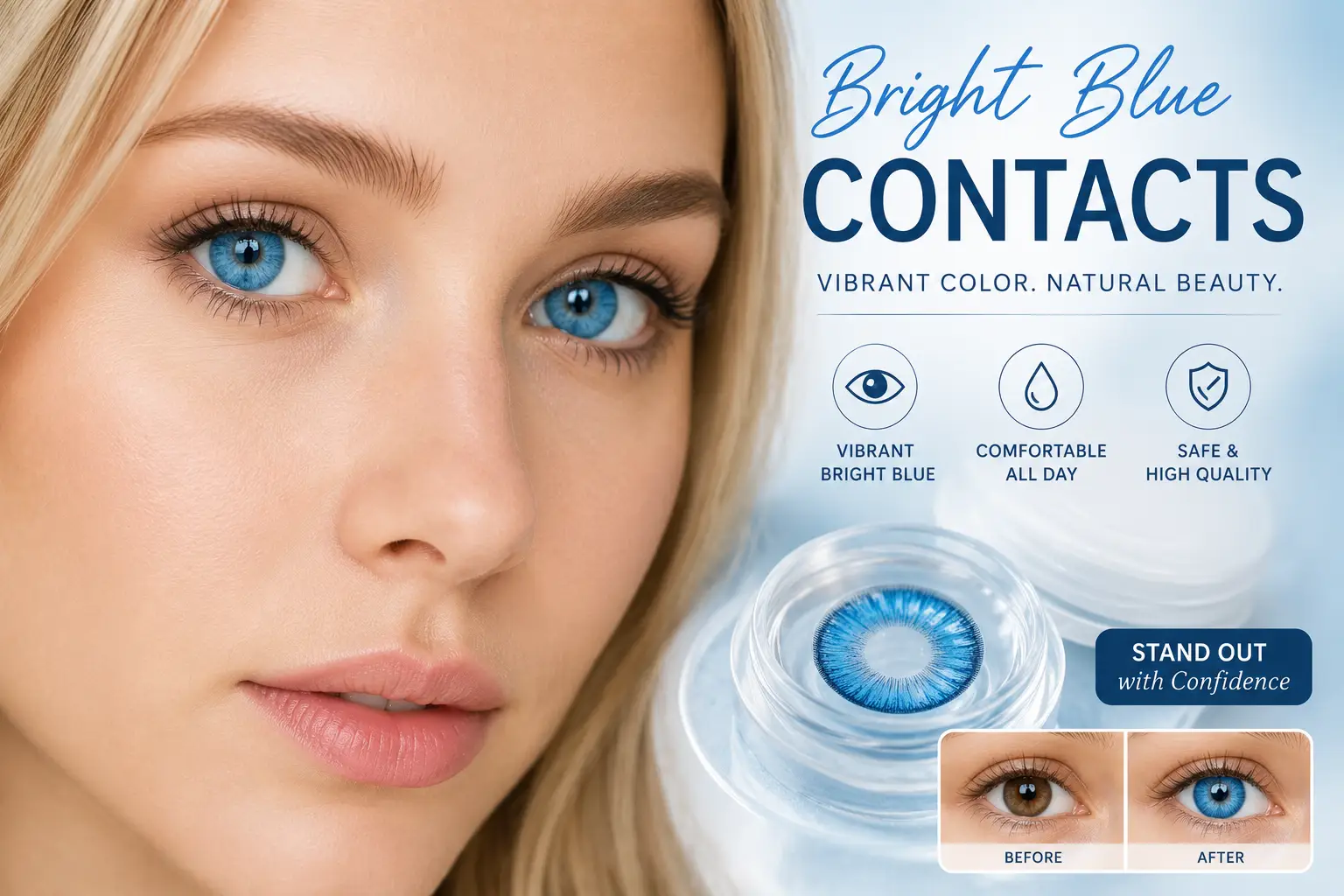
Brown eyes, hazel eyes, green eyes — it doesn’t matter what you started with, because bright blue contacts can change your whole look in about thirty seconds. Whether you’re chasing a dramatic costume transformation, a subtle everyday shift, or just curious what you’d look like with striking blue eyes, the market has never offered more real options than it does in 2026. The tricky part isn’t wanting blue eyes; it’s figuring out which lens actually delivers a natural-looking, comfortable, safe result instead of a flat, plastic-looking tint that dries out your eyes by lunchtime.
That’s what this guide is for. We’ve dug into real spec sheets, aggregated customer feedback, and the technical differences between opaque tints, blended color technology, and enhancer lenses so you don’t have to guess. You’ll find seven real, purchasable blue contact lens products spanning budget-friendly to premium, an honest comparison of how they perform on different eye colors, and the safety information the U.S. Food and Drug Administration wants every buyer to know before ordering colored lenses of any kind. One thing to flag right away: in the United States, all contact lenses — including purely cosmetic, zero-correction bright blue contacts — are legally classified as medical devices and require a valid prescription and a proper fitting from a licensed eye care professional, even if you don’t need vision correction.
We’ll cover how the leading brands differ in comfort, opacity, and color technology; which options work best for dark brown eyes versus lighter eyes; how to budget for ongoing lens costs; and the everyday mistakes that lead to disappointing results or, worse, an eye infection. By the end, you’ll know exactly which bright blue contacts fit your eye color, your budget, and your lifestyle.
Quick Comparison: Bright Blue Contacts at a Glance
Before diving into full reviews, here’s a fast snapshot of how the seven picks stack up on wear schedule, opacity, and price range.
| Product | Lens Type | Wear Schedule | Best For | Price Range |
|---|---|---|---|---|
| FreshLook Colorblends Blue | 3-tone blended opaque | Monthly | Natural-looking color shift | $30–$40/box of 6 |
| Air Optix Colors Brilliant Blue | Opaque, silicone hydrogel | Monthly | All-day comfort, dark eyes | $40–$55/box of 6 |
| SofLens Natural Colors Sapphire | Enhancer tint | Monthly | Budget pick for light eyes | Under $30/box |
| TTDeye Spanish Blue | Opaque cosmetic | Monthly | Budget bold color | $20–$25/pair |
| EyeCandys Glossy Blue | Opaque cosmetic | Monthly | Trend-forward vivid blue | $25–$35/pair |
| Desio Icy Blue | Ring-blend opaque | Monthly | Natural-edge premium look | $45–$60/pair |
| Solotica Hidrocor Azul | Hydrocor pigment opaque | Monthly | Most vivid, high-end finish | $60–$80/pair |
Looking at this table, the spread tells its own story: SofLens Natural Colors Sapphire and TTDeye Spanish Blue are the entry points for anyone testing the waters, while Solotica Hidrocor Azul sits at the top for buyers who want the most saturated, glass-like blue money can currently buy. The middle of the pack — FreshLook Colorblends Blue, Air Optix Colors Brilliant Blue, EyeCandys Glossy Blue, and Desio Icy Blue — is where most first-time colored contact wearers land, because they balance opacity, comfort, and price without asking you to compromise much on any single factor.
💬 Found a favorite already? One click helps you compare current pricing and availability before you commit! 😊
Top 7 Bright Blue Contacts You Can Actually Buy in 2026
Every product below is a real, currently sold lens, evaluated on its actual specs, its aggregated customer sentiment, and how it performs specifically as a bright blue color contact. Remember: every one of these requires a valid prescription and a comfortable, correctly fitted lens from an eye doctor — even the zero-correction “plano” versions.
1. FreshLook Colorblends Blue — most natural-looking blended blue
Alcon’s Colorblends line built its reputation on a simple idea: three transparent colors layered together look more like a real iris than one flat blue disc, and that’s exactly what you get here. The lens blends dots of blue, turquoise, and gray-blue across the surface instead of stamping down a single opaque circle, so light passes through it the way it does through a natural eye. Available with or without vision correction, it works on a wide range of prescriptions, and Alcon’s Lightstream Technology keeps the lens surface smooth and comfortable through a full month of scheduled wear.
What makes this one worth the extra thought is how it performs specifically on darker eyes: because the color layers overlap rather than sitting as a single flat tint, brown-eyed wearers get more depth and less of the “circle drawn over my iris” look that cheaper opaque lenses produce. Reviews consistently report that Colorblends looks convincingly close to a real eye color in daylight and photos, which is the single most common complaint people have about budget colored contacts. It’s a strong pick for someone who wants their blue eyes to read as plausible rather than obviously cosmetic, whether that’s for everyday wear, a wedding, or a photoshoot.
Aggregated customer feedback across major retailers skews positive on comfort and color realism, with the most common criticism being that the blue shade can look slightly muted on very dark brown eyes compared to the marketing photos — a pattern that shows up across nearly every blended-tone lens, not just this one.
Pros:
- ✅ Natural three-tone blend looks convincing in daylight
- ✅ Available with or without vision correction
- ✅ Smooth, comfortable surface for full-month wear
Cons:
- ❌ Less dramatic color pop than fully opaque options
- ❌ Requires a fitting appointment before your first order
In the $30 to $40 range per box of six lenses, Colorblends lands as one of the better value picks here — you’re paying mid-range money for a color technology that usually looks more expensive than it is.
2. Air Optix Colors Brilliant Blue — best all-day comfort for dark eyes
Air Optix Colors swaps the standard hydrogel material found in most colored lenses for silicone hydrogel, which is a genuinely meaningful upgrade rather than a marketing footnote. Silicone hydrogel lets roughly three to five times more oxygen reach the cornea than conventional hydrogel materials, which translates into less end-of-day dryness and redness — the exact complaint that drives most people to stop wearing colored contacts within the first few months.
The opaque Color Stable technology bonds pigment beneath the lens surface, which means the color doesn’t rub off, fade, or shift with UV exposure the way older dye-based lenses sometimes did. On dark brown eyes specifically, this opacity is a real advantage: the blue color reads as fully opaque and vivid rather than washed out, something the more natural-blend lenses on this list can’t always claim. Based on comparing the specs across this whole roundup, Air Optix Colors is the clearest “best comfort” pick for anyone who wears contacts most of their waking hours.
Aggregated reviews are strongly positive on comfort during long wear days, with the most repeated praise being that eyes don’t feel dry by evening the way they do with cheaper hydrogel-only lenses; the most common complaint is that the color, while vivid, reads as slightly more “obviously colored” than blended alternatives up close.
Pros:
- ✅ Silicone hydrogel material boosts oxygen flow to the eye
- ✅ Opaque tint shows true blue even on very dark eyes
- ✅ Color Stable technology resists fading over the month
Cons:
- ❌ Premium material pushes it above budget lens pricing
- ❌ Color can look slightly less “natural blend” up close
Between $40 and $55 per box of six lenses, this is a premium-tier price, but the oxygen permeability alone justifies it for daily wearers who’ve struggled with dry, irritated eyes on cheaper lenses.
3. SofLens Natural Colors Sapphire — best budget pick for lighter eyes
Bausch + Lomb’s SofLens Natural Colors line takes a different approach than the opaque lenses on this list: instead of covering your natural iris, it’s an enhancer tint designed to intensify a color that’s already close to blue. If you have light-colored eyes — gray, light hazel, or pale blue — this lens deepens and brightens what’s already there rather than trying to overwrite it, which is why it’s the most affordable option in this roundup.
The tradeoff is honest and worth stating plainly: on medium-to-dark brown eyes, an enhancer tint like this won’t produce a visible color change, because there’s no opaque layer to mask the underlying pigment. What it does well is give light-eyed wearers a richer, more saturated version of their natural blue or gray without the flat, “costume contact” look that heavier opaque tints can have. Reviews consistently describe it as the most comfortable, least noticeable lens to wear precisely because the tint is subtle rather than dramatic.
For buyers specifically hunting bright blue contacts to transform brown eyes, this isn’t the right product — but for anyone whose eyes are already light-toned and who wants a low-cost, low-drama boost, aggregated sentiment is consistently positive on comfort and natural appearance.
Pros:
- ✅ Lowest price point in this comparison
- ✅ Very natural, subtle result on light eyes
- ✅ Comfortable daily-wear material
Cons:
- ❌ Minimal to no visible effect on brown or dark eyes
- ❌ Less dramatic color payoff than opaque alternatives
At under $30 per box, this is the cheapest entry on the list — genuinely good value, but only for the specific eye-color situation it’s built for.
4. TTDeye Spanish Blue — best budget bold color
TTDeye built its business around exactly the shopper this article is written for: someone who wants a dramatic, fully opaque bright blue color without paying premium-brand prices. The Spanish Blue shade uses a fully opaque pigment layer, so it delivers a strong, obvious color shift on virtually any base eye color, including the darkest brown eyes — no subtlety, no blending, just a bold blue that reads clearly in photos.
What the spec sheet doesn’t say, but aggregated reviews reveal, is that opacity this strong comes with a tradeoff in edge definition: some wearers report the color ring can look slightly less blended at the outer edge compared to premium blended-tone lenses, especially in close-up photography. That’s a reasonable compromise at this price point, and it’s exactly why TTDeye has built a loyal following among people buying colored contacts primarily for cosplay, costume looks, or social media content rather than everyday subtlety.
Aggregated customer sentiment is generally positive on color payoff and value, with the most repeated theme being that buyers are surprised by how vivid the color looks for the price, while a smaller subset of reviews note the lenses feel slightly less breathable during very long wear sessions compared to silicone hydrogel options.
Pros:
- ✅ Fully opaque — visible color change on any eye shade
- ✅ Lowest price for a fully opaque bold blue
- ✅ Available with correction for nearsighted buyers
Cons:
- ❌ Less breathable material than silicone hydrogel lenses
- ❌ Edge blend less refined than premium options
Around $20 to $25 per pair, TTDeye Spanish Blue is the best-value pick here for anyone who wants maximum color drama on the smallest budget.
5. EyeCandys Glossy Blue — best trend-forward vivid finish
EyeCandys has built a strong online following, particularly with buyers who discover colored contacts through social media rather than a traditional optical retailer, and the Glossy Blue shade shows exactly why: it’s designed with a slightly reflective, glassy finish that photographs well under artificial and flash lighting, not just daylight. The opaque pigment layer sits with a soft gradient at the limbal ring (the darker outer edge of the iris), which is the detail that keeps fully opaque lenses like this one from looking like a flat sticker.
Beyond aesthetics, EyeCandys offers the lens with correction for a solid range of nearsighted prescriptions, which isn’t universal among the trend-driven cosmetic lens brands — many stick to plano-only. Based on comparing this to TTDeye, the closest competitor in this price tier, EyeCandys generally commands a slightly higher price for a marginally more refined limbal ring gradient and a glossier finish that shows up more in photos than in person.
Reviews consistently praise the color vibrancy and photo performance, while a recurring critique in aggregated feedback is that comfort during extended wear (eight-plus hours) doesn’t quite match premium silicone hydrogel lenses — a fair tradeoff most buyers accept given the price and the finish.
Pros:
- ✅ Glassy, photo-friendly finish with gradient limbal ring
- ✅ Available with correction for common prescriptions
- ✅ Strong color vibrancy in artificial lighting
Cons:
- ❌ Comfort dips on very long wear days versus premium lenses
- ❌ Priced above other cosmetic-focused competitors
In the $25 to $35 range per pair, EyeCandys Glossy Blue sits just above the rock-bottom budget tier, which tracks with its slightly more refined finish.
6. Desio Icy Blue — best natural-edge premium look
Desio, an Italian brand, takes the ring-blend approach popularized by Korean and Japanese circle lens brands and applies it specifically to a bright, icy blue shade. Rather than a hard-edged color circle, the lens uses a soft gradient ring design that fades gradually into the pupil area, which produces a result that reads as bright and dramatic from a normal conversational distance but avoids the stark, painted-on look of cheaper fully opaque lenses up close.
This is where honest analysis matters: Desio isn’t the most vivid or opaque lens on this list — Solotica and TTDeye both deliver a bolder, flatter color payoff — but it’s arguably the most flattering for everyday wear because the gradient does the work of making an obviously artificial color look intentional rather than costume-like. What most buyers overlook with a lens like this is that the softer edge design generally requires a slightly larger, more consistent iris measurement to look its best, which is one more reason a proper fitting matters before ordering.
Aggregated reviews highlight the natural gradient and comfortable fit as the standout qualities, with occasional feedback noting the price feels steep relative to the less dramatic color change compared to fully opaque competitors.
Pros:
- ✅ Soft gradient ring avoids a flat, painted-on look
- ✅ Reads as bright blue without looking costume-like
- ✅ Comfortable fit reported across most eye shapes
Cons:
- ❌ Premium pricing for a less opaque color payoff
- ❌ Best results depend on a careful, professional fitting
Between $45 and $60 per pair, Desio sits in premium territory, and the value case rests entirely on how much you prioritize a natural-edge finish over maximum color saturation.
7. Solotica Hidrocor Azul — most vivid, high-end finish
Solotica, a Brazilian brand with a near-cult following among longtime colored contact wearers, uses a patented Hidrocor pigment technology that most reviewers and eye care commentators agree produces the most saturated, glass-like blue color available in a cosmetic lens today. Instead of a flat opaque disc, the Hidrocor pigment has a translucent, almost luminous quality that catches light differently than standard opaque tints, which is why this shade shows up so often in professional photography and on-camera work.
The tradeoff for that best-in-class color payoff is price and availability: Solotica lenses are imported and typically cost noticeably more than domestic competitors, and because the brand has such strong brand loyalty, demand can occasionally outpace stock at smaller retailers. What the spec sheet doesn’t capture is why this brand commands premium prices year after year — it’s the specific optical quality of the Hidrocor pigment layer, which reviewers repeatedly describe as looking “real” in a way flatter opaque lenses don’t quite achieve, even at this price point.
Aggregated customer sentiment is the most consistently enthusiastic of any product in this roundup on the specific point of color realism and vividness, with the most common criticism centering on price rather than performance.
Pros:
- ✅ Most saturated, glass-like blue in this comparison
- ✅ Translucent pigment technology looks more lifelike
- ✅ Strong, long-standing reputation among repeat buyers
Cons:
- ❌ Highest price point of any product on this list
- ❌ Import availability can mean longer shipping windows
In the $60 to $80 range per pair, Solotica Hidrocor Azul is a genuine investment, but for buyers chasing the single most convincing bright blue, aggregated sentiment consistently backs it up as worth the premium.
✨ Don’t Miss These Exclusive Picks!
🔍 Take your search for the perfect bright blue contacts to the next level with this carefully curated lineup — click a highlighted pick above to check current pricing and availability before it changes.
How to Insert, Remove, and Care for Blue Contacts the Right Way
Getting a beautiful pair of bright blue contacts is only half the equation — how you handle them in the first thirty days determines whether you get months of comfortable wear or an early trip back to the eye doctor. Start with hands: wash and dry them thoroughly with a lint-free towel before you touch a lens, every single time, no exceptions. Skipping this step is the single most common cause of the eye irritation that gets blamed on the lens itself.
For insertion, place the lens on your fingertip, confirm it isn’t inside-out (a properly shaped lens looks like a smooth bowl; an inverted one looks like a shallow saucer with a slight lip), and use your other hand to hold your upper and lower lids open before gently placing it on the white of your eye. Blink slowly and let it settle rather than trying to center it manually. Removal follows the reverse logic — clean hands, look up or to the side, and gently pinch the lens off the lower white of the eye rather than pulling at the center.
Cleaning and storage matter just as much as handling. Rub the lens gently in fresh solution even if your solution is labeled “no-rub” — rubbing physically removes more debris and protein buildup than soaking alone, according to guidance from the CDC’s contact lens care resources. Never top off old solution in the case; empty it, rinse the case, and refill with fresh solution every time. Replace your lens case itself every one to three months, since cases accumulate biofilm that no amount of rinsing fully removes.
A few first-30-days mistakes to watch for: sleeping in lenses not approved for overnight wear, using tap water or saliva in a pinch (never do this — it introduces waterborne organisms that can cause serious infections), and wearing lenses past their replacement schedule to “stretch” a box. All three are avoidable, and all three account for a disproportionate share of the contact-lens-related eye infections reported each year.
Real-World Scenarios: Which Blue Contacts Match Your Life
Sometimes the fastest way to choose is to see yourself in a specific scenario rather than comparing spec sheets in the abstract. Here are three common buyer profiles and the picks that make sense for each.
The everyday transformer. She’s 24, has medium-brown eyes, and wants a blue that looks believable in her daily selfies and at work — not a costume look. Budget is moderate, around $30–$50 a box, and she wears contacts most of her waking hours. The best match here is FreshLook Colorblends Blue for the blended, natural depth, with Air Optix Colors Brilliant Blue as the upgrade pick if dryness by the end of the day becomes an issue.
The cosplay and content creator. He’s putting together a character look for a convention and needs maximum color drama on camera, worn for a few hours at a time rather than daily. Price sensitivity is moderate, but color payoff is non-negotiable. TTDeye Spanish Blue delivers the boldest opaque color for the lowest cost, while Solotica Hidrocor Azul is the splurge option for anyone doing professional photography or video where the glass-like pigment quality will actually show up on camera.
The light-eyed subtle upgrade seeker. She already has gray-blue eyes and just wants them to look a little more vivid for a wedding or photoshoot, without anyone clocking that she’s wearing colored contacts at all. SofLens Natural Colors Sapphire is the clear match — it’s built specifically to intensify a color that’s already present rather than mask a darker one, and it’s the most budget-friendly option in this entire roundup.
Solving the 5 Most Common Blue Contact Lens Problems
Problem 1: The color looks washed out on my dark brown eyes. This almost always comes down to opacity, not brand quality. Enhancer tints like SofLens Natural Colors Sapphire aren’t built to mask dark pigment; switch to a fully opaque lens like TTDeye Spanish Blue, Air Optix Colors Brilliant Blue, or Solotica Hidrocor Azul for a true color change over brown eyes.
Problem 2: My eyes feel dry by the afternoon. This is typically a material issue rather than a fit issue. Standard hydrogel lenses transmit less oxygen than silicone hydrogel; if dryness is a recurring problem, Air Optix Colors Brilliant Blue addresses it directly through its silicone hydrogel construction.
Problem 3: The lens looks obviously “fake” or flat in photos. Fully opaque single-tone lenses can look painted-on under flash photography. Blended or gradient designs like FreshLook Colorblends Blue or Desio Icy Blue scatter light more like a natural iris and photograph more convincingly.
Problem 4: I can’t get the lens to stop sliding off-center. This is frequently a base curve or diameter mismatch rather than a technique problem — a lens fitted for a flatter cornea can ride loosely on a steeper one. This isn’t something to troubleshoot at home; it requires a follow-up fitting with your eye doctor to adjust the prescribed parameters.
Problem 5: My eyes are red and irritated after a few hours. Stop wearing the lens immediately and don’t attempt to “push through it.” Redness and irritation are the earliest warning signs of an ill-fitting lens, a solution sensitivity, or the beginning of an infection, and the American Academy of Ophthalmology is unambiguous that this symptom warrants a same-week appointment, not a wait-and-see approach.
What Are Bright Blue Contacts?
Bright blue contacts are colored contact lenses designed to visibly change a wearer’s natural eye color to a vivid blue, using either a fully opaque pigment layer or a blended, multi-tone design. They’re available with or without vision correction, and in the U.S. they’re regulated as medical devices requiring a prescription regardless of whether correction is needed…
That regulatory point is worth expanding on, because it’s the single most misunderstood fact about this entire product category. Plenty of shoppers assume that a lens with no vision correction — often marketed as a “plano” or “zero power” lens — falls outside prescription requirements the way reading glasses or sunglasses do. It doesn’t. The FDA is explicit that any contact lens, decorative or corrective, is a medical device that must be fitted and prescribed by a licensed eye care professional, because an improperly fitted lens can scratch the cornea or trap bacteria against the eye regardless of whether it corrects vision.
Technically, the “bright blue” color effect comes from one of three approaches: enhancer tints that deepen an already-light iris color, blended multi-tone lenses that layer several shades to mimic natural iris texture, and fully opaque lenses that use a solid pigment layer to override any underlying eye color. Which category fits your goals depends heavily on your natural eye color, which is exactly why the products in this guide span all three approaches.
How to Choose Bright Blue Contacts: 7 Expert-Backed Steps
- Start with your natural eye color. Light eyes (gray, light hazel, pale blue) work well with enhancer tints; medium-to-dark brown eyes need a fully opaque or richly blended lens to show any visible color change at all.
- Book a fitting with a licensed eye doctor first. This isn’t optional paperwork — base curve and diameter measurements are specific to your eye, and a mismatched lens is the leading cause of discomfort and injury.
- Decide between opaque, blended, and enhancer designs. Opaque delivers the boldest color; blended designs look the most natural; enhancers work only on already-light eyes.
- Check the material for your wear habits. If you wear contacts most of the day, prioritize silicone hydrogel lenses like Air Optix Colors Brilliant Blue for oxygen flow and comfort.
- Confirm the wear schedule fits your routine. Every product in this guide is a monthly disposable, which requires a consistent cleaning routine — daily disposables exist in some brands if you’d rather skip lens care entirely.
- Match your budget to realistic expectations. Entry-level lenses like TTDeye Spanish Blue deliver strong color for less money, while premium picks like Solotica Hidrocor Azul buy you a more lifelike pigment quality, not just a brand name.
- Read aggregated reviews for your specific eye color, not just star ratings. A 4.5-star average tells you little if most reviewers have blue-gray eyes and you have dark brown eyes — look for reviews that mention starting eye color specifically.
Common Mistakes to Avoid When Buying Bright Blue Contacts
The most expensive mistake buyers make is skipping the professional fitting entirely and ordering based on eye color photos alone. Every cornea has a slightly different curvature and diameter, and a lens sized for the “average” eye can ride uncomfortably or even scratch a cornea that’s shaped differently — this is precisely why the FDA treats decorative and corrective lenses identically under prescription law.
A second common misstep is assuming any colored lens will produce the same result regardless of starting eye color. As covered above, an enhancer tint on dark brown eyes will produce little to no visible change, leading to disappointed reviews that are really a mismatch problem, not a product defect. Read the “best for” guidance on each product rather than assuming uniform results.
Buyers also frequently underestimate ongoing costs. A single box or pair is a one-time purchase, but monthly disposables need replacing on schedule, and solution, cases, and rewetting drops add up over a year — a detail we cover in more depth further down this guide.
Finally, a significant number of buyers purchase decorative lenses from non-optical retailers or costume shops that don’t require a prescription at all. The FDA has repeatedly warned that these unregulated lenses carry meaningfully higher infection and injury risk because they skip the fitting process entirely — a risk that isn’t worth the convenience, no matter how good the price looks.
Features That Actually Matter (and Ones That Don’t)
Marketing copy for colored contacts loves to highlight flashy-sounding features, but not all of them affect your actual experience. Opacity type (enhancer, blended, or fully opaque) matters enormously, because it determines whether you’ll see any color change at all on your specific eye color — this is the single most important spec on this entire list. Material (standard hydrogel versus silicone hydrogel) matters a lot if you wear lenses for eight-plus hours a day, since it directly affects oxygen flow and end-of-day comfort.
On the other hand, some frequently advertised features matter less than they sound. “UV blocking” claims, for instance, sound like a meaningful health feature, but the FDA and eye care professionals are consistent that contact lenses with UV blocking should never replace sunglasses, since they only cover the cornea, not the full eye area — treat it as a minor bonus, not a safety feature you can rely on. Similarly, marketing language around “diamond” or “crystal” finishes is largely aesthetic branding around the same underlying pigment technology, not a meaningfully different material.
Base curve and diameter, while not marketed heavily, matter more than almost any advertised feature — they’re the numbers your eye doctor measures during your fitting, and getting them right is what separates a comfortable lens from one that slides, pinches, or feels like there’s something in your eye all day.
Bright Blue Contacts vs. Natural-Tone Blue Contacts
| Factor | Fully Opaque Blue | Blended/Natural-Tone Blue |
|---|---|---|
| Color payoff on dark eyes | Strong, highly visible | Moderate, more subtle |
| Photo realism up close | Can look flatter | Looks more like a real iris |
| Best examples | TTDeye Spanish Blue, Solotica Hidrocor Azul | FreshLook Colorblends Blue, Desio Icy Blue |
| Best for | Costume, content creation, dramatic change | Everyday wear, professional settings |
| Typical price tier | Budget to high-end | Mid-range to premium |
This comparison isn’t about which category is objectively better — it’s about matching the effect to the setting. If you need your eyes to read as unmistakably blue on camera or across a room, TTDeye Spanish Blue or Solotica Hidrocor Azul deliver that reliably. If you want coworkers and family to do a double-take without immediately clocking “colored contacts,” a blended option like FreshLook Colorblends Blue does a better job of looking plausible up close.
Bright Blue Contacts for Dark Brown Eyes
Dark brown eyes are the hardest starting point for a convincing bright blue result, and it’s worth being honest about that upfront rather than letting marketing photos set unrealistic expectations. Brown pigment is dense and sits close to the surface of the iris, which means enhancer tints — the SofLens Natural Colors approach — essentially disappear against it. If you have brown eyes and want visible blue, you need a lens with genuine opacity.
Within the fully opaque category, Air Optix Colors Brilliant Blue and TTDeye Spanish Blue both deliver reliably visible color on dark eyes, with the meaningful difference being comfort during long wear (Air Optix’s silicone hydrogel construction) versus price (TTDeye’s budget positioning). For buyers who want the most convincing, least “painted-on” result specifically on dark eyes, Solotica Hidrocor Azul‘s translucent pigment technology is repeatedly singled out in aggregated reviews as the closest thing to a natural-looking dramatic color change available.
One frequently overlooked tip for dark-eyed wearers specifically: opt for a lens with a defined, slightly darker limbal ring (the outer edge of the iris), since this detail does more to sell the illusion of a natural eye than the center color alone — it’s a big part of why EyeCandys Glossy Blue‘s gradient ring design tests well with this specific audience in aggregated feedback.
Safety, Regulations, and Standards for Colored Contact Lenses
This section carries more weight than any other in this guide, because the risks here are genuinely medical, not just cosmetic disappointment. In the United States, all contact lenses — corrective or purely decorative — are classified as Class II or Class III medical devices by the FDA and require a valid prescription from a licensed optometrist or ophthalmologist, along with a proper fitting. This applies even to zero-power “plano” lenses that don’t correct vision at all; color alone doesn’t exempt a lens from prescription law.
| Factor | Prescription (Legitimate) Colored Contacts | Non-Prescription “Costume Shop” Contacts |
|---|---|---|
| Fitting required | Yes, always | No — sold without one |
| Legal in the U.S. | Yes | No, per FDA regulation |
| Base curve/diameter matched to your eye | Yes | No, one-size-fits-all |
| Infection/injury risk | Low when worn as directed | Meaningfully elevated |
The gap in that table isn’t a marketing exaggeration. The FDA has published repeated warnings specifically around Halloween and costume season, when unregulated decorative lenses sold at costume shops, novelty stores, or unlicensed websites cause a predictable spike in corneal abrasions, allergic reactions, and infections — some serious enough to threaten permanent vision. The American Academy of Ophthalmology echoes this guidance directly, noting that a proper fitting is what prevents the mechanical damage that improperly sized lenses cause, independent of hygiene.
Beyond the fitting itself, the CDC’s prevention guidance for contact lens wearers emphasizes a short list of habits that dramatically cut infection risk: never sleep in lenses not explicitly approved for it, never rinse or store lenses in tap water, replace lenses on the schedule printed on the box rather than stretching it, and see an eye doctor promptly at the first sign of redness, pain, or blurred vision rather than waiting it out. None of the seven products in this guide are exempt from these rules — opaque cosmetic lenses carry the same care requirements as corrective ones.
Long-Term Cost and Maintenance: What Blue Contacts Really Cost Per Year
The sticker price on a single box only tells part of the financial story. Monthly disposables need replacing on a predictable schedule, and solution, a lens case, and the occasional bottle of rewetting drops are recurring costs most first-time buyers don’t budget for.
| Cost Category | Budget Tier (e.g., TTDeye, SofLens) | Premium Tier (e.g., Solotica, Air Optix) |
|---|---|---|
| Lenses (12-month supply) | Roughly $120–$200/year | Roughly $360–$600/year |
| Solution + case (annual) | Around $60–$90/year | Around $60–$90/year |
| Eye doctor fitting/exam | Typically $50–$150 (often annual) | Typically $50–$150 (often annual) |
Looking at the full-year picture rather than the box price changes the value calculation somewhat. A budget pick like TTDeye Spanish Blue still costs meaningfully less over a full year even after adding solution and exam costs, while a premium pick like Solotica Hidrocor Azul represents a genuine ongoing commitment, not just a higher one-time purchase. Either way, the annual eye exam isn’t optional overhead to skip to save money — it’s the checkpoint that catches fit problems and early irritation before they become a bigger issue.
Frequently Asked Questions
❓ Do bright blue contacts require a prescription even without vision correction?
❓ Will bright blue contacts work on dark brown eyes?
❓ How long do a pair of blue contact lenses typically last?
❓ Are bright blue contacts safe to wear every day?
❓ Can I order bright blue contacts online without an eye exam?
Conclusion
Bright blue contacts have come a long way from the flat, obviously-fake lenses that gave the whole category a bad reputation years ago. The seven products in this guide show just how different “blue” can look depending on the technology behind it — from the subtle intensity of SofLens Natural Colors Sapphire to the glass-like saturation of Solotica Hidrocor Azul, with plenty of well-built, honestly reviewed options in between like FreshLook Colorblends Blue, Air Optix Colors Brilliant Blue, TTDeye Spanish Blue, EyeCandys Glossy Blue, and Desio Icy Blue.
The real decision points aren’t complicated once you break them down: your natural eye color determines whether you need an opaque or blended lens, your wear habits determine how much material comfort should factor into your budget, and your goal — everyday subtlety versus dramatic transformation — points you toward blended or fully opaque designs respectively. What should never get compromised, regardless of which product you choose, is the fitting itself; every legitimate retailer will ask for a valid prescription, and that step exists to protect your vision, not to slow down your order.
Take the comparison table, the “best for” notes, and the real-world scenarios above, match them to your own eye color and lifestyle, and you’ll land on a pair of bright blue contacts that actually looks the way you pictured it — comfortably, safely, and for longer than a single afternoon.
Recommended for You
- 7 Best Tinted Spectacles for Light Sensitivity in 2026 (Ranked)
- Thin Eyeglass Frames: 7 Best Lightweight Picks for 2026
- Red Contacts Prescription: 7 Best Options to Try in 2026
Disclaimer: This post contains affiliate links. As an Amazon Associate, I earn from qualifying purchases made through these links, at no additional cost to you.
✨ Found this article helpful? Share it with someone who needs it! 💬🤗