In This Article
What Are Orange Tinted Glasses, and Do You Actually Need a Pair?
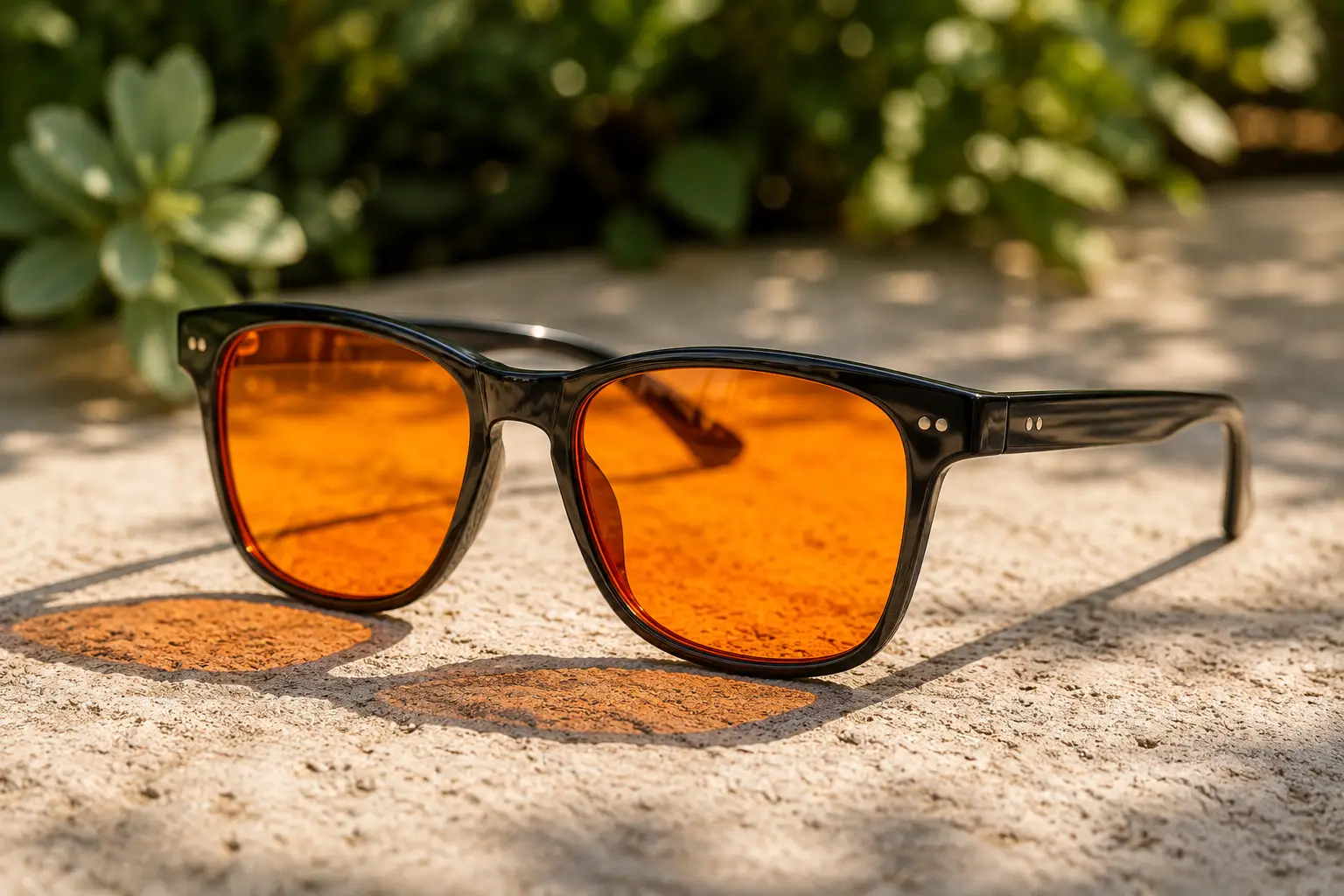
If you’ve ever scrolled TikTok at midnight and then stared at the ceiling for an hour, you’ve probably seen someone blame the glow of their phone and slip on a pair of orange tinted glasses before bed. These aren’t sunglasses, and they’re not a fashion statement (though some models are stylish enough to double as one). Orange tinted glasses are eyewear with amber-to-orange lenses engineered to filter a large share of blue-toned light — the kind pumped out by phones, laptops, TVs, and LED bulbs — before it reaches your eyes.
What is orange tinted glasses use for? In short: orange tinted glasses are amber-lensed eyewear designed to filter blue light (roughly the 450-500nm range) from screens and LED lighting, worn mainly in the evening to support melatonin production, reduce screen glare, and ease digital eye strain during nighttime device use.
The orange tint isn’t cosmetic. Lens dyes are formulated to absorb the shorter blue wavelengths while letting warmer light pass through relatively unfiltered, which is why everything looks a little sepia-toned the moment you put them on. That warm cast is the whole point — it’s the visual signature of a lens that’s actually doing something to the light hitting your retina, rather than a clear coating that mostly just reduces glare.
It’s worth being upfront here, too: the science on blue light and eye damage is more contested than most product listings let on. The American Academy of Ophthalmology has stated there’s no evidence that light from screens damages the eye, and doesn’t recommend special eyewear for computer use. Where the evidence is more solid is circadian biology — blue-enriched light in the evening measurably suppresses melatonin, and filtering it out before bed is a reasonable, low-risk habit. This article treats orange tinted glasses as exactly that: a sleep-hygiene tool and a personal-comfort choice, not a medical device, and it walks through seven real, current models so you can compare specs, pricing, and honest trade-offs before you buy.
Orange Tinted Glasses at a Glance: Quick Comparison
| Product | Best For | Lens Type | Price Range |
|---|---|---|---|
| Gamma Ray Optics Orange Tint 1.00x | Best budget pick | 97% blue-light-blocking orange, plastic | Under $20 |
| Swanwick Classic Night Swannies | Best overall / premium build | CR-39, 99%+ orange-amber | Around $70-$100 |
| Honeywell Uvex Skyper SCT-Orange | Best for work & night driving | Polycarbonate, ANSI Z87.1-rated | Under $15 |
| THL Orange +1.5 Reading Glasses | Best for readers/presbyopia | 7-layer CR-39 orange, diopter | In the $30-$40 range |
| Spectra479 99.9% Amber Sleep Glasses | Best dedicated sleep glasses | Wraparound acetate, 99.9% blocking | In the $20-$30 range |
| Eyekepper Fitover Amber Glasses | Best for prescription wearers | Oversized fitover, amber polycarbonate | Under $20 |
| ZIHVEUC Amber 99% Computer Readers | Best lightweight everyday pair | Amber polycarbonate, spring hinge | Under $15 |
Looking at the table above, there’s no single “best” pair — it depends entirely on what you’re solving for. If you just want to test whether cutting evening blue light helps you fall asleep faster, the Gamma Ray Optics Orange Tint 1.00x or the ZIHVEUC Amber 99% Computer Readers let you try the concept for less than the cost of a takeout dinner. If you already know you sleep better without screen glare and want something you’ll wear nightly for years, the Swanwick Classic Night Swannies justify the higher price with sturdier CR-39 lenses and a warranty-backed frame. And if you need daytime performance too — say, driving home after a late shift — the Honeywell Uvex Skyper SCT-Orange brings ANSI-rated contrast enhancement that the sleep-focused models simply aren’t built for.
💬 One click helps other shoppers make an informed choice too! 😊
The 7 Best Orange Tinted Glasses in 2026: Expert Analysis
1. Gamma Ray Optics Orange Tint 1.00x — best budget entry point
For under $20, the Gamma Ray Optics Orange Tint 1.00x is the easiest way to find out whether orange lenses are your thing before you spend real money on the category. The lenses are rated to block roughly 97% of blue light in the disruptive 450-500nm range, and the wraparound-style frame is built with spring hinges that resist snapping if you fall asleep with them on — a small detail, but a common failure point on cheap glasses. Practically speaking, that 97% figure means you’ll get most of the sleep-hygiene benefit of a premium pair without the anti-reflective coating polish of a $90 model. Based on comparing the specs against pricier competitors, this is the pair to hand a skeptical partner or teenager who “doesn’t believe in this stuff” — the investment is small enough that a bad night’s sleep isn’t a financial loss. Reviews consistently report that the deep orange tint noticeably dims screen glare within minutes of putting them on, and that the classic black frame looks unremarkable enough to wear around the house without comment; a recurring complaint is that the lack of a case means lenses can scratch if tossed loose into a bag.
Pros:
- ✅ Extremely low price for a first pair
- ✅ Spring hinges add everyday durability
- ✅ Deep orange tint blocks glare fast
Cons:
- ❌ No hard case included
- ❌ Coating feels basic next to premium frames
At under $20, the Gamma Ray Optics Orange Tint 1.00x is close to risk-free — even if you decide orange lenses aren’t for you, you haven’t lost much.
2. Swanwick Classic Night Swannies — best overall, premium build
Swanwick Classic Night Swannies are the closest thing this category has to a household name, and the build quality shows why. The lenses are CR-39 (a scratch-resistant optical-grade plastic used in prescription eyewear), rated to filter over 99% of light in the 400-500nm blue band, paired with anti-reflective coating on both lens faces and a BPA-free acetate frame with spring hinges. In practice, the CR-39 lens material matters more than the spec sheet lets on: it holds its clarity and color longer than the injection-molded plastic used in budget pairs, so the tint doesn’t fade or yellow unevenly after a year of nightly wear. This is the pair for someone who has already decided blue-light-blocking glasses are part of their nightly routine and wants a frame sturdy enough to survive years of use, rather than a $15 experiment. Reviews consistently report that Night Swannies feel noticeably more comfortable during multi-hour wear than cheaper acetate frames, and that customers appreciate the accessible customer service line when frames need adjustment; a common thread in less favorable reviews is that the price feels steep next to no-name alternatives with similar published blocking percentages.
Pros:
- ✅ CR-39 lenses resist scratching and clouding
- ✅ Anti-reflective coating improves visual comfort
- ✅ Established brand with real customer support
Cons:
- ❌ Premium price versus generic competitors
- ❌ Bold orange tint isn’t for everyone’s taste
If budget isn’t your main constraint, the Swanwick Classic Night Swannies are the pair most likely to still be in your nightstand drawer in three years.
3. Honeywell Uvex Skyper SCT-Orange (S1933X) — best for work and night driving
The Honeywell Uvex Skyper SCT-Orange takes a different approach from the sleep-focused pairs on this list — it’s a genuine safety glasses model, built to ANSI Z87.1 standards for industrial and occupational eyewear, with an SCT-Orange (Special Contrast Tint) polycarbonate lens designed to sharpen contrast in low light rather than simply dim blue tones. What that means practically: the SCT-Orange tint was engineered for people working night shifts under sodium or fluorescent lighting, where it enhances the visibility of edges and depth, which is also why this lens family has become popular with people who do a lot of night driving. The dual-purpose design is the honest sell here — you’re not buying a dedicated sleep aid, you’re buying a rugged, wraparound, impact-rated lens that happens to share the same amber-orange filtering properties. Based on comparing this to the acetate-framed pairs above, the polycarbonate build and wraparound coverage make it far more resistant to fogging and scratching in real-world outdoor or workshop use, though the sporty safety-glasses look reads more “job site” than “bedroom nightstand.” Reviews consistently mention the lightweight, no-slip fit during long shifts, with the most common complaint being that the styling is too utilitarian for casual daytime wear.
Pros:
- ✅ ANSI Z87.1-rated for genuine impact resistance
- ✅ Enhances contrast for night driving and shift work
- ✅ Lightweight, no-slip wraparound fit
Cons:
- ❌ Utilitarian look, not designed for casual wear
- ❌ Not marketed or tested as a sleep aid
For anyone who spends evenings behind the wheel or on a job site rather than in bed, the Honeywell Uvex Skyper SCT-Orange is the more honest fit than a sleep-branded pair.
4. THL Orange +1.5 Blue Light Blocking Reading Glasses — best for readers who need magnification
Most orange tinted glasses assume you have 20/20 vision, which is a problem if you’re one of the millions of Americans over 40 dealing with presbyopia. The THL Orange +1.5 Blue Light Blocking Reading Glasses solve that by combining a 7-layer CR-39 orange lens with actual reading-strength magnification, available in +0.25 through +2.50 diopters. The layered lens construction adds oleophobic (fingerprint-resistant), anti-reflective, and anti-glare coatings on top of the blue-light filtering, which in practice means less nightly cleaning and less halo-glare around bright screens than a single-coat lens would produce. The honest analytical case for this pair is narrow but strong: if you already wear reading glasses to check your phone before bed, swapping in a diopter-matched orange pair removes a decision point entirely — you get your correction and your blue-light filter in a single object instead of stacking two pairs of glasses. Reviews consistently report accurate diopter labeling and a comfortable spring-hinge fit for extended reading sessions; a repeated criticism is that buyers need to already know their correct reading strength, since there’s no adjustable option once purchased.
Pros:
- ✅ Combines magnification with blue-light filtering
- ✅ Multiple coatings reduce glare and fingerprints
- ✅ Handles reading and prep for bed in one pair
Cons:
- ❌ Requires knowing your correct diopter in advance
- ❌ Fixed strength, no adjustability after purchase
If nightstand reading is part of your routine, the THL Orange +1.5 Blue Light Blocking Reading Glasses save you from juggling two separate pairs.
5. Spectra479 99.9% Amber Sleep Glasses — best dedicated sleep glasses
The Spectra479 99.9% Amber Sleep Glasses are built around a single mission, and the wraparound frame design makes that obvious the moment you see them: this is a sleep tool first, an everyday accessory a distant second. The lenses claim to block 99.9% of blue light in the 450-510nm band — the range most researchers flag as the most disruptive to melatonin production — and the flexible frame is engineered to seal light from creeping in around the temples and brow, a gap that flatter frame designs leave open. What that flexible wraparound fit means in practice is fewer light leaks compared to standard rectangular frames, which matters more than the blocking percentage alone once you’re trying to fall asleep in a room with any ambient light at all (a hallway nightlight, a partner’s phone screen, a streetlight through the blinds). This is the pick for someone who has tried a “normal-looking” pair of orange glasses and found stray light still got through. Reviews consistently describe the fit as comfortable enough to wear lying down without pinching, with a repeated note that the frame runs large and may not suit smaller head sizes; buyers with narrower faces should size down if the brand offers it.
Pros:
- ✅ Near-total blue-light blocking rating
- ✅ Wraparound design blocks peripheral light leaks
- ✅ Comfortable for lying down while wearing them
Cons:
- ❌ Frame runs large for smaller faces
- ❌ Styling is purely functional, not fashion-forward
If light leakage around the edges of “normal” glasses has undermined your results before, the Spectra479 99.9% Amber Sleep Glasses‘ sealed fit directly targets that problem.
6. Eyekepper Fitover Amber Blue Light Blocking Glasses — best for prescription wearers
If you already wear prescription glasses, most orange tinted glasses are a non-starter — you can’t stack two frames comfortably. The Eyekepper Fitover Amber Blue Light Blocking Glasses solve that with an oversized amber polycarbonate lens designed to fit directly over your existing prescription frames, similar in concept to the fitover sunglasses sold for post-cataract-surgery patients. The oversized coverage isn’t just about fit; it also blocks more ambient light from the sides than a same-size standalone pair would, since the lens has to be large enough to clear a normal eyeglass frame underneath. The clear practical upside here is that you don’t need a separate blue-light prescription lens made — a real cost and hassle saver, since prescription blue-light lenses from an optometrist often run well over $100 once the anti-reflective coating and lens material are factored in. Reviews consistently report a snug, non-slipping fit over a wide range of standard prescription frame sizes; a recurring complaint is that the semi-rimless design can feel bulky compared to slimmer frame options, and it’s not discreet enough for most people to wear outside the house.
Pros:
- ✅ Fits directly over prescription glasses
- ✅ Saves the cost of custom prescription blue-light lenses
- ✅ Snug fit across most standard frame sizes
Cons:
- ❌ Bulkier profile than a standalone pair
- ❌ Not discreet enough for public wear
For prescription wearers who don’t want to pay for a second custom lens, the Eyekepper Fitover Amber Blue Light Blocking Glasses are the practical, budget-friendly workaround.
7. ZIHVEUC Amber 99% Blue Light Blocking Computer Reading Glasses — best lightweight everyday pair
Rounding out the list, the ZIHVEUC Amber 99% Blue Light Blocking Computer Reading Glasses target the buyer who wants something light enough to forget they’re wearing, with an amber polycarbonate lens rated at 99% blue-light blocking and a spring-hinge frame that keeps weight low across long sessions. Polycarbonate is inherently lighter and more impact-resistant than glass or CR-39, which in practice means less nose-bridge fatigue during a two-hour movie binge or late-night work session compared to heavier acetate frames. This is a reasonable middle-ground pick for someone who wants a pair that looks like ordinary glasses rather than obvious “sleep gear,” and who prioritizes all-day comfort over the last percentage point of blue-light filtering. Reviews consistently note the lightweight feel and describe the tint as noticeably lighter/more amber than some competitors’ near-black-orange lenses, which some buyers prefer for daytime-adjacent use, while others flag it as a downside if maximum blue-light blocking before bed is the priority; either way, this is a case where the honest trade-off is comfort and subtlety versus raw blocking percentage.
Pros:
- ✅ Very lightweight for long wear sessions
- ✅ Understated tint looks closer to normal glasses
- ✅ Budget-friendly, everyday-usable design
Cons:
- ❌ Lighter tint may block less blue light
- ❌ Less rigid frame than CR-39 alternatives
For anyone who wants a low-key pair they can wear for hours without noticing, the ZIHVEUC Amber 99% Blue Light Blocking Computer Reading Glasses hit that comfort target well.
Full Feature Comparison: How the 7 Products Stack Up
| Product | Blocking Rating | Frame Material | Diopter Options | Best For |
|---|---|---|---|---|
| Gamma Ray Optics Orange Tint 1.00x | ~97% | Plastic, spring hinge | No | First-time buyers |
| Swanwick Classic Night Swannies | 99%+ | CR-39, acetate | No | Long-term nightly use |
| Honeywell Uvex Skyper SCT-Orange | SCT-Orange (contrast) | Polycarbonate, wraparound | No | Night driving, shift work |
| THL Orange +1.5 Readers | High (7-layer coated) | CR-39, acetate | +0.25 to +2.50 | Presbyopia/reading |
| Spectra479 99.9% Amber | 99.9% | Flexible wraparound acetate | No | Sealed-fit sleep use |
| Eyekepper Fitover Amber | 100% blue reduction claimed | Oversized polycarbonate | Fits over Rx | Prescription wearers |
| ZIHVEUC Amber 99% | ~99% | Lightweight polycarbonate | No | Everyday comfort |
The clearest takeaway from this table is that “blocking percentage” alone doesn’t tell the whole story — fit and frame design change how much of that blocking rating you actually experience. The Spectra479 99.9% Amber and Eyekepper Fitover Amber both compensate for gaps in coverage with oversized or wraparound designs, while the ZIHVEUC Amber 99% trades a slightly lighter tint for comfort. If magnification is a factor, the THL Orange +1.5 Readers are the only pair on this list built to handle it.
✨ Don’t miss these exclusive deals!
🔍 Take your orange tinted glasses shopping to the next level with this carefully curated lineup. Click a highlighted item to check current pricing and availability. These picks will help you unwind at night, cut evening screen glare, and get the restful sleep the whole family will enjoy!
Orange Tinted Glasses vs. Clear Blue Light Glasses
The biggest decision most first-time buyers face isn’t which brand to pick — it’s orange versus clear. Clear-lens blue light glasses look like ordinary eyewear and are marketed for daytime computer use, but they filter a much smaller percentage of blue light, since removing too much blue from a clear lens would visibly tint it. Orange and amber lenses filter far more of the disruptive 450-500nm band, but the trade-off is obvious the moment you look in a mirror: everything you see, including your phone screen, takes on a warm orange cast, and colors on screen become unreliable. That’s precisely why orange lenses are designed to be worn in the hour or two before bed rather than all day at a desk — the color distortion that makes them useless for daytime graphic design or color-accurate work is a non-issue once you’re just trying to wind down and stop scrolling. Reviews and buying guides that compare the two formats consistently land on the same conclusion: clear glasses are a subtle, all-day accessory with a modest effect, while orange lenses are a stronger, more deliberate nighttime tool, and most people who buy the clear “for computer use” version report a milder experience than they expected, while orange-lens buyers who use them specifically before bed report a more noticeable effect.
Does the Science Actually Back Up Orange Tinted Glasses?
It’s worth separating hype from evidence here, because the marketing on some listings overstates the case. According to a review by researchers cited in the McGill University Office for Science and Society, orange-lensed glasses are considered the original and more effective style of blue-blocking glasses precisely because they filter a broad swath of blue wavelengths, unlike newer clear-lens versions that sacrifice filtering strength to stay transparent. Where the science gets murkier is on daytime eye strain: multiple recent reviews summarized by outlets like U.S. News note that leading eye-health bodies have found no compelling evidence that blue light glasses reduce digital eye strain symptoms compared to regular lenses, and that eye strain is more likely caused by reduced blinking and prolonged focus than by the light itself. The nuance that gets lost in most marketing: the sleep-related mechanism (filtering blue-enriched light before bed to support melatonin) rests on more established biology than the eye-strain claim does, which is why this guide frames orange tinted glasses primarily as a bedtime tool rather than a cure for tired eyes at your desk.
What most buyers overlook is that even a genuinely effective pair of orange glasses is only one variable in a sleep routine — room darkness, screen brightness, and consistent bedtime matter at least as much, and orange glasses work best as one piece of a broader wind-down habit rather than a standalone fix.
How to Choose Orange Tinted Glasses: 6 Criteria That Actually Matter
- Blocking percentage in the 450-500nm range. Look for a specific number (97%, 99%, 99.9%) rather than vague claims — the higher the percentage in this specific band, the more of the sleep-relevant light gets filtered.
- Frame coverage. Wraparound or oversized frames reduce light leaking in around the temples and brow, which matters more once you’re actually trying to sleep in a semi-lit room.
- Lens material. CR-39 tends to hold clarity and color longer than injection-molded plastic; polycarbonate is lighter and more impact-resistant but can scratch more easily over time.
- Fit over existing eyewear. If you wear prescription glasses, decide upfront between a fitover model or a diopter-matched reading pair — trying to stack two standard frames rarely works comfortably.
- Intended use window. A dedicated sleep-focused pair (deep orange, heavy tint) suits the hour before bed; a lighter amber pair suits longer evening wear if total darkness isn’t your priority.
- Comfort for your face shape and wear duration. A pair you’ll actually put on consistently every night beats a “technically superior” pair that pinches or slides.
Getting the Most Out of Your New Orange Tinted Glasses: A First-30-Days Guide
Buying the right pair is only half the equation — how you use them in the first month determines whether they become a habit or end up in a drawer. Start by wearing them consistently at the same time each evening, roughly two to three hours before your target bedtime, rather than only reaching for them on nights you’re already struggling to sleep; consistency is what trains the habit and lets you fairly judge whether they’re helping. Pair them with dimming your actual room lighting rather than expecting the lenses to compensate for a fully lit house — orange lenses filter light coming through them, but they don’t fix a bright overhead LED you’re still looking around. Clean the lenses with a proper microfiber cloth rather than a shirt hem, since orange and amber tints can show smudges more visibly than clear lenses under lamp light. One common first-month mistake is wearing them for a “quick check” of a phone under bright daytime light and concluding the world looks strange and unusable — remember these are an evening tool, and the color distortion that feels jarring at noon is a non-issue in a dim room at 10 p.m. Finally, give the adjustment period real time: several nights of your brain treating the orange cast as novel before the effect on sleep onset becomes noticeable is normal, and judging a pair after one night undersells what a consistent routine can do.
Who Actually Needs Orange Tinted Glasses? 3 Real-World Scenarios
The late-shift worker. Someone finishing a hospital or warehouse shift at 11 p.m. and trying to wind down before a 7 a.m. alarm faces a tougher circadian challenge than a standard 9-to-5 schedule allows for. For this profile, a dedicated sleep-focused pair like the Spectra479 99.9% Amber Sleep Glasses worn from the moment the shift ends, combined with blackout curtains, gives the body the strongest possible signal that it’s time to wind down despite the mismatched schedule.
The remote worker who reads in bed. Someone in their 40s or 50s who wraps up laptop work, then reads news or a book on a tablet in bed, is dealing with both presbyopia and screen glare at the same time. The THL Orange +1.5 Blue Light Blocking Reading Glasses, matched to their actual reading prescription strength, solve both problems in a single object instead of requiring a frame swap between “computer glasses” and “reading glasses.”
The budget-conscious first-timer. Someone who’s skeptical but curious, and doesn’t want to spend $80 to test a theory, is the ideal buyer for the Gamma Ray Optics Orange Tint 1.00x or the ZIHVEUC Amber 99% Blue Light Blocking Computer Reading Glasses — both let them run a genuine two-week experiment for well under $20 before deciding whether to invest in a premium pair.
Common Mistakes to Avoid When Buying Orange Tinted Glasses
A few recurring missteps show up across customer reviews and buying guides alike. First, buyers often choose a clear or lightly tinted “blue light glasses” pair while expecting orange-lens-level filtering — check the actual tint depth in product photos, not just the marketing copy, since a barely-amber lens won’t perform like a true orange one. Second, people frequently skip checking frame size against their own head width, especially with wraparound or fitover styles, and end up with a pair that either pinches or slides down constantly. Third, some buyers assume a higher price automatically means a higher blocking percentage — as the comparison table above shows, several budget pairs post blocking numbers competitive with premium brands, so it’s worth reading the actual spec rather than assuming price equals performance. Fourth, wearing orange glasses during the day for computer work and expecting the same daytime eye-strain relief that daytime-marketed clear glasses promise sets buyers up for disappointment, since orange lenses are simply not designed or comfortable for all-day, color-accurate use. Finally, expecting immediate, dramatic results after a single night is a common setup for a one-star review; sleep-hygiene tools like this tend to show their value over a consistent one-to-two-week trial, not a single evening.
Long-Term Cost and Care
One advantage orange tinted glasses have over other sleep aids is low ongoing cost. Unlike a white-noise machine that draws power nightly or a supplement you repurchase monthly, a well-made pair is a single purchase that, with basic care, can last years. CR-39 lenses like those on the Swanwick Classic Night Swannies hold their coating and color longer than injection-molded plastic, which matters for long-term value even at a higher upfront price — a $90 pair that lasts five years works out to roughly $18 per year, cheaper over time than replacing a $15 pair annually as hinges loosen or lenses scratch. Store any pair in a hard case rather than a bag pocket, avoid setting lenses face-down on a nightstand, and clean with a microfiber cloth and lens spray rather than saliva or a shirt hem, which can grind grit into the coating over time. Budget pairs like the Gamma Ray Optics Orange Tint 1.00x and ZIHVEUC Amber 99% Blue Light Blocking Computer Reading Glasses are reasonable as a low-commitment test, but buyers who confirm the habit sticks often find it worth upgrading to a coated CR-39 pair for the long haul.
Safety, Regulations, and What “Blue Light Blocking” Claims Actually Mean
Because orange tinted glasses are sold as general eyewear rather than a medical device, there’s no FDA approval process behind the “blocks 99% of blue light” claims printed on most listings — those figures come from manufacturer lab testing, not independent regulatory verification, so it’s reasonable to treat exact percentages as directional rather than certified. The one product on this list built to an actual third-party standard is the Honeywell Uvex Skyper SCT-Orange, which meets ANSI Z87.1 requirements for impact-resistant occupational eyewear — a genuinely tested safety standard, distinct from blue-light-blocking marketing claims. On the disclosure side, this article contains affiliate links, and under FTC endorsement guidance, any material connection between a reviewer and the products being promoted has to be clearly disclosed — you’ll find that disclosure below, and it applies to every product mentioned above.
Frequently Asked Questions
❓ Do orange tinted glasses really help you sleep better?
❓ Can I wear orange tinted glasses all day?
❓ What's the difference between orange and amber lenses?
❓ Are orange tinted glasses safe to wear while driving at night?
❓ How long do orange tinted glasses typically last?
Conclusion
Orange tinted glasses aren’t a miracle cure for sleepless nights, and the honest research on daytime eye strain is far less convincing than most product listings suggest. But as a low-cost, low-risk piece of a broader wind-down routine — dimmer lights, a consistent bedtime, and less blue-enriched glare in the last hour before sleep — they’re a reasonable tool worth testing. Whether you start with a $15 pair like the Gamma Ray Optics Orange Tint 1.00x to see if the habit sticks, or go straight for the durability of the Swanwick Classic Night Swannies, the key is consistent nightly use paired with realistic expectations. Match the pair to your actual situation — reading strength, prescription eyewear, shift work, or simple curiosity — rather than chasing the single highest blocking percentage on the label, and you’ll get a far more honest read on whether orange tinted glasses genuinely change your nights.
✨ Ready to try orange tinted glasses tonight?
🔍 Pick the pair above that matches your routine, check current pricing on Amazon, and give it a consistent two-week trial before judging the results. Better wind-down nights start with one small change!
Recommended for You
- Glasses With Magnifying: 7 Best Picks for Sharper Reading in 2026
- 7 Best Green Tinted Glasses for Every Budget (2026 Guide)
- Green Contacts on Brown Eyes: 7 Best Picks (2026)
Disclaimer: This post contains affiliate links. As an Amazon Associate, I earn from qualifying purchases made through these links, at no additional cost to you.
✨ Found this article helpful? Share it with someone who needs it! 💬🤗