In This Article
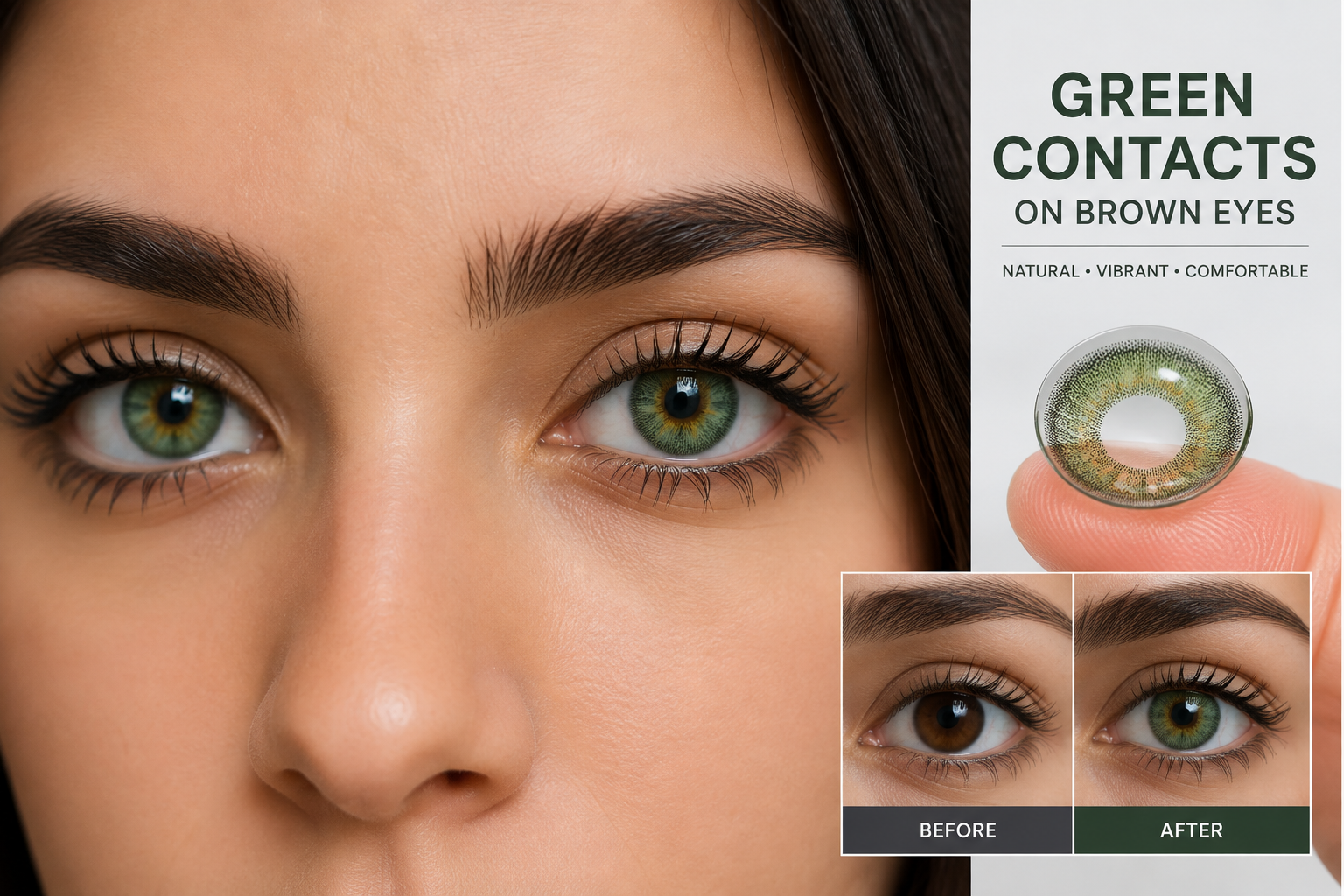
Wearing green contacts on brown eyes is one of the most popular color-change combinations out there, but it’s also one of the hardest to pull off convincingly — the natural depth and pigment density of a dark iris can overpower a poorly designed colored lens, leaving it looking flat or artificial. Getting a genuinely natural-looking green result on brown eyes takes real color engineering: multi-layer pigment printing, opacity calibrated to actually cover dark irises, and tonal blending that mimics the subtle variation of a real eye rather than a single flat color.
Before anything else, though, there’s something more important than which shade to pick: in the United States, all contact lenses — including purely cosmetic ones that don’t correct vision at all — are classified by the FDA as medical devices and legally require a valid prescription from an eye care professional. This applies whether you have 20/20 vision or not. A “plano” or non-prescription colored lens still needs a fitting and prescription, because contact lenses that don’t fit your specific eyes properly can cause real, sometimes serious, eye damage.
With that safety context established, this guide covers what actually makes a green lens work well on brown eyes, then walks through 7 real, currently available prescription options — from budget-friendly monthly lenses to premium natural-blend brands.
What Makes Green Contacts on Brown Eyes Look Natural?
A green contact lens that works well on brown eyes uses opaque, multi-layer pigment technology specifically calibrated to cover dark iris pigment while still looking natural — thin, translucent tints designed for light eyes often can’t achieve visible color change on brown eyes at all. The best options blend an outer limbal ring, a mid-tone color layer, and inner definition to mimic the natural variation of a real iris rather than appearing as a single flat color.
Quick Comparison: Green Contacts for Brown Eyes
| Category | Product | Price Range | Best For |
|---|---|---|---|
| Most breathable | Air Optix Colors (Gemstone Green) | $30–$100/box | Daily comfort, monthly wear |
| Daily disposable | Dailies Colors (Mystic Green) | $35–$60/box | Occasional or hygiene-focused wearers |
| Premium natural | Solotica Hidrocor Jade | $60–$90/box | Vivid, long-lasting color |
| Astigmatism | Toricolors (Emerald Green) | $40–$70/box | Wearers with astigmatism |
Even at a glance, the spread here shows real variety in this category: Air Optix Colors anchors the widely available, dermatologist-and-optometrist-recommended end of the market, while Solotica Hidrocor Jade represents a premium, longer-lasting option favored for its especially natural blend on dark eyes. We’ll cover all seven picks, including three not shown above, in detail next — and every single one requires a valid prescription and professional fitting.
💬 Bookmark this guide — you’ll want to bring it to your eye exam when discussing options with your eye doctor.
Top 7 Green Contacts for Brown Eyes
Here are 7 real, currently available green contact lens options well-suited to brown eyes. Every option listed requires a valid prescription and a proper fitting from a licensed eye care professional — this is a legal requirement in the U.S., not just a recommendation.
1. Air Optix Colors (Gemstone Green) — best for breathability and daily comfort
Manufactured by Alcon, Air Optix Colors is made from silicone hydrogel, a more oxygen-permeable material than older hydrogel lenses, which generally translates to better comfort over a full day of wear. The Gemstone Green shade uses a tri-tone color design with an outer ring for definition, a mid-tone for blending, and an inner ring for depth — engineered specifically to read as natural rather than painted-on against dark irises.
What most buyers overlook is how much lens material affects real-world comfort over the actual monthly wear cycle, not just the first hour of wearing them — silicone hydrogel’s higher oxygen permeability specifically helps reduce the dryness and irritation that can build up toward the end of a long wear day, a genuine advantage over older-generation colored lens materials. Based on comparing this to its discontinued predecessor FreshLook ColorBlends, Air Optix Colors represents Alcon’s current-generation successor, meaning it has the most active manufacturer support and widest retail availability of any option in this lineup.
Reviews and eye care professionals consistently point to Air Optix Colors’ SmartShield technology, which helps resist surface deposit buildup, as a meaningful comfort advantage for wearers who keep the same pair in for the full 30-day cycle.
Pros:
- ✅ Silicone hydrogel material offers better oxygen permeability than older lenses
- ✅ Tri-tone pigment design designed specifically to read naturally on dark eyes
- ✅ Widely available through optometrists and major online retailers
Cons:
- ❌ Higher price point than some budget alternatives
- ❌ Monthly lens requires nightly removal, cleaning, and proper storage
Typically priced around $30–$100 per box depending on retailer and prescription strength, Air Optix Colors (Gemstone Green) is the strongest all-around pick for most brown-eyed wearers seeking a natural green look with genuine daily comfort.
2. Dailies Colors (Mystic Green) — best daily disposable option
For wearers who prefer not to deal with lens cleaning and storage, Dailies Colors in Mystic Green offers a daily disposable format — a fresh pair every day, discarded at night, with zero maintenance required. Also manufactured by Alcon, it uses the same 3-in-1 color design philosophy as other lenses in this lineup, with an outer ring, inner ring, and central color ring working together for a natural, dimensional result.
What most buyers overlook is how meaningfully the daily disposable format reduces infection risk compared to monthly lenses, simply by removing the cleaning and storage steps where contamination most commonly occurs — for anyone new to colored contacts or wearing them only occasionally (special events, photoshoots, or specific outfits), that reduced maintenance burden is a genuine practical and safety advantage over committing to a full 30-day lens. Based on comparing this to monthly options, the tradeoff is a higher ongoing cost per wear if you’re using lenses daily, but a real convenience win for occasional or hygiene-conscious wearers.
Reviews consistently praise the fresh, consistent comfort of a new lens each day, with many wearers specifically choosing this format for special occasions or intermittent wear rather than as an everyday lens.
Pros:
- ✅ Fresh lens daily eliminates cleaning, storage, and associated contamination risk
- ✅ 3-in-1 color design blends naturally with brown eyes
- ✅ No maintenance required, ideal for occasional wearers
Cons:
- ❌ Higher cost per wear than monthly lenses for frequent use
- ❌ Requires more frequent reordering than a 30-day supply
Typically priced around $35–$60 per box, Dailies Colors (Mystic Green) is the pick for anyone who wants occasional, low-maintenance green contacts without committing to a monthly lens routine.
3. FreshLook ColorBlends (Gemstone Green) — best budget option while supplies last
FreshLook ColorBlends was, for years, the industry-standard budget-friendly colored contact, using a patented 3-in-1 color-blending technology in a hydrogel material. It’s worth knowing upfront: Alcon discontinued FreshLook ColorBlends as of September 2023 in favor of Air Optix Colors, so availability is now limited to remaining retailer stock rather than ongoing production.
What most buyers overlook is that this discontinuation status genuinely changes the calculus on buying it — while FreshLook ColorBlends remains a well-regarded, effective lens with a loyal following, anyone starting fresh with colored contacts should weigh the practical downside of a discontinued product against its typically lower price versus Air Optix Colors. Based on comparing the two directly, both share the same 3-in-1 Gemstone Green color technology, but Air Optix Colors’ silicone hydrogel material and active production status make it the more future-proof choice for new wearers, even at a somewhat higher price.
Reviews from longtime FreshLook wearers consistently express genuine fondness for the lens and disappointment at its discontinuation, with many specifically stocking up on remaining inventory before it becomes fully unavailable.
Pros:
- ✅ Genuine 3-in-1 Gemstone Green color-blending technology
- ✅ Historically lower price point than Air Optix Colors
- ✅ Long track record of natural-looking results on brown eyes
Cons:
- ❌ Discontinued by Alcon; only limited retailer stock remains
- ❌ Hydrogel material offers less oxygen permeability than newer silicone hydrogel lenses
While remaining stock lasts, typically priced around $25–$40 per box, FreshLook ColorBlends (Gemstone Green) remains a solid budget option, though its discontinued status is worth factoring into a long-term decision.
4. TTDeye Green Shades (Trinity Green, Queen Green) — best for natural-looking dark brown eyes
TTDeye has built its reputation specifically around colored contacts engineered for dark eyes, with shades like Trinity Green and Queen Green designed with the opacity and pigment depth needed to actually show up convincingly on deep brown irises rather than washing out. The brand offers multiple green tones across its collections, from earthy, muted greens to brighter, more noticeable shades.
What most buyers overlook is that “designed for dark eyes” is a genuinely meaningful distinguishing factor in this category, not just marketing language — many colored contact lines are originally engineered for lighter eyes and simply don’t have enough opacity to fully cover a deep brown iris, resulting in a muddy or barely-visible color shift. Based on comparing this to more general-purpose brands, TTDeye’s specific focus on this use case shows in customer results, with the brand frequently recommended in dedicated brown-eyes buying guides for that reason.
Reviews consistently highlight the natural blending and dimensional appearance across TTDeye’s green shades, with buyers specifically noting the difference in visible color payoff compared to lenses not specifically formulated for dark iris coverage.
Pros:
- ✅ Specifically engineered for visibility and blending on dark brown eyes
- ✅ Multiple green tone options across different collections
- ✅ Strong reputation specifically within the dark-eyes colored contact niche
Cons:
- ❌ Less mainstream availability through traditional eye care retailers than Alcon brands
- ❌ Still requires a valid prescription and fitting like any other contact lens
Pricing varies by retailer and collection, generally in a comparable range to other prescription colored contacts. TTDeye’s green shades are a strong pick specifically for wearers whose primary concern is visible, natural-looking color payoff on deep brown eyes.
5. Solotica Hidrocor Jade — best premium, long-lasting vivid option
Solotica, a Brazilian brand with a strong following among colored contact enthusiasts, offers Hidrocor Jade as a bright, sparkling green option within its Hidrocor line — a collection specifically known for its especially dimensional, light-catching color effect. Depending on the specific Solotica collection, some green options are rated for wear up to one year, a notably longer replacement cycle than the monthly or daily lenses common elsewhere in this category.
What most buyers overlook is that Solotica’s reputation in the colored contact community is built specifically on realism and dimensional depth that’s harder to achieve with simpler single-layer tints — the brand is frequently cited by wearers who’ve tried several colored contact brands as delivering a noticeably more convincing, less “costume-like” result, particularly on dark eyes. Based on comparing this to more mainstream U.S. pharmacy brands, Solotica commands a premium price specifically for that reputation and its longer wear cycle options.
Reviews consistently describe Solotica’s color payoff as more vivid and dimensional than typical drugstore-brand colored contacts, with the longer-wear options specifically praised by regular colored-contact wearers for reducing how often they need to reorder.
Pros:
- ✅ Especially vivid, dimensional color effect within the Hidrocor line
- ✅ Some collections rated for up to one year of wear
- ✅ Strong reputation for realism among experienced colored contact wearers
Cons:
- ❌ Higher price point than mainstream monthly or daily brands
- ❌ Less widely stocked through standard U.S. optometry offices than Alcon products
Typically priced around $60–$90 per box depending on the specific collection, Solotica Hidrocor Jade is the pick for wearers who want the most convincing, vivid color effect and are willing to pay a premium for it.
6. Toricolors (Emerald Green) — best for wearers with astigmatism
Most colored contact lines are designed for standard spherical vision correction (or no correction at all), which leaves out a meaningful share of the population with astigmatism. Toricolors specifically addresses this gap, offering a toric lens design — built to correct astigmatism — in a small selection of color shades, including an emerald green.
What most buyers overlook is how genuinely limited the colored contact options become once astigmatism enters the picture — toric lenses require a specific orientation-stabilizing design to sit correctly on the eye and correct for the irregular corneal curvature astigmatism causes, and relatively few colored contact brands offer this combination at all. Based on comparing this to standard spherical colored lenses, anyone with astigmatism attempting to use a non-toric colored lens may find it rotates on the eye and blurs vision, making a dedicated toric option like this one a genuine necessity rather than a nice-to-have for that specific wearer.
Reviews from astigmatism patients consistently describe relief at finding a colored option that actually corrects their vision properly, a combination that’s genuinely harder to find than standard-vision colored contacts.
Pros:
- ✅ Toric design specifically corrects astigmatism, unlike most colored contacts
- ✅ Emerald green shade delivers a genuine dramatic color change even on dark eyes
- ✅ Designed for regular daily use, replacing standard prescription lenses
Cons:
- ❌ Limited to just a handful of shades compared to standard-vision colored lines
- ❌ Requires a more precise fitting given the toric stabilization design
Typically priced around $40–$70 per box, Toricolors (Emerald Green) fills a genuine gap for astigmatism patients who don’t want to give up color options just because of their prescription needs.
7. Pure Colors HD (Green shade) — best for vibrant, high-definition pigmentation
Pure Colors HD represents a newer generation of colored contact pigment technology, using high-definition color layering across 9 available shades to deliver a more vibrant, precisely defined color effect than older single-layer tints. It’s a monthly disposable lens designed for continuous comfort throughout its wear cycle.
What most buyers overlook is that “HD” pigment technology in this context isn’t just marketing language — it genuinely refers to a more precise, layered printing process during manufacturing that creates sharper color boundaries and more convincing depth than older tinting methods, similar in concept to how HD television improved on standard definition through finer resolution. Based on comparing this to older-generation colored contacts, wearers specifically report the color appearing less like a uniform tint and more like genuine iris texture, a meaningful step up in realism for anyone who’s found older colored lenses looking flat.
Reviews consistently describe the color as looking notably natural and the comfort as reliable throughout the day, with several wearers specifically noting this as their preferred option after trying multiple other colored contact brands.
Pros:
- ✅ HD pigment layering creates more realistic depth and texture than older tints
- ✅ 9 available shades offer flexibility beyond just green
- ✅ Comfortable, reliable performance throughout the monthly wear cycle
Cons:
- ❌ Newer to market with a shorter track record than established brands like Air Optix
- ❌ Not approved for overnight wear despite extended-wear marketing language from some retailers
Pricing is generally comparable to other monthly colored contacts in this lineup. Pure Colors HD is a strong pick for wearers specifically seeking the most vivid, texturally realistic green effect currently available.
Product Comparison at a Glance
| Product | Wear Cycle | Material | Key Strength | Price Range | Best For |
|---|---|---|---|---|---|
| Air Optix Colors (Gemstone Green) | Monthly | Silicone hydrogel | Breathability, availability | $30–$100/box | Most wearers |
| Dailies Colors (Mystic Green) | Daily | Hydrogel | Zero maintenance | $35–$60/box | Occasional wear |
| FreshLook ColorBlends (Gemstone Green) | Monthly | Hydrogel | Budget price (limited stock) | $25–$40/box | Budget, while available |
| TTDeye (Trinity/Queen Green) | Varies | Varies | Dark-eye-specific formulation | Comparable to category | Deep brown eyes |
| Solotica Hidrocor Jade | Up to 1 year (varies) | Varies | Vivid, dimensional realism | $60–$90/box | Premium, long-lasting |
| Toricolors (Emerald Green) | Monthly | Toric design | Astigmatism correction | $40–$70/box | Astigmatism patients |
| Pure Colors HD (Green) | Monthly | Silicone hydrogel-based | HD pigment realism | Comparable to category | Vibrant, textured look |
A clear pattern emerges here: mainstream Alcon products (Air Optix Colors, Dailies Colors, Pure Colors HD) offer the widest availability and most established safety track record, while specialty brands like TTDeye and Solotica compete specifically on dark-eye formulation and color realism, and Toricolors fills a narrow but genuine need for astigmatism correction.
How to Choose the Right Green Contacts for Brown Eyes
- Start with an eye exam, not a shade chart. Every option on this list requires a valid prescription and professional fitting — this is the mandatory first step, not an optional add-on.
- Match wear frequency to lens type. Daily wearers benefit from the breathability of Air Optix Colors; occasional or special-event wearers may prefer the zero-maintenance convenience of Dailies Colors.
- Prioritize dark-eye-specific formulations if color payoff is your main concern. Brands like TTDeye are specifically engineered to show up convincingly on deep brown irises, unlike lenses originally designed for lighter eyes.
- Check for astigmatism correction if you need it. Standard colored lenses can rotate uncomfortably on an astigmatic eye — Toricolors is built specifically to avoid that problem.
- Weigh premium realism against cost. Solotica Hidrocor Jade offers genuinely more vivid, dimensional color at a real price premium over mainstream monthly lenses.
- Consider availability and manufacturer support. FreshLook ColorBlends’ discontinued status is worth factoring in if you want a long-term, easily reorderable lens.
- Never buy from a source that doesn’t require your prescription. This applies to every option on this list — a retailer skipping the prescription step is operating illegally and is a serious red flag for product safety.
Getting Started: The Right Way to Buy Colored Contacts
The process starts with a comprehensive eye exam from an optometrist or ophthalmologist, even if you have no vision correction needs — a proper contact lens fitting measures your specific corneal curvature and eye surface characteristics, since a lens that doesn’t fit your eyes correctly can cause abrasion, discomfort, or worse regardless of how good the color looks. Your eye care professional will provide a prescription that specifies the lens brand, curve, diameter, and power (even if that power is “plano,” meaning no vision correction).
Once you have a valid prescription, order from a retailer that requires you to submit or verify it — legitimate online contact lens retailers, your eye doctor’s office, or major optical chains will all require this step, and any seller that doesn’t is operating outside the law. Follow your eye doctor’s specific wear-time and replacement schedule exactly, whether that’s daily, monthly, or a longer cycle like some Solotica collections, and never extend wear beyond what’s approved for your specific lens.
A common first-time mistake is assuming that because a colored lens doesn’t correct vision, it’s somehow less regulated or lower-risk than a prescription lens — this is false, and the FDA has specifically and repeatedly warned that purely cosmetic decorative lenses carry the exact same risk of serious eye injury as vision-correcting ones when obtained or worn improperly.
✨ Ready for your new look? Book an eye exam with a licensed professional before shopping the picks above. 👁️
Real-World Scenarios: Matching the Lens to Your Situation
The everyday wearer wanting a natural transformation: Someone planning to wear green contacts regularly, day after day, benefits most from Air Optix Colors’ breathable silicone hydrogel material, which holds up better through repeated full-day wear than older hydrogel alternatives.
The occasional or special-event wearer: Anyone who only wants colored contacts for specific occasions — a photoshoot, a costume, a particular outfit — is better served by Dailies Colors, avoiding the maintenance and 30-day commitment of a monthly lens for infrequent use.
The wearer specifically seeking maximum realism on deep brown eyes: Someone whose primary frustration has been colored contacts looking flat or barely visible on their dark eyes should specifically look at TTDeye’s dark-eye-formulated shades or the premium dimensional effect of Solotica Hidrocor Jade.
The wearer with astigmatism: Anyone with astigmatism who has struggled to find colored options that don’t rotate or blur should go directly to Toricolors, one of the few brands specifically addressing this combination.
Common Mistakes to Avoid
The most common and most dangerous mistake is buying colored contacts from a source that doesn’t require a prescription — costume shops, beauty supply stores, flea markets, and unverified online sellers frequently sell decorative lenses illegally, and federal agencies have specifically run enforcement operations seizing tens of thousands of pairs of counterfeit and illegally imported decorative lenses sold this way.
A second frequent error is assuming a lens formulated for light eyes will look the same on brown eyes; opacity and pigment depth genuinely matter, and a lens without enough coverage will look muddy or barely change color at all on a deep brown iris, which is exactly why dark-eye-specific brands like TTDeye exist. A third mistake is sharing contact lenses with a friend to “try before buying” — even briefly, this risks transferring eye infections and is explicitly warned against by ophthalmology professional organizations.
Finally, many wearers extend lens wear beyond the approved schedule, treating a monthly lens as a six-week lens or wearing a daily disposable for multiple days — this significantly increases infection risk and should never be done regardless of how comfortable the lens still feels.
Prescription vs. Non-Prescription Colored Contacts
| Factor | Prescription (Power) | Prescription (Plano/No Power) |
|---|---|---|
| Vision correction | Yes, tailored to your prescription | No, purely cosmetic |
| Legal requirement | Valid prescription and fitting required | Valid prescription and fitting still required |
| Fitting process | Comprehensive eye exam and lens fitting | Comprehensive eye exam and lens fitting |
| Common misconception | None — widely understood as needing a prescription | Often mistakenly believed to be unregulated |
| FDA classification | Medical device | Medical device |
The critical point here is that the right-hand column doesn’t actually differ from the left in terms of legal or safety requirements — a “plano” or zero-power colored lens is still classified by the FDA as a medical device requiring the same prescription, fitting, and professional oversight as a vision-correcting lens. This misconception is exactly why illegal decorative lens sales remain a persistent problem despite years of federal enforcement action.
Eye Safety: Why This Category Requires Extra Care
Colored contact lenses, including every product in this guide, carry real risks when obtained or worn improperly, and this is worth taking seriously rather than skimming past. According to the FDA, decorative contact lenses are medical devices overseen for safety and effectiveness just like vision-correcting lenses, and wearing them without a valid prescription or proper use can cause serious eye damage — the agency specifically warns against purchasing contacts from street vendors, beauty supply stores, flea markets, novelty stores, or Halloween shops.
The risks are not hypothetical. FDA guidance for eye care professionals and consumers notes that contact lens wear without valid prescription, fitting, and professional supervision has been associated with corneal ulcers, which can rapidly progress to serious infection, corneal scarring, and in severe cases, permanent vision loss or loss of the eye. The American Academy of Ophthalmology reinforces this directly, stating that colored contact lenses require a prescription and supervision by an eye care professional and should never be shared with others, since the same precautions that apply to standard vision-correcting contacts apply equally to cosmetic ones.
If you experience redness, pain, unusual discharge, or vision changes while wearing any contact lens, remove it immediately and contact an eye care professional — these can be early signs of infection that require prompt treatment to avoid lasting damage.
Problem → Solution: Fixing Common Roadblocks
Problem: You have brown eyes and previous colored contacts looked washed out. Solution: Switch to a brand specifically formulated for dark-eye coverage, like TTDeye or Solotica Hidrocor Jade, rather than a general-purpose lens not designed for that pigment depth.
Problem: You have astigmatism and think colored contacts aren’t an option for you. Solution: Ask your eye doctor specifically about Toricolors, one of the few brands offering both astigmatism correction and color in the same lens.
Problem: You only want colored contacts occasionally, not every day. Solution: Choose a daily disposable option like Dailies Colors instead of committing to a full monthly lens cycle you won’t use consistently.
Problem: You’re not sure if a retailer selling colored contacts is legitimate. Solution: Confirm they require a valid prescription before purchase — any seller that doesn’t is operating illegally, regardless of how professional their website looks.
Problem: Your monthly colored lenses feel dry or uncomfortable by end of day. Solution: Ask your eye doctor about switching to a silicone hydrogel option like Air Optix Colors or Pure Colors HD, both of which offer better oxygen permeability than older hydrogel materials.
Frequently Asked Questions
❓ Do I need a prescription for green contacts even if my vision is perfect?
❓ Will green contacts look natural on brown eyes?
❓ How long can I wear colored contacts each day?
❓ Can I buy colored contacts without an eye exam?
❓ Are colored contacts safe for people with astigmatism?
Conclusion
Finding a green contact lens that looks genuinely natural on brown eyes comes down to choosing a brand with the right pigment depth and opacity for dark irises — and every single step of that process should start and end with a licensed eye care professional. Air Optix Colors offers the best combination of comfort and availability for most everyday wearers, Dailies Colors suits occasional use, TTDeye and Solotica Hidrocor Jade deliver the most convincing results specifically formulated for dark eyes, Toricolors solves a genuine gap for astigmatism patients, and Pure Colors HD brings newer pigment technology to the category.
Before shopping any of these, book a comprehensive eye exam and contact lens fitting — this isn’t a formality to skip past, but the single most important step in wearing colored contacts safely, regardless of which shade or brand ultimately catches your eye.
✨ Don’t miss these exclusive deals! 🔍 Ready for a new eye color? Check current pricing and availability on the picks above, and don’t forget to schedule your eye exam first. These options will help you find a genuinely natural green look, safely!
Recommended for You
- 7 Best Glasses Frames Without Prescription: 2026 Expert Style Guide
- 7 Best Non Rx Glasses in 2026: Expert Tested Clear Lens Frames
- 7 Best non prescription glasses for fashion in 2026 (Expert Review)
Disclaimer: This post contains affiliate links. As an Amazon Associate, I earn from qualifying purchases made through these links, at no additional cost to you. Colored contact lenses are medical devices that require a valid prescription and fitting from a licensed eye care professional in the United States, regardless of whether they correct vision. This article is for informational purposes only and is not medical advice — consult an eye care professional before purchasing or wearing any contact lens.
✨ Found this article helpful? Share it with someone who needs it! 💬🤗