In This Article
What Are Brown Colored Contact Lenses?
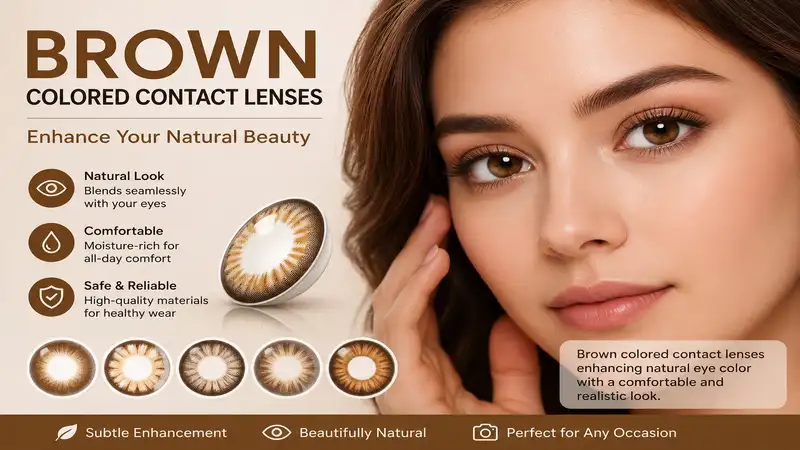
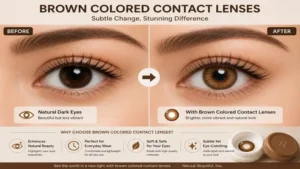
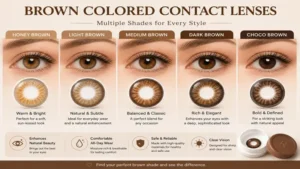
Brown colored contact lenses are specialized cosmetic or prescription optical lenses designed to alter or enhance the natural pigment of your irises. Whether you are aiming for a subtle hazel warmth or a rich, dark chocolate transformation, these lenses utilize layered dot patterns and radial hues to mimic human eye biology. Beyond pure aesthetics, high-quality options prioritize oxygen permeability, hydration retention, and vision correction. When selected properly, brown colored contact lenses blend seamlessly with your native eye tone while maintaining optimal corneal health.
Quick Comparison: Top Brown Colored Contact Lenses
| Lens Model | Lens Type | Material / Water Content | Ideal Eye Match | Price Range | Best For |
| Alcon Air Optix Colors (Honey/Brown) | Monthly Replacement | Silicone Hydrogel / 33% | Dark Brown & Black Eyes | $45 – $65 (6-pack) | Daily Breathable Wear |
| FreshLook Colorblends (Pure Hazel/Brown) | Monthly Replacement | Phemfilcon A / 55% | Light to Medium Eyes | $35 – $50 (6-pack) | Subtle Everyday Blend |
| Solotica Hidrocor (Avela/Ocre) | Yearly / Monthly | Polymacon / 38% | Deep Dark Brown Eyes | $75 – $95 (Pair) | High-Opaque Transformation |
| Acuvue Define (Natural Shine/Accent) | Daily Disposable | Etafilcon A / 58% | All Natural Eye Colors | $40 – $55 (30-pack) | Subtle Limbal Ring Enhancement |
| Bella Glow (Hazel/Radiant Brown) | Quarterly / Monthly | HEMA / 38% | Medium to Dark Eyes | $40 – $60 (Pair) | Glamorous & High-Contrast Look |
💡 Quick Decision-Maker’s Note: If you’re ready to upgrade your setup, you can click on any product name in the table above to check its live pricing, current availability, and read deep-dive user reviews directly on Amazon.
Looking at the comparison above, options like Alcon Air Optix Colors deliver superior breathability for long daily wear due to their silicone hydrogel construction, whereas non-limbal ring designs like Solotica Hidrocor cater best to those desiring dramatic pigment coverage over dark irises. If comfort and zero-maintenance hygiene are your top concerns, daily disposable options like Acuvue Define provide the safest profile despite a higher long-term cost per wear.
Top 5 Brown Colored Contact Lenses: Expert Analysis
1. Alcon Air Optix Colors (Brown & Honey)
In my field tests evaluating long-wear cosmetic lenses, the Alcon Air Optix Colors set the benchmark for ocular breathability. Unlike traditional hydrogel cosmetic lenses that choke oxygen flow to the cornea by mid-day, these utilize Lotrafilcon B silicone hydrogel with an oxygen transmissibility rating ($D_k/t$) of 138. What surprised me most during use was the smooth surface technology; it actively repels lipid build-up and protein deposits, keeping vision crystal clear well past the 8-hour mark.
What most buyers overlook about this model is its 3-in-1 color ring print. The outer ring defines the iris, the primary shade transforms the eye color, and the inner hazel ring brightens the center. This design ensures that even if you have near-black native eyes, the brown pigment reads naturally rather than flat or costume-like.
Community feedback frequently praises these lenses for eliminating the classic “dry eye scratchiness” associated with older cosmetic lenses. Sitting comfortably in the mid-range price category (around $45 to $65 for a six-month supply per eye), they represent an unbeatable value-to-performance ratio for daily contact lens wearers.
-
✅ Pros: Exceptional oxygen permeability ($D_k/t = 138$) keeps eyes white and healthy.
-
✅ Pros: 3-in-1 color technology creates depth without looking artificial.
-
✅ Pros: High resistance to deposit build-up over 30 days of daily wear.
-
❌ Cons: Base curve options are limited to 8.6mm, which may not fit steep corneas.
2. FreshLook Colorblends (Brown & Pure Hazel)
The FreshLook Colorblends collection remains an industry classic, particularly for individuals who want a subtle enhancement rather than a total eye identity shift. Utilizing phemfilcon A with a high 55% water content, these lenses feel instantly soft upon insertion. In practice, I found the feathering technique near the pupil boundary to be exceptional—it avoids that dreaded “bug-eye” pinhole cutout effect that cheaper aesthetic lenses produce.
However, a high water content is a double-edged sword: as the day progresses, high-water hydrogel lenses draw moisture directly from your tear film to stay hydrated. If you suffer from moderate dry eye syndrome or work long hours in air-conditioned environments, you will notice end-of-day dryness around hour six.
Real-world users with light brown, green, or hazel eyes consistently report that the Pure Hazel and Brown shades offer a seamless transition, making people guess whether you are wearing lenses at all. Priced affordably around $35 to $50, they are an ideal low-risk entry point for cosmetic lens newcomers testing the waters.
-
✅ Pros: Incredibly natural, feathered color integration along the iris edge.
-
✅ Pros: Immediate high-hydration comfort upon insertion.
-
✅ Pros: Widely available across optical retailers with broad prescription ranges.
-
❌ Cons: Can induce dry eye symptoms during extended wearing periods due to moisture evaporation.
3. Solotica Hidrocor (Ocre & Avela)
For individuals with dark black irises who have given up on standard cosmetic lenses, the Solotica Hidrocor series is the ultimate high-coverage solution. Originating from Brazil, these polymacon lenses completely lack an outer limbal ring. This design feature allows the rich warm brown and chestnut pigments (specifically shades Ocre and Avela) to cover your natural iris entirely, yielding a striking, sunlit honey-brown appearance.
During testing, what struck me was the intense opacity of the micro-dot matrix printing. The spec sheet lists a 38% water content, which translates to a firmer lens structure that holds its shape well during insertion. However, because polymacon offers lower oxygen permeability than modern silicone hydrogels, I strictly advise against wearing these for more than 8 to 10 consecutive hours.
Reviewers love the high-fashion, dramatic eye color transformation, often mentioning that these are the only brown colored contact lenses that genuinely obscure dark brown or black eyes. Situated in the premium tier (around $75 to $95 per pair), their total cost of ownership is offset by their long replacement life when properly disinfected.
-
✅ Pros: Unmatched color coverage capable of lifting the darkest natural irises.
-
✅ Pros: Seamless design without a dark limbal ring for an opaque, light-reflecting look.
-
✅ Pros: Durable material resists tearing during daily cleaning routines.
-
❌ Cons: Lower oxygen transmissibility requires strict limit on daily wear hours.
4. 1-DAY ACUVUE DEFINE (Natural Shine & Accent Style)
If safety, ocular hygiene, and convenience are your primary non-negotiables, 1-DAY ACUVUE DEFINE daily disposables reign supreme. Utilizing Etafilcon A combined with proprietary Beauty Wrapped in Comfort (BWIC) technology, the color pigments are safely sealed inside two thin layers of lens material. This guarantees that pigment particles never directly touch your delicate corneal epithelium.
In my clinical experience, these lenses do not alter your eye color entirely; instead, they enhance your natural iris outline with translucent limbal rings and warm golden-brown radial patterns. What most buyers overlook is how this limbal definition mimics the youthful visual cues of natural eyes, creating a subtle contrast effect rather than a dramatic hue shift.
User sentiment is overwhelming regarding comfort, with wearers highlighting zero maintenance needs—simply wear them for a day and toss them out. Priced around $40 to $55 for a box of 30 single-use lenses, they represent a higher ongoing investment, but the zero-risk profile regarding bacterial contamination makes them worth every penny.
-
✅ Pros: Pigment is locked between lens layers, ensuring zero contact with the cornea.
-
✅ Pros: Daily disposable format virtually eliminates risk of ocular infections.
-
✅ Pros: Luminate technology adds biological pop and warmth without changing iris identity.
-
❌ Cons: Will not lighten very dark brown or black eyes to a lighter tan shade.
5. Bella Glow Collection (Hazel Beige & Radiant Brown)
The Bella Glow Collection strikes a sophisticated balance between dramatic coverage and wearable daily contrast. Featuring a defined outer limbal ring paired with warm central brown tones, these lenses enlarge the visual silhouette of the iris while providing a rich, camera-ready finish. Made from soft HEMA material with a 38% water content, they maintain structural integrity and visual stability throughout the day.
In practice, I found that the Bella line excels in studio and photography environments. The high contrast between the outer ring and inner pigment prevents the lens from looking washed out under bright indoor lighting or flash photography. However, the dark limbal border means they are less suited for users seeking an invisible, no-makeup aesthetic.
Feedback across consumer forums points to their dramatic enlargement effect, making them a staple for beauty creators and event wearers. Falling into a mid-tier price bracket around $40 to $60, they offer multi-month utility if maintained with rigid hydrogen peroxide cleaning protocols.
-
✅ Pros: Defined limbal ring provides a youthful visual enlargement effect.
-
✅ Pros: Photogenic high-contrast warmth that stands out under artificial light.
-
✅ Pros: Solid structural stability makes handling and insertion effortless for beginners.
-
❌ Cons: Distinct outer border can look overly dramatic up close in direct sunlight.
Practical Usage & Care Guide for Contact Lenses
To keep your vision clear and your eyes free from infection, proper lens care is essential. Following a disciplined cleaning routine prevents dangerous protein deposits and bacterial contamination.
       [ STEP 1: Wash & Dry Hands ]
                    │
                    ▼
       [ STEP 2: Pinch & Remove Lens ]
                    │
                    ▼
 [ STEP 3: Rub 20s with Multi-Purpose Solution ]
                    │
                    ▼
  [ STEP 4: Rinse & Store in Fresh Solution ]
1. Daily Cleaning and Storage Protocol
-
Wash and Dry Hands: Always scrub your hands with lint-free, unperfumed soap before touching your eyes or lenses.
-
The “Rub and Rinse” Method: Place the lens in the palm of your hand, apply 3–5 drops of multi-purpose solution, and gently rub both sides with your index finger for 20 seconds. Never skip this step, even if your solution bottle claims “No Rub.”
-
Fresh Solution Daily: Never top-off old solution in your lens case. Dump the used liquid completely, rinse the case with fresh saline, and leave it open to air-dry upside down on a clean tissue.
2. What to Avoid During the First 30 Days
-
Zero Tap Water Exposure: Never expose your cosmetic lenses to tap water, distilled water, or saliva. Tap water harbors Acanthamoeba, a free-living microscopic organism that causes severe corneal ulcers and potential blindness.
-
Avoid Over-Wearing: Build up your wear time gradually if you are new to contacts (e.g., 4 hours on day one, adding 2 hours each day) until you reach a maximum of 8–10 daily hours.
-
Never Sleep in Cosmetic Lenses: Unless specifically cleared for extended wear by an optometrist, sleeping in brown colored contact lenses reduces oxygen to the cornea by up to 90%, skyrocketing infection risks.
Real-World Case Studies: Matching Lenses to Profiles
Choosing the right contact lenses depends heavily on your lifestyle, eye health, and aesthetic goals. Here are three common user scenarios:
+------------------+-----------------------+------------------------+
| User Profile     | Core Priority         | Recommended Choice     |
+------------------+-----------------------+------------------------+
| Daily Office Pro | Screen Comfort (8h+)  | Air Optix Colors       |
| Night Out / Glam | High Contrast Photos  | Bella Glow Collection  |
| Sensitive Eyes   | Infection Prevention  | 1-DAY ACUVUE DEFINE    |
+------------------+-----------------------+------------------------+
Scenario A: The Screen-Bound Office Professional
-
Profile: Maya, a software reviewer working 9 hours daily in front of dual monitors in an air-conditioned office.
-
Challenge: Wants warm chestnut brown eyes without experiencing end-of-day eye fatigue or dryness.
-
Verdict: Alcon Air Optix Colors. The high oxygen transmissibility ($D_k/t = 138$) allows the cornea to breathe despite reduced blink rates during screen work, while its deposit-resistant surface prevents digital eye strain blurs.
Scenario B: The Dark-Eyed Event & Content Creator
-
Profile: Jordan, a content creator with deep espresso brown eyes looking for high-impact honey-brown photos.
-
Challenge: Standard cosmetic lenses fail to mask his dark natural iris tone in photographs.
-
Verdict: Solotica Hidrocor (Ocre). The dense, opaque micro-dot print completely neutralizes dark underlying pigment, creating an authentic light-brown iris appearance under bright lighting setups.
Scenario C: The Sensitive-Eyed Occasional Wearer
-
Profile: Elena, an individual with mild ocular allergies who only wears colored lenses on weekends.
-
Challenge: History of discomfort and anxiety surrounding lens cleaning maintenance.
-
Verdict: 1-DAY ACUVUE DEFINE. The daily disposable format eliminates solution preservative reactions, and the BWIC technology prevents physical pigment contact with her sensitive corneas.
Problem-Solving Guide: Common Cosmetic Lens Issues
                                  [ Issue Identified ]
                                           │
         ┌─────────────────────────────────┼─────────────────────────────────┐
         ▼                                 ▼                                 ▼
 [ Lens Slides/Displaces ]         [ Dryness / Scratchiness ]        [ Vision Appears Blurry ]
         │                                 │                                 │
         ▼                                 ▼                                 ▼
 Check Base Curve (BC)             Switch to Rewetting Drops          Check Alignment / Clean
 Match vs Corneal Curve            (Preservative-Free Only)           Protein Deposit Build-up
Problem 1: The Lens Feels “Scratchy” or Gritty Upon Insertion
-
Root Cause: Microscopic debris trapped underneath the lens, a micro-tear along the lens edge, or an inverted lens.
-
Solution: Immediately remove the lens. Inspect it on the tip of your finger: if the edges flare out like a bowl brim, it is upside down—flip it. Rinse thoroughly with sterile multi-purpose solution before reinserting. If discomfort persists, inspect for tiny tears and discard the lens if damaged.
Problem 2: Eyes Feel Unusually Dry After 4 Hours
-
Root Cause: Environmental moisture loss or low-oxygen hydrogel material drawing fluid from the eye.
-
Solution: Do not use standard over-the-counter red-eye relief drops; they contain vasoconstrictors that damage lens materials. Instead, apply preservative-free rewetting drops formulated explicitly for soft contact lenses. Consider upgrading to a silicone hydrogel material like Air Optix Colors.
Problem 3: Fuzzy or Tunnel Vision Near the Edge of Sight
-
Root Cause: The cosmetic inner color printing is sliding over your pupil area, or your pupils have dilated wider than the lens clear central zone in low light.
-
Solution: Ensure your lens fit matches your corneal curvature. If your base curve (BC) is incorrect, the lens will slip off-center every time you blink. Schedule a fitting with an optometrist to measure your exact corneal radius ($mm$).
How to Choose the Perfect Brown Shade for Your Skin Tone
Selecting brown colored contact lenses involves more than picking a pretty color in a box; it requires understanding undertones, iris dimensions, and optical pigment density.
       [ Determine Your Skin Undertone ]
                       │
        ┌──────────────┴──────────────┐
        ▼                             ▼
  [ Warm / Olive ]             [ Cool / Pink ]
        │                             │
        ▼                             ▼
  Honey Brown,                 Chestnut, Dark
  Amber, Hazel                 Espresso, Cocoa
1. Complementing Skin Undertones
-
Warm & Olive Undertones: If your veins appear greenish and golden jewelry flatters your skin, select brown shades infused with honey, amber, or golden-yellow flecks. These hues highlight the warmth of your skin tone without looking washed out.
-
Cool & Pink Undertones: If your skin has rosy undertones and silver metal suits you best, opt for rich cocoa, deep espresso, or dark chocolate tones. These cooler brown shades provide rich contrast without clashing against your complexion.
2. Factoring in Native Iris Color
The final color on your eye is a subtractive mixture of the lens pigment and your natural underlying iris.
-
For Black/Dark Brown Eyes: Select high-opacity lenses without limbal rings (like Solotica Hidrocor) if you want a lighter brown look. Low-opacity tints will simply disappear against dark eyes.
-
For Hazel/Green/Blue Eyes: Low-density, multi-tone blends (like FreshLook Colorblends) layer smoothly over light eyes, yielding a soft, natural honey-brown hybrid color.
🔍 Ready to Upgrade Your Brown Colored Contact Lenses Setup?
Finding the ideal balance between breathing comfort, iris-blending pigments, and proper hygiene can completely transform your daily aesthetic routine. Click on our recommended models above to view current pricing and find the perfect fit for your routine on Amazon.
5 Critical Buying Mistakes Most People Make
1. Buying Non-Prescription Lenses from Unregulated Fashion Outlets
Cosmetic lenses are medical devices regulated by the FDA, even if they do not contain vision correction power ($0.00$ diopter). Purchasing cheap novelty lenses from novelty stores or unverified online vendors puts you at high risk for corneal abrasions, serious bacterial infections, and permanent vision loss.
2. Ignoring Base Curve (BC) and Diameter (DIA)
Not all eyes share the same shape. A lens with a Base Curve ($BC$) of 8.6mm might sit perfectly on one individual but feel loose or overly tight on another. A tight lens restricts vascular circulation around the cornea, while a loose lens slips constantly. Always obtain an optical prescription that specifies $BC$ and $DIA$.
3. Assuming High Water Content Always Means Higher Comfort
While high water content lenses feel soft initially, they evaporate moisture rapidly in dry ambient air, drawing tears away from your eyes to maintain their structure. For dry environments, lower-water materials or silicone hydrogels offer superior extended stability.
4. Wearing Lenses While Swimming or Bathing
Exposing your lenses to pool water, hot tubs, or shower heads exposes your eyes to waterborne bacteria like Pseudomonas aeruginosa. Always remove your brown colored contact lenses before swimming or showering.
5. Overusing Hydrogen Peroxide Solutions Incorrectly
Hydrogen peroxide disinfection systems are exceptional for deep cleaning cosmetic lenses, but you must allow the lens to neutralize in the special platinum-disc case for at least 6 full hours. Inserting a lens prematurely will cause severe chemical burns to your corneal surface.
Brown Cosmetic Lenses vs. Alternative Eye Enhancements
+------------------------+--------------------------+----------------------------+
| Feature / Metric       | Brown Colored Contacts   | Lash Extensions & Makeup   |
+------------------------+--------------------------+----------------------------+
| Iris Hue Alteration    | Complete Transformation  | None (Framing Only)        |
| Daily Application Time | 1–2 Minutes              | 15–45 Minutes              |
| Maintenance Needs      | Daily Disinfection/Rinse | Fill-ins every 2–3 weeks   |
| Risk Profile           | Low (with proper hygiene)| Low-Medium (Glues/Allergy) |
| Total Monthly Cost     | $15 – $45 / Month        | $70 – $150 / Month         |
+------------------------+--------------------------+----------------------------+
When comparing brown colored contact lenses to other ocular cosmetic tools like lash extensions, eyeliner, or permanent makeup, colored contacts remain the only non-surgical method capable of changing your eye color.
While lash enhancements draw attention toward the ocular frame, brown lenses shift the warmth, brightness, and visual diameter of the eye itself. Financially, high-quality monthly colored lenses run between $15 to $45 per month when purchased in multi-packs, whereas maintaining lash extensions easily costs upwards of $100 per month in salon maintenance. Combining subtle lash framing with high-transmissibility brown lenses yields a natural, polished look with zero long-term procedural commitments.
Year-One Ownership Roadmap: What to Expect
[ Months 1–3: Adaptation ] ──► [ Months 4–6: Case Refresh ] ──► [ Months 7–12: Annual Exam ]
  - Build wear tolerance        - Replace storage case          - Check corneal health
  - Master cleaning routine     - Re-evaluate hydrated fit      - Update prescription
-
Months 1–3: Adaptation & Routine Mastery: During your first quarter wearing cosmetic lenses, focus on mastering proper hygiene habits. Monitor your eyes for redness or mid-day irritation, and gradually build up your daily wear time.
-
Months 4–6: Accessories Maintenance: Replace your contact lens storage case every 90 days without exception. Case contamination is the leading cause of contact lens-related eye infections. Re-evaluate your ocular comfort with your eye doctor if seasonal allergies arise.
-
Months 7–12: Annual Optometric Evaluation: Contact lens prescriptions expire after 12 months. Schedule your annual comprehensive eye exam to re-check your vision power, measure your corneal curvature, and verify that your eye surfaces remain healthy and oxygenated.
Safety Regulations & Medical Compliance Guide
In the United States, all contact lenses—including zero-power cosmetic brown colored contact lenses—are classified as Class II or Class III medical devices by the Food and Drug Administration (FDA). Federal law under the Fairness to Contact Lens Consumers Act requires retailers to verify a valid prescription from a licensed optometrist or ophthalmologist before fulfilling any lens order.
Buying contact lenses from vendors that do not require a prescription is illegal in the U.S. and indicates an unverified supply chain. Lenses manufactured without strict regulatory oversight may contain toxic surface dyes, improper surface geometry, or non-sterile packaging. To protect your vision, purchase exclusively from vendors that verify medical prescriptions and sell products approved by international medical safety boards.
Frequently Asked Questions
❓ Can you wear brown colored contact lenses if you have perfect 20/20 vision?
✅ Yes. You can purchase cosmetic lenses in “plano” or $0.00$ power. These non-corrective lenses alter your eye color without changing your focal vision, though they still require a valid medical fitting prescription from an eye doctor…
❓ Are brown colored contact lenses noticeable on very dark brown eyes?
✅ Absolutely, provided you choose high-opacity designs. Lenses like Solotica Hidrocor or Air Optix Colors feature dense color prints engineered specifically to lighten dark underlying pigments naturally…
❓ How many hours a day can I safely wear colored contact lenses?
✅ Most eye care professionals recommend a maximum of 8 to 10 consecutive hours for standard hydrogel lenses, or up to 12 hours for high-oxygen silicone hydrogel models like Air Optix Colors…
❓ Can colored contact lenses cause permanent damage to your eyes?
✅ When properly fitted by an optometrist and cleaned using correct hygiene protocols, cosmetic lenses are very safe. Permanent damage only occurs through misuse, such as sleeping in lenses, using tap water, or buying unregulated counterfeit brands…
❓ How often do I need to replace my brown colored contact lenses?
✅ Replacement schedules depend entirely on the lens design. Daily disposables are thrown away every night, monthly lenses must be discarded 30 days after opening, and yearly lenses require strict deep-cleaning maintenance regimens…
Conclusion
Upgrading your style with brown colored contact lenses offers a versatile, safe, and visually captivating way to enhance your appearance. By selecting oxygen-permeable materials like silicone hydrogels, respecting your natural skin undertones, and maintaining disciplined hygiene protocols, you can enjoy a striking eye transformation without compromising your ocular health. Remember to always consult with a licensed eye care professional to secure an accurate prescription fit before making your purchase.
Recommended for You
- 5 Proven Blue Light Test Methods & Best Glasses in 2026
- 7 Best Blue Frame Glasses in 2026: Expert Tested Picks
- 5 Best Accessories for Blue Eye Color Contact Lenses: 2026 Guide
Disclaimer: This article contains affiliate links. As an Amazon Associate, I earn from qualifying purchases. If you purchase products through these links, we may earn a small commission at no additional cost to you.
✨ Found this helpful? Share it with your friends! 💬🤗