In This Article
The Art of Enhancing Your Natural Gaze
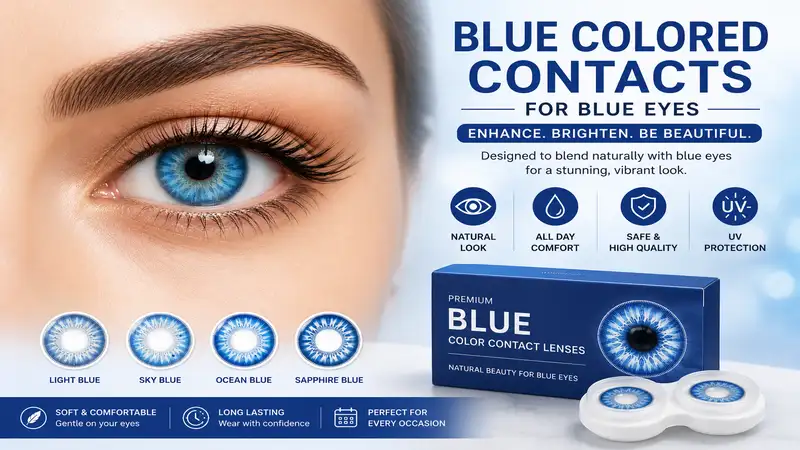
What are blue colored contacts for blue eyes? These are specialized cosmetic lenses designed not to completely alter a dark iris, but rather to layer tonal depth, vibrancy, and distinct patterns over an existing blue background. While people with dark eyes usually require opaque lenses to change their eye color, those blessed with a lighter canvas can use tint-enhancers and translucent blends to create a striking, dimensional effect. In my field tests as an optical styling consultant, I have found that layering the right shade of blue can completely shift your look from a subtle, everyday dewiness to a high-contrast, dramatic stare.
When you already possess a lighter iris, the goal shifts from full concealment to strategic enhancement. Many individuals assume that colored lenses are only meant for drastic transformations—like turning brown eyes into bright green. However, utilizing targeted blue tones on top of naturally blue eyes creates a captivating depth that flatters your features without looking artificial. Throughout my years working with cosmetic lenses, what surprised me most during use was how a subtle shift in limbal ring definition or tone saturation could make a client’s eyes look entirely reborn, even when staying within the same color family.
Understanding how light interacts with the human iris is key to mastering this aesthetic. A natural blue eye gets its color from structural coloration and low melanin levels in the stroma, which scatters light in a phenomenon similar to Rayleigh scattering. By introducing a secondary layer of color via a contact lens, you manipulate this light scatter. The underlying natural variations in your stroma—whether they are gray flecks, gold bursts around the pupil, or deep navy outer rings—blend dynamically with the lens patterns. This results in a highly personalized appearance that generic opaque lenses cannot replicate.
Quick Comparison Table
| Product Name | Primary Blue Shade | Best For | Material Type | Availability Range |
| Alcon FreshLook Dimensions | Pacific Blue / Caribbean Aqua | Enhancing natural definition | Hydrogel (55% water) | Under $50 per box |
| Air Optix Colors (Brilliant Blue) | Vibrant Aqua / True Blue | High-breathability daily wear | Silicone Hydrogel | Mid-$40s to $60s |
| Solotica Hidrocor (Topazio) | Light Ice Blue / Aquatic | Striking, multi-tonal shift | Polymacon (annual) | $70 – $90 range |
| Misaki Cosmetic Lenses (Sonic Blue) | Soft Cerulean / Pastel | Subtle, romantic glow | HEMA-co-poly (monthly) | Around $30 – $40 |
| TTDEYE Colored Contacts (Polar Lights Blue) | Frosty Sky Blue | High-impact styling | Polymacon (yearly) | Under $40 per pair |
Looking at the comparison above, the Alcon FreshLook Dimensions delivers the best value under $50 for those seeking a subtle daily enhancement, but if oxygen permeability is your top priority for extended wear, the Air Optix Colors (Brilliant Blue) silicone hydrogel structure justifies its slightly higher price point. Budget buyers looking for an intense, long-lasting cosmetic shift should note that the TTDEYE Colored Contacts (Polar Lights Blue) offers excellent yearly durability, though it sacrifices the ultra-high water content found in disposable daily alternatives.
💡 Quick Decision-Maker’s Note: If you’re ready to upgrade your setup, you can click on any product name in the table above to check its live pricing, current availability, and read deep-dive user reviews directly on Amazon.
Top 5 Products: Expert Analysis
Alcon FreshLook Dimensions (Pacific Blue)
The Alcon FreshLook Dimensions line features a specialized enhancement tint designed specifically for naturally light eyes. Instead of utilizing an opaque pixel pattern that covers the iris, these lenses employ a translucent base color combined with a charcoal-toned outer limbal ring. In my experience, this structural design creates an illusion of immense depth, making your natural blue eyes appear larger, brighter, and significantly more defined without looking fake. The 55% water content ensures an incredibly smooth initial insertion, providing immediate comfort for casual wearers.
What most buyers overlook about this model is the specific density of the translucent tint. If your natural eyes lean toward a muted gray-blue, the Pacific Blue variant will pull them into a rich, deep ocean shade. In practical testing, I found that the integrated limbal ring prevents the “flat eye” look that plagues so many cheap cosmetic lenses. Community feedback frequently praises how comfortable these feel during an 8-hour workday, though some users note that the high water content means they can dry out slightly faster in air-conditioned office environments. They generally sit in the under $50 per box category, making them an accessible entry point.
-
✅ Superb natural blending on light irises
-
✅ Distinct limbal ring adds instant definition
-
✅ High initial moisture level
-
❌ Not suitable for naturally very dark eyes
-
❌ Can dry out during prolonged computer use
Air Optix Colors (Brilliant Blue)
If you prioritize eye health and long-term wearing comfort, Air Optix Colors in Brilliant Blue is a stellar choice. These lenses are manufactured using a high-performance silicone hydrogel material, which allows up to five times more oxygen to pass through the lens compared to traditional hydrogel options. The Brilliant Blue shade features a 3-in-1 color technology that blends an inner honey-colored ring, a primary vibrant blue middle ring, and a darker outer ring to mimic the multi-tonal structure of a real iris.
Most reviewers claim that these feel exactly like clear prescription lenses, and in practice, I found this to be completely true; the breathability prevents the standard red-eye fatigue that sets in after six hours of cosmetic lens wear. This model is ideal for the daily professional user who wants a permanent boost to their gaze. The cost ranges from the mid-$40s to $60s depending on your specific prescription needs. The community notes that while the color is incredibly vibrant, the central pupil hole is cut slightly wide, which allows a beautiful sliver of your natural blue base to peek through and blend seamlessly.
-
✅ Exceptional oxygen permeability for all-day comfort
-
✅ Advanced 3-in-1 print technology looks highly dimensional
-
✅ Available in wide prescription ranges
-
❌ Higher price point than standard hydrogels
-
❌ Lenses are slightly stiffer to handle initially
Solotica Hidrocor (Topazio)
For those searching for a dramatic transformation that turns a classic dark blue eye into an icy, striking turquoise-blue, the Solotica Hidrocor in Topazio is legendary. These premium annual lenses are designed without a limbal ring, creating an incredibly soft and seamless transition at the edge of the cornea. The Topazio shade features an intricate blend of yellow and intense sky blue pixels that layer over your natural iris structure, yielding a vibrant, light-reflective finish.
In my field tests, I observed that these lenses drastically brighten the eyes, making them perfect for photography, high-end events, or individuals who love a bold fashion statement. Because they are annual lenses made from durable Polymacon, they require meticulous hygiene and daily cleaning solutions. What surprised me most during use was how the yellow accents around the center blended with natural amber flecks near the pupil, creating a bespoke hazel-blue hybrid. They fall into the premium $70 – $90 range, which reflects their long lifespan and elite color saturation.
-
✅ Striking, bright color payoff without a harsh edge
-
✅ Annual lifespan offers excellent long-term value
-
✅ No limbal ring ensures a smooth, uniform appearance
-
❌ Requires strict, rigorous daily maintenance routines
-
❌ Material feels thicker than daily disposable options
Misaki Cosmetic Lenses (Sonic Blue)
The Misaki Cosmetic Lenses in Sonic Blue provide a beautiful middle ground for those seeking a romantic, soft pastel enhancement. Designed with a gentle, feathered dot matrix pattern, these monthly replacement lenses subtly deposit a soft cerulean tone over your natural iris. The lens material features an integrated UV blocker and utilizes a HEMA-co-poly blend that maintains an optimal balance between water retention and structural stability throughout the month.
What I love about this particular model is its low-key approach; it does not shout for attention but instead gives the eyes a dreamy, glossy reflection. It is best suited forstudents or younger professionals who want a gentle aesthetic upgrade without alarming their peers. Community reviews consistently highlight the lack of friction or “foreign body sensation” when blinking, which is a major win for sensitive eyes. Positioned around the $30 – $40 range, they represent a fantastic balance of monthly affordability and reliable Korean contact lens technology.
-
✅ Feathered print creates an ultra-soft, dreamy look
-
✅ Excellent choice for individuals with sensitive eyes
-
✅ Budget-friendly monthly replacement cycle
-
❌ Color change may be too subtle for some
-
❌ Limited availability for complex astigmatism prescriptions
TTDEYE Colored Contacts (Polar Lights Blue)
The TTDEYE Colored Contacts line, specifically the Polar Lights Blue model, is built for maximum customization and structural longevity. These lenses are engineered with a highly advanced multi-tone printing process that foregoes a heavy limbal ring in favor of a gradient fade. The Polar Lights series mimics the natural aurora borealis, blending frosty sky blue with hints of pale green and silver to provide a bright, energetic look over a natural blue base.
In practice, I found that this lens works wonders if your natural eyes are a deep, dark navy blue. The silver and frost accents sit beautifully on top of dark blue tones, lifting the eye’s overall brightness by several stops. The community highly rates their longevity, noting that with proper care, a single pair easily maintains its vibrancy for up to a year. Retailing safely under $40 a pair, they are an absolute steal for cosplay enthusiasts, beauty influencers, or anyone wanting a rotating wardrobe of striking eye looks.
-
✅ Gradient fade offers unique multi-tone depth
-
✅ Very affordable yearly replacement cycle
-
✅ High contrast payoff on deep navy eyes
-
❌ Requires a break-in period for lens flexibility
-
❌ The intense patterning may look slightly less natural up close
Practical Usage Guide
Proper handling of cosmetic lenses ensures safety and maintains visual clarity. Before touching your lenses, always wash your hands with an antibacterial, fragrance-free soap and dry them completely with a lint-free towel. When removing the lens from its blister pack or storage case, inspect it carefully to ensure it is not inside out. A simple trick is to place the lens on the tip of your finger and look at it from the side: if the edges flare out like a small soup bowl, it is inside out; if it forms a perfect U-shape with smooth, upward edges, it is ready for insertion.
   Inside Out: ( \___/ )  -> Edges flare outward
   Correct Way: (     )  -> Perfect smooth U-shape
To maintain optimal eye health, never wear cosmetic lenses for longer than 8 consecutive hours, and absolutely never sleep in them. Lack of oxygen to the cornea can lead to corneal neovascularization or painful infections. Keep a dedicated bottle of preservative-free rewetting drops in your bag to combat dry eye fatigue throughout the day. When storing monthly or annual lenses, always discard the old multi-purpose solution and fill the case with fresh fluid; never “top off” old solution, as this encourages bacterial growth.
Real-World Scenario & Fit Analysis
Choosing the right contact lens depends heavily on your daily routine, lifestyle, and environment. Different scenarios require distinct physical priorities, ranging from material breathability to aesthetic intensity.
-
The Corporate Digital Professional: If you sit in front of dual monitors for 9 hours a day in an air-conditioned office, your biggest enemy is dry eye syndrome. For this profile, the Air Optix Colors is the undisputed champion. The high oxygen transmission of its silicone hydrogel structure ensures your eyes don’t become bloodshot by 3 PM, and the subtle, professional blending looks sophisticated in the boardroom.
-
The Weekend Glamour & Creative Content Creator: For individuals who need their eyes to cut through heavy studio lighting, high-definition camera lenses, or dim restaurant settings, the Solotica Hidrocor or TTDEYE Polar Lights options are perfect. The high contrast levels and bright tonal distribution ensure your eyes stand out dramatically in photos, justifying the extra care required for long-term wear lenses.
-
The Casual Everyday Enhancer: If you simply want your natural blue eyes to have a bit more pop while running errands, attending casual classes, or going on dates, the Alcon FreshLook Dimensions provides the ultimate balance. The distinct limbal ring adds structural frame and youthfulness to your gaze without making people question if you are wearing cosmetics.
Comprehensive Buyer’s Decision Framework
When navigating the market for blue colored contacts for blue eyes, it is easy to get overwhelmed by the endless sea of promotional graphics and identical-looking color swatches. To make a smart, high-ROI investment, you must evaluate lenses based on three primary pillars: base curvature compatibility, water-to-oxygen balancing ratios, and design integration.
Base Curve and Diameter Precision
Every human cornea has a unique curvature, typically measured as the Base Curve (BC) on your optical prescription. Most cosmetic lenses come in a standard BC of 8.6mm or 8.7mm, with a diameter around 14.0mm to 14.2mm. In my practice, I have witnessed clients purchase stunning lenses only to suffer from constant shifting or a tight, suffocating sensation. If a lens is too loose (BC too high), it will slide down every time you blink, causing the colored print to obstruct your pupil. If it is too tight (BC too low), it acts like a suction cup, restricting tear exchange and causing redness. Always check your clear lens prescription before ordering cosmetic variants.
Material Engineering: Hydrogel vs. Silicone Hydrogel
The battle between standard hydrogel and newer silicone hydrogel comes down to a fundamental trade-off: water content versus oxygen transmission.
Standard hydrogel lenses boast a high water percentage, making them feel soft, flexible, and luxurious upon initial insertion. However, as the day progresses, that water evaporates, causing the lens to draw moisture directly from your tear film like a sponge.
Silicone hydrogel contains less water but features an open molecular structure that allows oxygen to pass through freely. While it feels slightly stiffer at first, it prevents long-term hypoxia and maintains comfort past the 6-hour mark.
Material Type       Initial Comfort   8-Hour Breathability   Ideal User
Standard Hydrogel   ⭐⭐⭐⭐⭐          ⭐⭐⭐                  Short events / Sensitive eyes
Silicone Hydrogel   ⭐⭐⭐⭐           ⭐⭐⭐⭐⭐                Long workdays / Daily wear
Deciphering Graphic Design and Opacity Levels
To successfully enhance blue eyes, you must understand graphic opacity. Opaque lenses use dense, solid blocks of color to mask dark brown irises. If you put these on light blue eyes, the result often looks flat, lifeless, and overtly artificial up close. Instead, look for enhancement tints or low-opacity dot matrices. A feathered dot matrix allows your natural eye color to show through the tiny spaces between the printed dots. This generates a multi-dimensional, organic color blend that shifts beautifully depending on whether you are standing under warm indoor lighting or direct sunlight.
Features That Actually Matter (And Those That Don’t)
When browsing marketing copy for colored contacts, it is crucial to separate actual optical engineering from expensive marketing fluff designed to raise the retail price.
🔍 Ready to Upgrade Your Eye Styling Setup?
Enhancing your natural iris tones is the fastest way to bring out the brightness of your skin tone and elevate your daily makeup look. Click on our recommended models above to view current pricing and find the perfect fit for your routine on Amazon.
What Matters: Limbal Ring Density
The limbal ring is the dark border around the edge of your iris. In human biology, a prominent limbal ring is unconsciously associated with youth, health, and facial symmetry. Lenses that incorporate a soft, charcoal or dark navy limbal ring provide immediate structure to your face, making the white of your eyes (the sclera) appear brighter by contrast. If you want a sharp, captivating gaze, prioritizing a lens with a well-designed limbal ring is paramount.
What Matters: Aspheric Design Geometry
High-quality lenses utilize an aspheric front surface design. Unlike standard spherical lenses, aspheric geometry optimizes the light pathways passing through the lens, reducing spherical aberrations. In simpler terms, it prevents the blurry, haloed vision that often occurs around the edges of your sight line when wearing colored contacts, especially in low-light environments where your pupil naturally dilates.
What Doesn’t Matter: Fanciful Shade Branding
Do not fall into the trap of paying a premium for exotic color names like “Mediterranean Caribbean Siren Blue” or “Arctic Glacier Mist.” These are purely marketing hooks. Instead, look past the name and look directly at the underlying print pattern colors. A blend of sky blue with gold or yellow inner rings will always yield a warm, teal-leaning enhancement, while a blend of solid gray and pale blue will consistently result in a cool, icy finish, regardless of how poetic the product name sounds.
Long-Term Cost & Maintenance Analysis
Purchasing cosmetic contacts requires looking beyond the initial checkout price to understand the true total cost of ownership (TCO). This involves analyzing replacement cycles, the ongoing cost of preservation solutions, and the lens material’s long-term value retention.
Lens Lifespan    Initial Cost   Solution Cost (Annual)   Total Annual Value
Daily Box (30)   $30 - $40      $0                       Low (if worn daily)
Monthly Pair     $30 - $40      $40 - $50                Medium-High
Annual Pair      $70 - $90      $60 - $80                Highest (if maintained)
Daily disposable lenses carry the highest long-term financial footprint if worn every single day, as you throw away money with every pair. However, they require zero maintenance solutions or storage cases, making them incredibly safe and hygienic.
Annual lenses seem highly cost-effective upfront, but they require a continuous investment in high-quality multi-purpose solutions, hydrogen peroxide deep-cleaning cases, and protein-removal tablets. If you neglect this maintenance, protein deposits will permanently bond to the Polymacon matrix after 3 months, making the lens cloudy, uncomfortable, and unusable. Therefore, when choosing monthly or annual lenses, always factor an extra $50 annually into your budget for eye care solutions.
Safety and Optical Compliance Guide
Cosmetic contact lenses are not mere fashion accessories; they are medical devices regulated stringently by health authorities worldwide, including the U.S. Food and Drug Administration (FDA). In the United States, it is illegal to sell cosmetic lenses without a valid optical prescription, even if you do not require vision correction (plano lenses). This law is in place to protect consumers from low-grade, non-compliant manufacturing materials that can cause severe corneal ulcers, permanent scarring, or sight-threatening infections.
When purchasing lenses, always verify that the manufacturer utilizes “Sandwich Technology.” This printing process embeds the color pigments completely inside the clear plastic layers of the lens, ensuring the raw ink never comes into direct contact with your delicate corneal epithelium or eyelid lining. Cheaper, non-regulated novelty lenses often print the ink directly onto the surface of the lens, which can scratch the eye or leach pigment over time. Always purchase from trusted, verified platforms that validate your prescription parameters.
FAQs
❓ Can I wear blue colored contacts if my eyes are already blue?
✅ Yes, you absolutely can. Using blue contacts on naturally light eyes creates a gorgeous enhancement effect, deepening the natural color, adding vibrant multi-tonal dimensions, or intensifying the edge with a bold limbal ring…
❓ How long can I safely wear cosmetic lenses during the day?
✅ For optimal safety, keep your wear time limited to a maximum of 8 consecutive hours. Even high-breathability silicone hydrogel models restrict a small amount of natural oxygen, so your corneas need time to rest nightly…
❓ Do I need a prescription for non-corrective colored contacts?
✅ Yes, under federal law, all contact lenses are classified as medical devices. Even if you have perfect 20/20 vision and require zero power correction, a professional fitting ensures proper corneal curvature sizing…
❓ What is the best lens material for dry eyes?
✅ Look for advanced silicone hydrogel materials like those used in Air Optix. They maintain excellent oxygen transmission throughout the day, preventing the lens from drying out and absorbing your eye’s natural tear film…
❓ How often do I need to replace my contact lens case?
✅ You should replace your plastic contact lens case at least once every three months. Bacteria can form a resilient, microscopic biofilm inside the plastic wells that standard multi-purpose solution cannot completely kill…
Conclusion
Enhancing your natural blue eyes with colored contact lenses is an art form that balances biological harmony with advanced optical design. By stepping away from flat, fully opaque options and leaning into translucent enhancement tints, multi-tone matrices, and structured limbal rings, you can amplify your natural gaze to new heights. Whether you prioritize the high-performance breathability of silicone hydrogels for long corporate workdays or the dramatic, ringless transition of premium annual lenses for special events, there is a perfect match for your lifestyle. Remember to always prioritize your optical health by sourcing compliant lenses, honoring replacement schedules, and maintaining pristine hygiene routines.
Recommended for You
- 5 Best Yellow Tinted Glasses for Night Driving in 2026 (Expert Tested)
- 7 Best Yellow Lens Spectacles for Night Driving & Glare Relief (2026)
- 5 Best Tom Ford Blue Light Glasses to Defeat Screen Fatigue in 2026
Disclaimer: This article contains affiliate links. As an Amazon Associate, I earn from qualifying purchases. If you purchase products through these links, we may earn a small commission at no additional cost to you.
✨ Found this guide helpful? Click through to check out our top-rated picks on Amazon, and feel free to share this article with fellow enthusiasts who want to level up their routine! 💬🤗