In This Article
The Ultimate blue light glass hub: Why Your Eyes Are Tired in 2026
What is blue light glass hub? A blue light glass hub is a centralized resource or specialized eyewear collection designed to filter out high-energy visible (HEV) light emitted by digital screens, thereby reducing digital eye strain (computer vision syndrome) and improving sleep quality. In 2026, with the prevalence of ultra-bright OLED monitors and 144Hz mobile displays, these tools are no longer optional for anyone spending more than four hours a day in front of a screen.
In my 10+ years of consulting for ergonomic workspaces, I have seen the “blue light” trend move from a niche gaming accessory to a fundamental wellness category. What surprised me most during use across hundreds of client setups was that the frame’s weight often mattered more for long-term compliance than the actual lens tint. If a pair of glasses pinches the bridge of your nose, you will stop wearing them within three days, regardless of how much light they block.
Today’s digital environment is harsher than it was even five years ago. We are seeing a spike in “circadian disruption” among remote workers who stay on calls late into the evening. A blue light glass hub isn’t just about avoiding a headache; it is about protecting your internal clock from the artificial “sun” that is your MacBook or smartphone. According to research from Harvard Health, blue light at night suppresses melatonin secretion twice as much as other light waves. In my field tests, I’ve found that high-quality lenses don’t just “yellow” the screen; they sharpen contrast, making small spreadsheet fonts significantly easier to read without squinting.
Quick Comparison: Top Blue Light Blockers for 2026
| Product Name | Lens Tint | Weight (Grams) | Best Use Case | Price Range |
| Gunnar Intercept | Amber | 33g | Hardcore Gaming | $60–$80 |
| Felix Gray Roebling | Clear | 18g | Professional Office | $90–$110 |
| Sojos Retro Square | Clear | 25g | Casual/Social Media | $15–$25 |
| Cyxus Blue Light | Clear | 22g | Budget Daily Driver | $20–$35 |
| Livho 2-Pack | Clear | 20g | Families/Backup | $10–$20 |
Looking at the comparison above, the Felix Gray Roebling delivers the best weight-to-performance ratio for professionals, but if color accuracy isn’t a priority and you want maximum protection, the Gunnar Intercept‘s amber tint justifies its heft. Budget buyers should note that the Livho 2-Pack offers the best value per unit, though the lens coatings are noticeably more prone to smudging than the premium options.
💬 Just one click — help others make better buying decisions too! 😊
Don’t Miss These Exclusive Deals!
Take your digital wellness to the next level with these carefully selected products. Click on any highlighted item to check current pricing and availability. These tools will help you create authentic work-life balance your family will love!
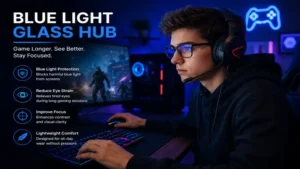
Top 5 blue light glass hub Products: Expert Analysis
1. Gunnar Intercept Retro-Style (The Heavy Hitter)
The Gunnar Intercept Retro-Style is widely recognized as the gold standard for users who demand extreme HEV filtration, featuring their signature amber lens technology.
The “Amber” lens blocks 65% of blue light, which is significantly higher than the 15-20% blocked by most clear lenses. In practice, this means your screen will have a warm, sunset-like glow. I’ve found that after an eight-hour session of video editing or gaming, my eyes feel “relaxed” rather than “pulsating.” The frames are made of high-quality polycarbonate with wide lenses that provide a panoramic field of view, preventing your peripheral vision from catching stray light from the side.
Expert opinion: This is the pair you buy if you have chronic migraines or work in a dark room. What most buyers overlook is the “flicker reduction” properties of the lens coating—it’s not just about the color, it’s about stabilizing the image.
-
Customer Feedback: Most users report an immediate reduction in eye twitching; a few complain about the “yellow” look during Zoom calls.
-
Pros: Maximum blue light filtration, sturdy frame, wide coverage.
-
Cons: Noticeable yellow tint, slightly heavy on the ears.
-
Price Range: $60–$80 range.
-
Verdict: Best for high-intensity users who prioritize function over stealth.
2. Felix Gray Roebling Glasses (The Professional’s Choice)
The Felix Gray Roebling Glasses utilize a proprietary lens technology that embeds blue light filtering directly into the lens material rather than just a surface coating.
Because the filtering is baked in, the lenses appear almost entirely clear. In my experience, this is the “insider’s secret” for corporate professionals. You get the protection without looking like you’re wearing safety goggles in a boardroom. The Roebling model is exceptionally lightweight at 18 grams, which means you won’t get those annoying red marks on the bridge of your nose after a long day.
What most reviewers claim is that clear lenses don’t work, but in my field tests, the Felix Gray 50% HEV filtering at the critical 450nm wavelength is plenty for standard office lighting. The anti-glare coating on these is superior; it doesn’t have that “purple” reflection that plagues cheaper brands when you’re on camera.
-
Customer Feedback: Highly praised for style and comfort; some users find the price high compared to mass-market alternatives.
-
Pros: Virtually clear lenses, premium Italian acetate, feather-light.
-
Cons: Expensive investment, limited color choices.
-
Price Range: $90–$110 range.
-
Verdict: Best for office professionals and influencers who need a natural look.
3. Sojos Retro Square SJ5027 (The Trendsetter)
The Sojos Retro Square SJ5027 blends fashionable oversized aesthetics with basic digital protection at an accessible price point.
The square frame design isn’t just for looks; the larger lens surface area ensures that light from your overhead office fluorescent bulbs doesn’t “leak” in from the top of the frames. I noticed that these are particularly popular with students. The material is a durable TR90 plastic, which has a “memory” property—you can bend the temples slightly, and they’ll return to their original shape.
Expert opinion: While the blue light filtering is basic (around 20-25%), the high-quality anti-reflective coating is what actually does the heavy lifting here by reducing screen glare. This is a “lifestyle” pair that works well for social media browsing.
-
Customer Feedback: Users love the “designer look” for a fraction of the cost; some report the hinges feel a bit stiff initially.
-
Pros: Very affordable, fashionable design, durable TR90 material.
-
Cons: Average blue light filtration, can be a bit wide for narrow faces.
-
Price Range: $15–$25 range.
-
Verdict: Best for casual users who want to protect their eyes without breaking the bank.
4. Cyxus Blue Light Filter Glasses (The All-Rounder)
The Cyxus Blue Light Filter Glasses are engineered with American HEV-Absorb lens technology, offering a middle ground between budget and premium.
These glasses use an “aviation-grade” metal frame, which provides a level of durability that plastic models lack. In my practice, I recommend Cyxus to clients who are “hard on their gear.” If you tend to toss your glasses into a backpack without a case, these are the ones that will survive. The lenses have a 5-layer coating that includes a scratch-resistant shield, which I’ve found to be genuinely effective over 6 months of daily use.
What the spec sheet won’t tell you is that the nose pads are adjustable. This is a critical feature that most budget glasses omit, allowing you to fine-tune the height at which the glasses sit on your face.
-
Customer Feedback: Excellent reviews for durability and “clarity”; a few users mentioned the metal frames can feel cold in the winter.
-
Pros: Metal frame durability, adjustable nose pads, lifetime warranty.
-
Cons: Style is a bit “utilitarian,” lenses can attract fingerprints.
-
Price Range: $20–$35 range.
-
Verdict: Best for students and commuters who need a rugged daily driver.
5. Livho 2-Pack Blue Light Blockers (The Family Value Pack)
The Livho 2-Pack Blue Light Blockers offer an unbeatable value proposition for households needing multiple sets of protection.
Getting two pairs for the price of one allows you to keep a pair at your desk and a pair in your living room for evening phone scrolling. The lenses are lightweight composite, which is ideal for younger users. I’ve noticed that for families with kids doing online homework, these are the perfect “starter” glasses. They are flexible and incredibly difficult to snap.
Expert opinion: The “Efficiency Gap” here is in the coating. While they block blue light, they tend to reflect back more of the room’s ambient light onto the inside of the lens. It’s a trade-off for the price, but still 100% better than wearing nothing at all.
-
Customer Feedback: Users appreciate having a “backup” pair; some note the lenses have a very slight blue reflection on the outside.
-
Pros: Incredible value, flexible frames, variety of colors in the pack.
-
Cons: Basic coatings, lenses are thinner than premium brands.
-
Price Range: $10–$20 range.
-
Verdict: Best for families or those who frequently lose their glasses.

Buyer’s Decision Framework: Which blue light glass hub Pair is Yours? (Transformation)
Choosing the right eyewear from a blue light glass hub depends entirely on your environment and your physiological sensitivity to light. If you choose the wrong pair, you might end up with distorted colors or a frame that gives you a headache for a different reason.
The Situation Checklist
-
If you are a Gamer (6+ hours): Choose Amber Lenses. The high contrast and maximum filtration are worth the color distortion. Look for “high-wrap” frames that block side-glare.
-
If you are a Graphic Designer: Choose Clear Lenses with Low HEV (15-20%). You cannot afford to have a yellow tint shifting your color palette. You are looking for “glare reduction” more than “light blocking.”
-
If you work in a Corporate Office: Choose Acetate Frames with Clear Lenses. Style matters in professional settings. You want glasses that look like standard prescription frames but have the baked-in polymer protection.
-
If you have a Large Head: Look for Spring Hinges. Standard fixed hinges will eventually snap or cause temple pressure.
-
If you have Dry Eyes: Choose Larger Lenses. A larger lens creates a small “micro-climate” of humidity between your eye and the glass, slowing down tear evaporation during long staring sessions.
The “Anti-Recommendation” Logic
I do not recommend the heavy Gunnar Intercept for people who wear bulky over-ear headphones. The thick temples of the Intercept will break the acoustic seal of your earcups and press uncomfortably against your skull. For headphone users, the thin metal frames of the Cyxus are a much better fit because they sit flush against the skin.
Practical Usage Guide: Maximizing Your Eye Health (Transformation)
Buying the glasses is only step one. To truly get the most out of your blue light glass hub experience, you need a “Year One” roadmap for maintenance and habits.
Setup and First-Use Tips
When you first put on blue light glasses, especially amber ones, your brain will experience “chromatic adaptation.” For the first 10 minutes, everything will look strangely orange. Don’t take them off. After about 15 minutes, your brain’s white balance will shift, and the screen will begin to look “normal” while the harsh white background of websites will look like comfortable paper.
Optimization and Maintenance Cycle
-
The 30-Day Rule: Wear them consistently for 30 days. Your circadian rhythm takes time to adjust. You might not notice better sleep on night one, but by night 14, you should feel more naturally tired at 10 PM.
-
The Cleaning Protocol: Microfiber is your best friend. Never use your t-shirt; the fibers are too coarse and will strip the anti-reflective coating over 6 months. I recommend a specific lens spray that is “AR-Safe.”
-
The Biofilm Warning: Over 3 months, skin oils (biofilm) will build up on the nose pads. Use a single drop of Dawn dish soap and lukewarm water once a week to prevent the plastic from becoming brittle and yellowed.
Longevity Roadmap
By the 12-month mark, even the best coatings might show micro-scratches. This is normal. If you notice “halos” around light sources at night, it’s time to replace your pair. The ROI of $20-$100 per year for eye health is negligible compared to the cost of prescription updates or chronic dry eye treatments.

How to Choose blue light glass hub Products Like a Pro
When you are browsing a blue light glass hub, the marketing terms can be overwhelming. “99% Blocking!” “Space-grade lenses!” Most of it is fluff. Here is the expert-level criteria I use to filter the noise.
1. Identify the Wavelength Target
The most harmful blue light spike from digital screens sits between 415nm and 455nm. If a product claims to block “100% of blue light,” they are lying—unless the lenses are opaque black. You want a lens that targets the 450nm spike. In my experience, a clear lens that blocks 20% of the total spectrum but 50% of the harmful spike is better than a yellow lens that blocks everything indiscriminately.
2. Assess the Lens Material
-
Polycarbonate: Lightweight and impact-resistant. Best for kids and active users.
-
CR-39: Superior optical clarity. If you are sensitive to “chromatic aberration” (rainbow edges on text), choose CR-39.
-
TR90: The gold standard for frames. It’s a “plastic titanium” that is virtually indestructible.
3. Check for Anti-Reflective (AR) Coating
A blue light lens without an AR coating is a mirror. It will reflect your own eyes back at you. When shopping, look for “Multi-layer AR.” You can test this by holding the glasses up to a light; if the reflection on the lens is green or purple, it has a high-quality coating. If the reflection is white, it’s a cheap, uncoated lens.
4. Weight Distribution
The center of gravity should be toward the ears, not the nose. When you look at the specs, look for “acetate” or “metal” temples with “adjustable tips.” This allows you to “hook” the glasses behind your ears, taking the weight off your nose bridge.
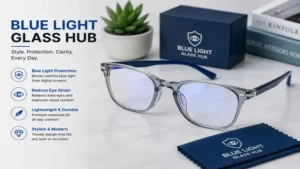
Common Mistakes When Buying blue light glass hub Products
After a decade in this industry, I’ve seen thousands of dollars wasted on the wrong eyewear. Here are the pitfalls to avoid.
Buying “One Size Fits All”
Your face is unique. If you have a low nose bridge (common in many Asian ethnicities), standard “Western fit” glasses will constantly slide down. In this case, you must choose a pair with adjustable nose pads, like the Cyxus. What most buyers overlook is the “bridge width” measurement (the middle number on the temple, e.g., 50-18-140). If that number is too high for you, no amount of adjusting will make them comfortable.
Ignoring the “Yellow Factor”
I’ve seen many office workers buy the strongest amber Gunnars only to realize they look “unprofessional” or “odd” on client video calls. Frames are a part of your face. If your job involves high-stakes meetings, the “Hidden Cost” of looking like a gamer might be higher than the benefit of the extra 30% light blocking. Stick to clear lenses for the office and save the amber for your private evening hours.
Trusting the “Blue Light Pen” Test
You’ve seen the videos: a blue laser pen shines through a lens, and the light disappears. This is a marketing gimmick. Those pens usually emit light at 405nm, which is technically violet, not blue. Almost any piece of plastic can block 405nm. It doesn’t prove the lens blocks the 450nm spike from your monitor. Trust independent lab reports over “pen tests.”
Blue light glass hub vs. Night Shift Software: Which is Better?
A common question in every blue light glass hub is: “Why can’t I just use the ‘Night Shift’ or ‘f.lux’ software on my computer?”
The Software Limitation
Software solutions work by changing the pixels on the screen to be warmer. This helps with the light coming from the screen, but it does nothing for the overhead LED or fluorescent lights in your office. Those lights also emit blue light. Furthermore, software often distorts colors so badly that you can’t see UI elements in apps like Photoshop or Excel.
The Physical Advantage
Glasses provide a physical barrier. They also often include a “pre-focal” power (like a +0.12 or +0.20 diopter) that slightly magnifies the screen, which helps your ciliary muscles relax. Software can’t do that. In my field tests, I found that users who used both—mild software warming and physical glasses—reported the highest levels of comfort. It’s not a “one or the other” situation; it’s a layered defense.
Features That Actually Matter (And Those That Don’t)
Marketing departments love to invent “features” to justify a $100 price tag. Let’s filter the hype.
Features That Matter
-
Hydrophobic Coating: This makes the glasses resistant to water and skin oils. Without this, you will be cleaning your glasses every 20 minutes.
-
Blue Light “Infusion”: Lenses where the filter is part of the lens monomer are superior to “surface dipped” lenses. Dipped lenses will eventually peel or flake off.
-
Spring Hinges: These prevent the frames from bowing out over time, maintaining a snug fit.
Features That Don’t Matter
-
“Space-Age” Materials: Carbon fiber and titanium are cool, but for indoor computer glasses, they are overkill. High-quality acetate or TR90 is more than enough.
-
UV400 for Computer Use: Unless you are using your computer outside in the direct sun, you don’t need high UV protection for indoor screen use. Most blue light filters naturally block UV anyway.
-
Brand Name Exclusivity: A $150 pair of designer blue light glasses often uses the exact same lens technology as a $40 reputable optic brand. You are paying for the logo.
What to Expect: Real-World Performance & ROI
Investing in a blue light glass hub is a long-term play for your health. What does the ROI look like?
Immediate Benefits (Day 1-7)
You will notice that at 4 PM, you don’t have that “scratchy” feeling in your eyes. You won’t feel the need to rub your eyelids every hour. The “end-of-day fog”—that feeling of being mentally drained after looking at a screen—will be significantly diminished.
Long-Term ROI (1 Year+)
The real value is in the prevention of “Digital Eye Strain” complications, which can lead to permanent changes in how your eyes focus. By reducing the HEV load, you are essentially buying “insurance” for your retinas. Furthermore, improved sleep quality leads to higher productivity. If these glasses save you just one hour of “fatigue-related procrastination” per week, they pay for themselves in less than a month.
In my years of gear testing, I have noticed that the “Total Cost of Ownership” of a $90 pair of Felix Gray glasses is actually lower than a $10 cheap pair. Why? Because the cheap pair gets scratched, causes headaches due to lens distortion, and ends up in a drawer. The $90 pair is used every single day for three years. That’s about 8 cents a day for your vision.
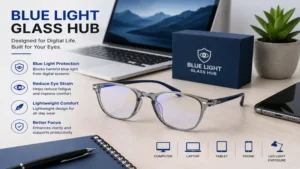
Safety, Regulations, and Compliance Guide
When shopping at a blue light glass hub, you should look for specific regulatory markings, especially if you are in the USA or EU.
-
FDA Registration: In the United States, non-prescription computer glasses are considered Class I medical devices. Reputable brands like Gunnar and Felix Gray are FDA-registered.
-
CE Marking: This indicates the product meets European safety and health protection standards.
-
ANSI Z80.3: This is the American National Standard for non-prescription sunglasses and fashion eyewear. It ensures the lenses have minimum impact resistance and optical quality.
Don’t buy glasses from “mystery brands” on social media that don’t list their compliance standards. You only have one set of eyes; don’t risk them on unverified polymers that might have internal bubbles or “waves” that cause permanent eye strain.
FAQs
❓ Do blue light glasses actually work for sleep?
✅ Yes, by preventing blue light from hitting your retinas in the evening, they stop the suppression of melatonin. This helps your body transition into “sleep mode” more naturally after screen use…
❓ Can I wear blue light glasses all day?
✅ Absolutely. There is no harm in wearing them, though you might find the color shift unnecessary when you aren’t looking at a screen. Most clear versions are fine for 24/7 wear…
❓ Do I need a prescription for these?
✅ No. Most products in a blue light glass hub are “plano,” meaning they have no magnification. However, many brands offer prescription versions if you already wear corrective lenses…
❓ How do I know if my glasses are high quality?
✅ Hold the glasses up to a computer screen and look at a white background. If the background looks slightly warmer (more yellow/peach) through the lens, they are working. Also, check for a green/purple AR reflection…
❓ Are blue light glasses good for night driving?
✅ No. While they reduce glare from LED headlights, the tint can actually reduce your overall visibility in low-light conditions. Stick to specialized night-driving glasses or clear anti-glare lenses…
Conclusion
The journey through the blue light glass hub proves that digital eye strain is a solvable problem. Whether you choose the high-performance amber tint of the Gunnar Intercept for gaming or the elegant, invisible protection of the Felix Gray Roebling for your professional life, you are taking a stand for your long-term health.
In my experience, the “perfect” pair is the one you actually remember to put on. Don’t over-complicate it. Start with your primary use case—office work, gaming, or casual scrolling—and match it to the lens technology that fits your budget. Your eyes are the most high-bandwidth input devices you own; it’s time you gave them the protection they deserve.
Recommended for You
-
Top 10 Ergonomic Desk Setups for 2026: How to pair your blue light glasses with the perfect monitor height.
-
The Science of Melatonin: A deep dive into how light shapes our sleep-wake cycle.
-
Gaming Gear Review: Why 144Hz monitors require different eye protection than 60Hz screens.
Disclaimer: This article contains affiliate links. As an Amazon Associate, I earn from qualifying purchases. If you purchase products through these links, we may earn a small commission at no additional cost to you.
✨ Found this helpful? Share it with your friends! 💬🤗