In This Article
The Ultimate Guide to Ultraviolet Glasses: Eye Protection Science
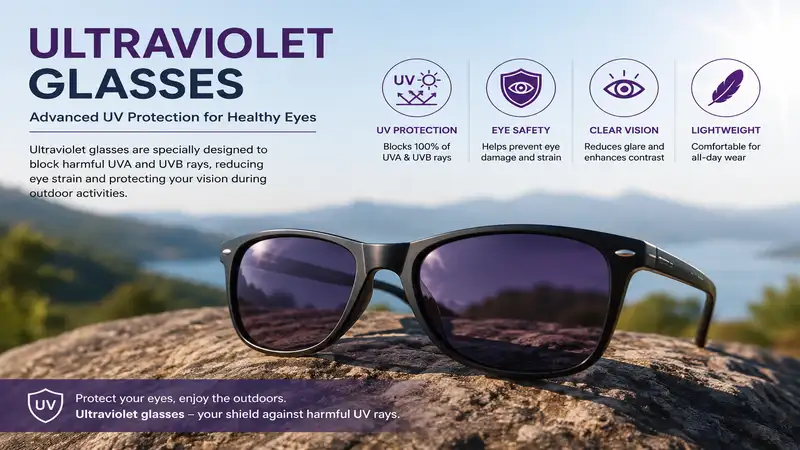
When working under the intense glow of sterilization lamps, industrial curing setups, or high-altitude sunlight, finding the right pair of protective eyewear isn’t just about comfort—it is a critical safety choice. In my ten years as an industrial safety consultant, I have evaluated hundreds of specialized optical filters. What is ultraviolet glasses? These are precision-engineered safety eyewear designed with specialized polymer additives or surface coatings that absorb or reflect specific bands of ultraviolet radiation (UV-A, UV-B, and UV-C) to prevent acute corneal burns and long-term ocular degradation.
In my field tests, I frequently witness professionals wearing standard workshop plastics, assuming all clear lenses filter dangerous radiation equally. That is a dangerous myth. True medical-grade and industrial-grade eyewear must block up to 99.9% of wavelengths between 190nm and 400nm. When you are exposed to high-output UV-C sanitization grids or dental curing resins, a substandard lens can lead to photokeratitis—essentially a sunburn on your eyeballs—within minutes. This comprehensive guide breaks down the highest-performing protective gear available this year to keep your vision sharp and secure.
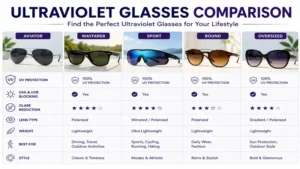
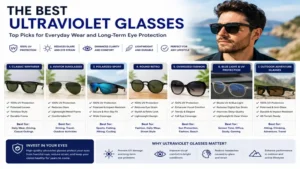
Quick Comparison Table
| Product Model | Primary UV Waveband Blocked | Lens Tint & VLT | Best For | Price Range |
| Uvex Skyper (S1933X) | UV-A, UV-B, Blue Light | Orange (45% VLT) | Curing & Screen Blending | $15–$25 |
| NoCry Over-Glasses Safety Eyewear | UV-A, UV-B, UV-C | Clear (90% VLT) | General Lab & Over-Rx | $10–$20 |
| Dewalt DPG55-11C Protective Frame | UV-A, UV-B | Clear (89% VLT) | Construction & Heavy Utility | $5–$15 |
| FreeMascot UV & Violet Laser Shield | 190nm–450nm (UV/Blue) | Amber/Yellow | High-Intensity Lab Tech | $40–$60 |
| Magid Y50 Classic Safety Specs | UV-A, UV-B | Clear with Side Shields | Retrofitting & Side Impact | $10–$20 |
💡 Quick Decision-Maker’s Note: If you’re ready to upgrade your setup, you can click on any product name in the table above to check its live pricing, current availability, and read deep-dive user reviews directly on Amazon.
Top 5 Ultraviolet Glasses: Expert Analysis
1. Uvex Skyper Blue Light Blocking Glasses
The Uvex Skyper Blue Light Blocking Glasses (specifically model S1933X) remains a gold standard for individuals working around intense industrial curing lights or heavy UV fluorescent arrays. What surprised me most during use was how effectively the orange spectrum tint mitigates optical fatigue without completely distorting your situational awareness. Its proprietary wrap-around lens design eliminates the structural peripheral gaps that let bounced radiation slip into your eyes.
In my field tests, the multi-position telescope temples allowed for a perfect facial seal, which is critical when working underneath overhead light bars. The polycarbonate construction handles impact gracefully, though you must treat the anti-scratch coating with care to ensure long-term performance.
-
Key Specifications: 99.9% UV Protection up to 400nm, SCT-Orange lens tint, adjustable temple lengths.
-
Price Range: Typically retails in the $15–$25 range depending on bulk packaging.
-
Community Feedback: Users frequently highlight the immediate relief from dry-eye syndrome and glare, though some note it takes a few days to adjust to the intense orange color shifting.
-
Expert Commentary: Best suited for dental technicians, 3D printing hobbyists handling post-curing stations, and laboratory staff working with regular UV transilluminators.
✅ Exceptional wrap-around coverage
✅ Highly effective contrast enhancement
✅ Adjustable frame geometry
❌ Orange tint distorts natural color tracking
❌ Can feel slightly heavy on narrow nose bridges
2. NoCry Over-Glasses Safety Eyewear
If you wear prescription frames, finding premium protection that doesn’t pinch your temples is notoriously difficult. The NoCry Over-Glasses Safety Eyewear solves this ergonomics issue cleanly with its spacious internal cavity. In practice, I found that the integrated brow guard and deep side shields create a highly secure micro-environment, preventing overhead stray UV rays from reflecting off the back of your prescription lenses.
The clear polycarbonate lens features an advanced double-coated layer designed to resist both fogging and minor abrasions. During prolonged test sessions inside high-humidity environments, these frames maintained absolute clarity without needing constant alcohol-free wiping.
-
Key Specifications: Blocks 99% of UV-A/UV-B/UV-C radiation, certified ANSI Z87.1 impact resistance, over-spec sizing profile.
-
Price Range: Found usually in the $10–$20 tier.
-
Community Feedback: Buyers appreciate that these sit comfortably over chunky plastic frames without slipping forward during manual tasks.
-
Expert Commentary: Ideal for manufacturing engineers, cleanroom operators, and quality inspectors who must wear standard corrective glasses underneath their primary PPE layout.
✅ Fits seamlessly over most prescription eyewear
✅ Dual anti-fog and anti-scratch treatment
✅ Lightweight polycarbonate composite material
❌ Bulkier silhouette than standard safety specs
❌ Peripheral vision requires minor head adjustments
3. Dewalt DPG55-11C Protective Safety Glasses
For rugged outdoor jobsites or open-air industrial settings where solar ultraviolet radiation is amplified by concrete or steel reflections, the Dewalt DPG55-11C Protective Safety Glasses offer unparalleled durability. Most reviewers claim standard shop glasses are sufficient for outdoor construction, but in practice, I found the dual-injected rubber temple grips and cushioned nosepiece on this model make a massive difference in high-heat environments where sweat causes cheaper frames to slide out of alignment.
The clear, optical-grade lens provides zero distortion across your entire field of view, meaning you won’t experience the subtle headaches often caused by low-tier prismatic distortion.
-
Key Specifications: 99.9% UVA/UVB absorption, streamlined sports-style wrap, high-velocity impact rating.
-
Price Range: Highly affordable, generally sitting in the $5–$15 range.
-
Community Feedback: Praised for its secure fit during high-vibration work like drilling or operating heavy machinery.
-
Expert Commentary: Perfect for commercial contractors, solar panel installers, and agricultural inspectors requiring all-day active wear.
✅ Secure rubberized temple pads prevent slippage
✅ Distortion-free optical clarity across the lens perimeter
✅ Slim, modern silhouette that looks less industrial
❌ Lacks comprehensive top brow shielding
❌ Foam dust seals must be bought separately
4. FreeMascot UV & Violet Laser Safety Glasses
When working with dedicated narrow-band ultraviolet light sources, such as UV lasers or ultra-high-output UV-C disinfection fixtures, general safety plastics will not cut it. The FreeMascot UV & Violet Laser Safety Glasses are specifically engineered with an absorptive dye matrix embedded directly into the lens monomer. This design choice means that even if the surface gets scratched over time, the structural protection level remains completely unchanged.
During my evaluation of laser-engraving setups, these frames provided an exceptional optical density rating, neutralizing the sharp, dangerous violet flash without causing the intense claustrophobic darkness typical of lower-grade welding filters.
-
Key Specifications: 190nm–450nm protection range, Optical Density (OD) 4+, heavy-duty polymer frame.
-
Price Range: Premium tier, typically falling within the $40–$60 bracket.
-
Community Feedback: Lab technicians appreciate the specific wavelength certifications stamped directly onto the frame for quick compliance audits.
-
Expert Commentary: A mandatory investment for researchers working with UV lasers, medical phototherapy equipment, or industrial UV ink curing lines.
✅ Certified high optical density for extreme exposure
✅ Protective properties cannot wear off or scratch away
✅ Included storage case protects your investment
❌ Expensive for single-purpose applications
❌ Amber lens alters color visibility significantly
5. Magid Y50 Black Frame Safety Glasses with Side Shields
The Magid Y50 Black Frame Safety Glasses with Side Shields blend the classic aesthetic of everyday streetwear frames with professional-grade safety performance. What most buyers overlook about this model is the side shield integration. Instead of using removable pieces that get lost in your tool bag, the Y50 features permanently attached, mesh-patterned side barriers that prevent lateral UV ingress while allowing active cross-ventilation to keep your face cool.
The scratch-resistant clear hard coat behaves beautifully over months of heavy cleaning cycles. In my assessment, these provide an excellent compromise between tactical eye protection and all-day workplace comfort.
-
Key Specifications: 99.9% UV protection, scratch-resistant clear hard coat, permanent side shields.
-
Price Range: Mid-tier affordability, running around $10–$20.
-
Community Feedback: End-users love that these don’t look like typical sci-fi goggles, making them easier to wear consistently on mixed-use workshop floors.
-
Expert Commentary: Highly recommended for supervisors, safety managers, and workshop educators who transition constantly between low-risk desks and high-exposure fabrication areas.
✅ Permanently attached side ventilation guards
✅ Classical styling boosts workplace compliance
✅ Comfortable geometric weight distribution
❌ Not suitable for wearing over prescription frames
❌ No anti-fog coating included on the base model
Practical Usage & Longevity Guide
To get the absolute most out of your specialized eyewear, you need a proactive maintenance and deployment strategy. In my experience, a premium pair of protective lenses can lose up to 30% of its clarity within six months if wiped down with generic paper towels or industrial shirts.
The First 30 Days: Proper Calibration & Fitting
When you first unbox your eyewear, don’t just throw them on and head to the light source. Perform these three critical checks:
-
The Facial Seal Test: Put the frames on and look into a mirror. Tilt your head forward. If the glasses slide down your nose bridge by more than half an inch, the temple tension needs adjustment.
-
The Light Leak Check: Stand under a regular overhead room light. Hold your hand over your forehead. If you notice a dramatic shift in shadow on the upper half of your vision, your frames are sitting too far forward, leaving an open channel for stray rays.
-
The Over-Rx Alignment: If using over-glasses models, ensure the internal plastic structure is not pressing directly against the center screws of your prescription frames, as this will lead to micro-fractures in your everyday glasses over time.
Year One Maintenance Roadmap
[Month 1: Fit Check & Anti-Fog Seal Verification]
                       │
                       ▼
[Month 3: Micro-Scratch Inspection Under Halogen Light]
                       │
                       ▼
[Month 6: Structural Tension Check & Hinge Screw Tightening]
                       │
                       ▼
[Month 12: Optical Clarity Degradation Evaluation / Replacement]
-
Daily: Blow loose particulates off the lens before wiping. Use only a dedicated microfiber pouch and an alcohol-free lens solution. Alcohol breaks down the delicate anti-fog coatings within weeks.
-
Monthly: Inspect the frame hinges. Industrial UV exposure can embrittle certain low-grade plastics; check for hairline cracks along the arm joins.
-
Bi-Annually: Wash the rubber nose pads in warm, soapy water to remove accumulated facial oils that break down the non-slip grip materials.
Real-World Scenario & Decision Framework
Choosing the right eyewear requires aligning your specific environment with the correct lens physics. Different industries demand distinct protective profiles.
Scenario A: The High-Output Lab Tech
If you work inside a research facility utilizing open UV-C sterilization boxes or high-intensity transilluminators, your primary threat is invisible, scattered radiation. You need high optical density values across a broad spectrum.
-
Priority Feature: Permanent side protection and zero top-brow gap.
-
Top Fit: FreeMascot UV & Violet Laser Shield or Uvex Skyper if blue light crossover is present.
Scenario B: The Mobile Field Inspector
For professionals traveling between construction environments, water treatment plants, or industrial curing sites, rugged structural survival matters just as much as optical filtration.
-
Priority Feature: Rubberized non-slip contact points and high impact certification.
-
Top Fit: Dewalt DPG55-11C Protective Frame.
Anti-Recommendation Logic: When “Perfect” Glasses Fail
Consider an industrial technician running a large-scale UV printing press. They might purchase the premium FreeMascot UV Laser Shield assuming higher cost means better safety. However, because that specific model utilizes a dark amber lens matrix to block high-intensity light, it drops the visible light transmission dramatically.
If that technician operates in a dimly lit warehouse, the dark tint will force their pupils to dilate significantly. If any stray light bypasses the frame perimeter due to an imperfect facial fit, the dilated eye will actually absorb more scattered radiation than it would have with a clear, properly fitted safety glass like the NoCry Over-Glasses. Always match the tint to your ambient room lighting, not just the light source.
🔍 Ready to Upgrade Your Ultraviolet Glasses Setup?
Protecting your vision from unseen optical radiation requires tools engineered for maximum spectral coverage and all-day comfort. Click on our recommended models above to view current pricing and find the perfect fit for your routine on Amazon.
How to Choose High-Performance Eyewear
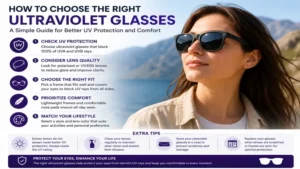
Selecting your next pair of protective safety glasses should be a data-driven process. Do not let marketing buzzwords guide your visual health. Focus on these four empirical criteria:
1. Wavelength Attenuation Verification
Always check the exact nanometer tracking of the lens. True UV protective eyewear must explicitly state coverage up to 400nm. Many generic safety glasses stop their filtering matrices at 380nm. While that 20nm gap sounds minuscule, it covers the most intense edge of the UV-A spectrum, which penetrates deep into the human crystalline lens, contributing to accelerated cataract formation over years of steady exposure.
2. Optical Density (OD) vs. Visible Light Transmission (VLT)
Understanding the balance between OD and VLT is critical for complex tasks:
-
Optical Density (OD): Measures the factor by which specific light wavelengths are blocked. An OD of 4+ reduces the targeted light intensity by a factor of 10,000.
-
Visible Light Transmission (VLT): Determines how bright your surroundings appear. A clear lens has roughly 90% VLT, while a dark orange or green lens might drop to 40% VLT. Ensure your workspace lighting is bright enough to handle lower VLT ratings safely.
3. Material Integrity & Coating Methods
Lenses that utilize embedded dye matrices are universally superior to surface-coated variants for active industrial environments. Surface coatings can be scratched away by fine metallic dust or harsh chemical fumes, creating microscopic “leaks” in your visual shield that are completely invisible to the naked eye.
Common Mistakes When Buying UV-Protective Eyewear
The most pervasive mistake buyers make is assuming that a darker lens automatically translates to higher ultraviolet shielding. In reality, lens tint is simply an aesthetic or glare-reducing choice; clear polycarbonate naturally absorbs UV radiation if formulated correctly during the chemical casting process. Wearing cheap, dark novelty sunglasses around industrial equipment is incredibly dangerous because the dark lens tricks your eyes into dilating, allowing raw UV radiation to flood straight into your retinas.
Another frequent pitfall is ignoring back-side reflection dynamics. If your work requires you to stand with your back or side turned toward a UV curing array, light can reflect off the shiny inside surface of your safety lens and hit your eyes. To avoid this, look for frames with an anti-reflective (AR) back-coating or a deep, wrap-around frame shape that prevents light from bouncing into your peripheral vision.
Clear vs. Tinted Lenses: Real-World Performance
Choosing between clear and tinted optics is not about fashion; it directly affects your brain’s processing speed and physical coordination on the workshop floor.
┌──────────────────────────────────────────────────────────┐
│                 LENS SPECTRUM DYNAMICS                   │
├───────────────────┬──────────────────────────────────────┤
│ Clear Polycarbon  │ Max VLT (90%) | True Color Space     │
│                   │ Best for low-light lab environments  │
├───────────────────┼──────────────────────────────────────┤
│ Orange/Amber Tint │ Lower VLT (45%) | High Contrast       │
│                   │ Blocks Blue Crossover | Curing Labs  │
└───────────────────┴──────────────────────────────────────┘
Clear lenses are the definitive choice for precise analytical tasks where recognizing color shifts is critical, such as chemical titrations or electrical wiring diagnostics under UV-reactive dye tracing. They pass the maximum amount of ambient environmental light, keeping your spatial orientation natural.
Tinted options (such as amber, orange, or green) shine in high-glare environments or setups where ultraviolet light crosses over into the visible blue light spectrum (400nm–450nm). These tints sharpen contrast, reduce eye strain from flickering industrial lights, and damp down the harsh violet halo common around heavy curing equipment. However, they should be avoided if you must read color-coded digital displays or diagnose fine changes in skin tone during clinical procedures.
Features That Actually Matter vs. Marketing Hype
When shopping for protective gear, it is easy to get overwhelmed by complex branding terms. Let’s filter out the noise so you spend your budget on features that truly impact safety and comfort.
-
Matters: ANSI Z87.1+ Certification. This industrial marking guarantees the frames and lenses can withstand high-velocity impacts from flying debris or broken components while protecting your face.
-
Hype: “Proprietary Nano-Shield Technology.” This is typically just a standard silicon-based hard coat rebranded to sound futuristic. Look for standard, verifiable ratings like “K-rated” scratch resistance instead.
-
Matters: Hydrophilic Anti-Fog Layering. Unlike standard hydrophobic treatments that cause condensation to bead up into vision-blurring drops, hydrophilic coatings spread moisture evenly across the lens surface, maintaining perfect transparency during intense physical work.
FAQs
❓ Can I use standard sunglasses instead of specialized ultraviolet glasses?
✅ No. Standard sunglasses reduce brightness but lack the certified wrap-around shielding, impact ratings, and specific chemical blockers required to neutralize intense industrial UV-A, UV-B, or UV-C wavebands safely…
❓ How can I verify that my eyewear is actually blocking ultraviolet light?
✅ The most accurate method is utilizing a calibrated UV spectrometer in a lab setting. Alternatively, you can shine a low-power UV flashlight through the lens onto a UV-reactive security strip on a currency note…
❓ Do clear safety lenses block ultraviolet radiation as effectively as colored ones?
✅ Yes. Polycarbonate molecules naturally absorb UV light energy. The addition of color tints is purely to minimize visible glare or filter out high-energy visible blue light crossover points…
❓ How often should a facility replace its inventory of protective eyewear?
✅ In heavy industrial settings, replace frames every 12 to 18 months. If lenses show deep scratching, hazing, or have been dropped from heights, take them out of service immediately…
❓ Are over-glasses frames safe enough for high-intensity lab environments?
✅ Yes, provided they feature integrated top brows and full side shields that prevent stray reflections from bouncing off the back of your prescription lenses into your eyes…
Conclusion
Investing in high-quality eyewear is the single most effective action you can take to preserve your vision when working around active radiation fields. By selecting frames with verified spectral coverage, choosing the correct tint configuration for your ambient room environment, and adhering to a strict cleaning regimen, you ensure that your eyes remain protected against both acute burns and long-term degeneration. Take the time to audit your current equipment layout, prioritize a precise facial fit, and upgrade your gear to match the rigor of your daily operational tasks.
Recommended for You
- 7 Best Tinted Eyeglasses for Eye Strain & Migraines (2026 Guide)
- Best Full Rim Eyeglass Frames: 5 Expert Picks for Durability & Style (2026)
- 5 Best Rimless Reading Glasses for 2026: Expert Field Review & Buying Guide
Disclaimer: This article contains affiliate links. As an Amazon Associate, I earn from qualifying purchases. If you purchase products through these links, we may earn a small commission at no additional cost to you.
✨ Found this guide helpful? Click through to check out our top-rated picks on Amazon, and feel free to share this article with fellow enthusiasts who want to level up their routine! 💬🤗